Your apartment serves its purpose. It gives you a roof over your head and a place to sleep. But when you walk through the door at the end of the day, does it actually feel like home? The walls are bare, and the lighting is harsh. It often feels more like a temporary hotel room than a real home.
You might be a student in a dorm, a young professional in a city rental, or a family saving to buy a house. The struggle is the same. You want warmth and personality, but you feel held back because you cannot make permanent changes. The problem is that most design inspiration ignores the reality of renting. You scroll through feeds filled with custom built-ins and painted accent walls. These are expensive ideas that will only cost you your security deposit.
Here is the truth. You do not need a renovation or an Interior designer to make your space feel like home. You just need a better plan. In this guide, we are sharing 15 interior design tips that require no construction or permission. They are low-risk, high-impact, and completely reversible. Most of these upgrades take less than an hour and cost less than a weekly grocery trip.
You really don’t have to wait until you buy a house to love where you live. You dese rve to feel at home right now, instead of feeling like you are just passing through. We have broken this down into 4 simple stages so you can start making it yours today.
Stage 1: Fixing the Foundation
It is completely normal to hesitate here, worrying that any change might risk your security deposit or just feel like a waste of effort. But we are going to keep this safe and simple. Before we buy decor, we must fix the vibe of the room to feel like home. If the lighting is clinical and the layout is awkward, art will not save the space. Let’s start by changing the way you actually see the room.
Tip 1: The “Golden Glow” Hack
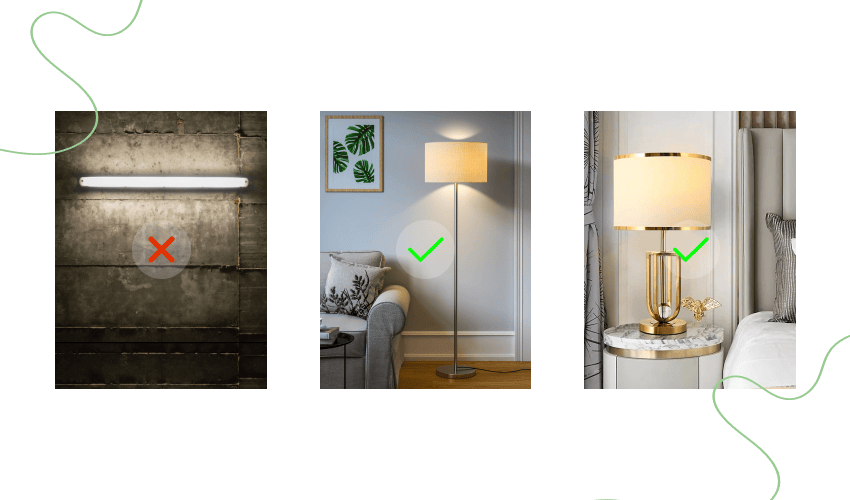
Most rentals come with harsh, blue-tinted light bulbs that make your living room feel like a dentist’s office, which is the main reason rental apartment lighting often feels cold.
In fact, we use this trick in almost every client rental we stage. Professional designers rarely rely on ceiling lights alone because overhead glare flattens the room. Instead, in most high-end homes we design, at least 60-70% of the lighting comes from lamps, sconces, and reflected light rather than the main switch.
To fix it, start with the main ceiling light. Head to the store and look specifically for LEDs labeled 2700K (Warm White). When you swap them in, the room will fill with a golden glow that hides dust and makes cheap furniture look expensive.
Please do not mix warm and cool bulbs in the same room, it will ruin the entire cozy effect.
If you cannot reach the ceiling fixtures, ignore them. Use floor lamps aimed at the walls. This creates “ambient light” that overrides the overhead glare.
The lighting is cozy now, and you can see the potential of the room. This brings us next to the layout.
Tip 2: Stop Lining the Walls
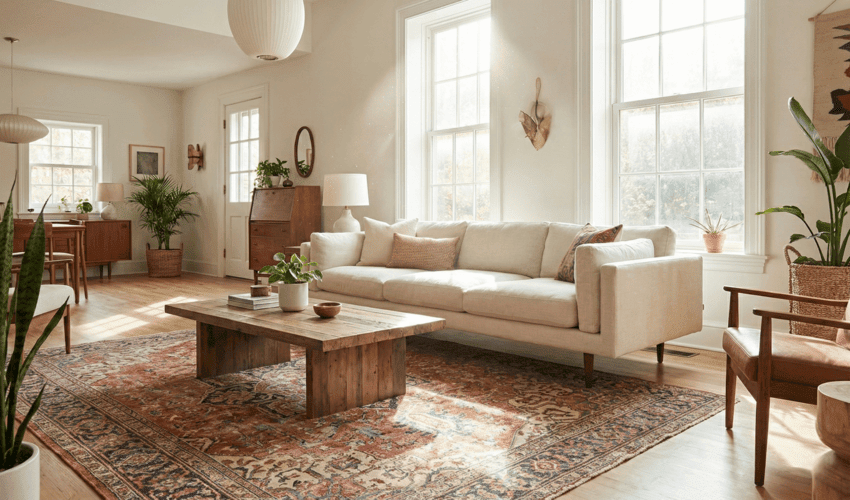
In small apartments, people often push every chair and sofa against the wall to save space. We get the temptation. But this creates a “waiting room” effect and highlights the empty center of the room.
We use this trick in client rentals to make small rooms feel sophisticated. Instead of hugging the walls, try to pull the sofa off the wall just 3 to 4 inches. If you have the space, “float” it in the middle of the room. This simple move separates the living area from the dining and makes the space feel intentional.
If your room is too narrow to float a sofa, try angling an armchair in the corner at 45 degrees. It breaks up the boxy feeling of square rooms and directs your eye through the space. Once your furniture is breathing, it’s time to look down.
Tip 3: Erase Scratched Floors Without Sanding
You might be dealing with scratched wood or outdated vinyl flooring that you can’t fix, so the only option is to distract the eye. Designers use a simple trick to expand floor plans when a landlord refuses to refinish damaged floors. While you can’t always change the material like you could in a renovation, understanding your flooring options for apartments in Dubai can help you realize what you’re trying to emulate or hide.Instead of just covering the spot, we manipulate the scale of the room to make the floor irrelevant.
The secret here is scale, so avoid dropping a tiny 5×7 rug in the center of the room because it shrinks the space; instead, aim for an 8×10 size or larger so the front legs of your furniture sit comfortably on top. This will isolate the area and effectively hide the damage underneath.
This logic applies to the dining room too, where the rug should extend at least 24 inches beyond the table on all sides to catch the chairs. If you are worried about spills in that eating zone, simply trade a fabric rug for a Vinyl Floor Cloth that looks like vintage tile but wipes clean like a placement.
The foundation is set. Now, let’s use a few visual tricks to make your apartment feel bigger than it actually is.
Stage 2: Visual Tricks to Double Your Space
It is easy to look at a small room and feel like you are stuck with that cramped feeling unless you knock down a wall. But you actually have more control over the space than you think. Old apartments often feel small and boxy, so we need to use a few visual tricks to push the walls out and lift the ceilings up.
4. Fake High Ceilings with the “High & Wide” Method
Look at your windows. Those standard plastic blinds are likely mounted right inside the frame. They drag the room down.
You can create an illusion of height by installing a curtain rod, but mount it 6 inches above the window frame and 6 inches wider on each side. When you hang floor-length curtains from this height, your small window will look grand, and the ceiling will feel taller.
Terrified of drilling holes? You can still get the look with Heavy-Duty Adhesive Curtain Rod Brackets (such as Command strips for rods). Stick them to the wall above the window frame, exactly where you would place real screws. Now you get the “penthouse height” and the grand drama without drilling a single hole.
Tip 5: Double Your Square Footage with Magic Mirrors
While curtains handle the height, mirrors are the secret to adding depth. The trick is to place a massive mirror on the wall opposite a window.
How big should it be? Aim for a floor-length piece at least 6 feet tall to truly bounce the light into dark corners. You do not need to risk your deposit by hanging it because leaning it safely against the wall actually looks more modern. Designers love this trick because it fools the eye into thinking the room continues past the wall.
If a large glass sheet is too expensive, try the ‘grid hack.’ Simply stick 6 small 12-inch square mirrors to the wall in a grid pattern using Command Strips to mimic a window pane for a fraction of the cost. Mirrors expand the space, but the room still feels a bit cold, so let’s add some nature to bring the room to life.
Tip 6: Soften the Boxy Feel with Living Sculptures
Rentals often feel rigid because they are full of straight lines, from the square rooms down to the sharp door frames. You need organic shapes to break up the grid, and the best way to do this is by adding indoor plants. Skip the tiny desk pots and aim for a large floor plant that stands at least 2 to 3 feet tall. A Snake Plant or a ZZ Plant works best here. You can place it directly on the floor or on a stand in the corner, allowing its wild shape to soften the hard edges of the room.
If you are bad at gardening, Choose dried eucalyptus or pampas grass instead. Just make sure to buy tall stems that are about 3 feet high so they make a real impact. They add the same texture and height but do not need water. Want to see some specific layouts that work in tight corners? Check out our other post on styling an indoor plant setup.
The room feels organic now, but every inch counts in a small rental. Let’s reclaim your floor space with a smart furniture choice.
Tip 7: Free Up 30% of Your Floor Space
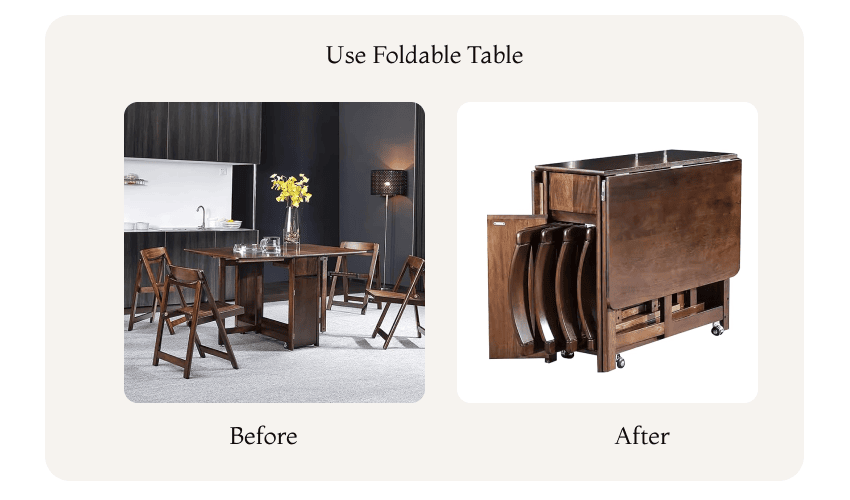
Living in a tiny studio or a small apartment often feels tight, especially when heavy furniture makes the room feel boxed in. You really do not need a dining table taking up floor space all day if you only use it for dinner. Professional designers almost always prioritize flexible furniture in these small spaces because it allows a 400-square-foot apartment to function like an 800-square-foot home.
You can start your changes with the dining table. Your sofa gets used constantly for relaxing, but a large table usually sits empty. Trade that bulky piece for a “gate-leg” table instead. This smart furniture opens up to create a full dining spot when you need it, then it folds down into a skinny console shelf when you are done. This simple switch makes your entire apartment feel twice as big visually.
You have maximized the space, but it might still feel a little empty. Let’s fix that by adding some personality to the walls.
Stage 3: Adding Personality
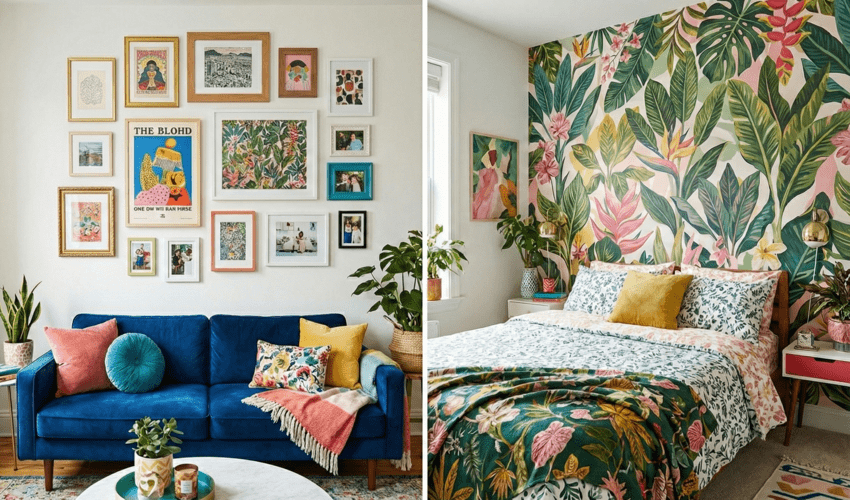
The room feels bigger and brighter. But it still looks generic. That is usually because we leave the walls bare, terrified that hanging art will cost us our deposit. But you don’t have to live in a blank box to be a good tenant. Let’s look at how to bring life to those walls without leaving a single mark.
Tip 8: The Gallery Wall Trick
Do those big, white walls make the home feel unfinished? Absolutely. But is hammering 20 nails worth the risk? Probably not.
The smart move is to use adhesive strips. You can hang a group of 3-5 art prints to create a “Gallery Wall” that acts as a focal point without damaging the paint.
If the rules are extremely strict, try the “Leaning Method.” Place large frames on the floor against the wall, or layer smaller frames on bookshelves. It looks intentional and relaxed.
Sometimes, however, a few frames aren’t enough because you crave serious color.
Tip 9: Get the “Painted” Look Without the Paint
If you are tired of staring at white walls but your lease forbids painting, Peel-and-Stick Wallpaper is the answer. Think of this as a temporary design layer that is safe for rentals because it peels off cleanly without damaging the drywall. You do not need to cover the entire room to make a difference. Focus on creating just one accent wall, such as the space behind your bed, to completely change the feel of the space.
If handling full sheets of paper feels like too much work, try vinyl wall decals instead. Simple shapes like polka dots are easier to stick on than full rolls, and they still break up the empty white space.
The living room is done, and it finally feels like a place you want to spend time in. Now let’s fix the spaces you actually use every day.
Stage 4: The Touchpoints (Kitchen & Bath)
Most renters give up here. It is easy to feel defeated when you are staring at a kitchen or bathroom full of fixed, ugly elements you simply cannot touch. It feels like a battle you can’t win. But you don’t need a sledgehammer to make a difference. These upgrades focus on how the home functions, making your daily routine feel luxurious.
Tip 10: The 20-Minute Kitchen Upgrade
You fixed the living room. But then you walk into the kitchen, and the vibe dies. You are staring at dated cabinets and harsh overhead shadows.
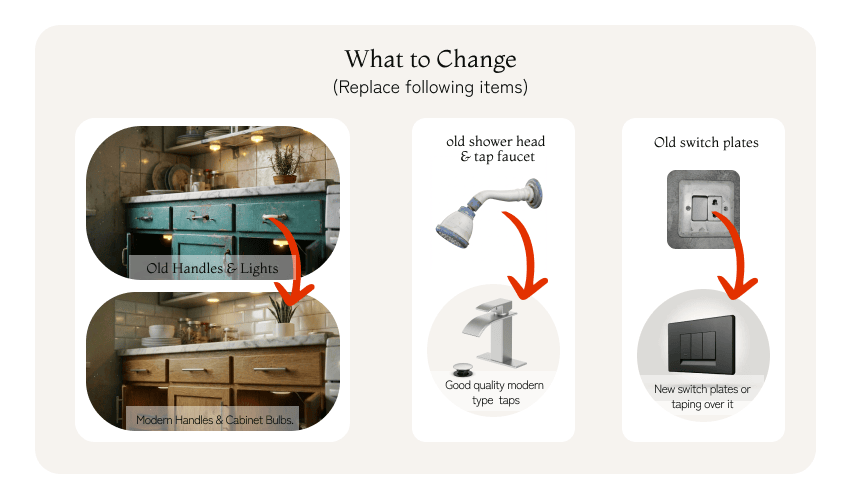
Start with the knobs. Swap the old, rusty hardware for modern matte black or brushed gold handles. It takes very little time to unscrew the old ones and attach the new ones. Just keep the original screws in a bag for move-out day.
Next, let’s turn our attention to the lighting. Rental kitchens are usually dark, which makes them feel dirty. Since you cannot hire an electrician, cheat with Rechargeable LED Motion Sensor Bars and stick them to the underside of your upper cabinets. It instantly creates “task lighting” that floods the counters with brightness and makes even cheap laminate look high-end.
You’ve rescued the kitchen from the dark ages, so let’s carry that momentum into the bathroom.
Tip 11: Turn Your Sad Rental Shower into a Spa
Most rentals have low-pressure showerheads that drizzle like a weak garden hose, which is a terrible way to start your day. You can fix this quickly by swapping it for a rainfall showerhead.
You do not need to hire a plumber for this because shower arms use a universal standard size that fits almost any new fixture. Simply unscrew the old one with a basic wrench and screw on the new one in minutes. It instantly changes your morning routine from a chore to a luxury.
While you are there, check your sink faucet. If the water splashes everywhere, screw on a new “foaming aerator” to make the water stream feel soft and bubbly. These attachments are universal and fit almost any standard faucet.
The water feels great. Now, let’s look at the switch plates you touch every single day.
Tip 12: The Cheap Detail That Screams “Custom”
Take a close look at your light switches. Are they yellowed, cracked, or covered in layers of old paint?
Swap them out. Go to the hardware store and buy clean, new white plates for less than the cost of a coffee. Swapping them takes two minutes, and while it seems like a tiny detail, your brain immediately registers the room as “clean and new.”
If you are scared of electricity, you can simply cover the existing plate with patterned Washi Tape for a pop of color that requires no screwdriver.
Everything looks good and works well. But you might still be staring at a few eyesores like an ugly radiator or bad flooring that distract from the design. The final step is simply hiding the ugly parts.
Stage 5: The Atmosphere
The house looks curated. But old apartments always have a few quirks we need to camouflage. It is discouraging to stare at an ugly radiator or weird flooring knowing you absolutely cannot tear it out. It feels like a flaw you are forced to live with. But you don’t have to just accept it. If we can’t remove the ugly parts, we can simply trick the eye into ignoring them.
Tip 13: Hide Ugly Radiators and Thermostats
Every old apartment has a yellowed thermostat, a weird breaker box, or a clunky radiator that ruins the view. Since you cannot remove these, your best option is to distract the eye. You can install a simple floating shelf directly above a radiator to draw the focus upward. This is perfectly safe as long as you leave at least 4 to 6 inches of clearance so the heat does not trap or damage the wood.
For an ugly thermostat on the wall, simply lean a framed piece of art on a console table or shelf right in front of it to physically block the view. If you make the surroundings beautiful, no one will notice the flaw itself.
The ugly spots are hidden. Now, let’s defend your design against the daily clutter of keys, mail, and bags.
Tip 14: Stop the Clutter Before It Takes Over
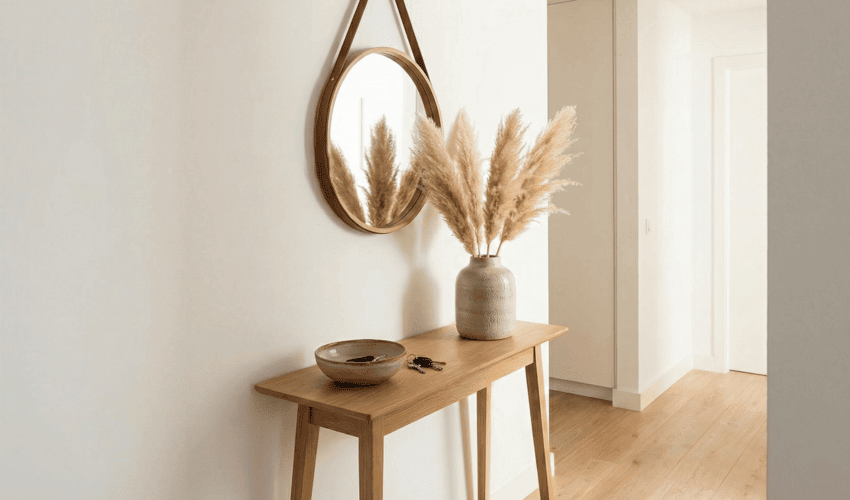
In many apartments, the front door opens directly into the living room, meaning keys and mail end up scattered everywhere.
The goal here is to define a clear space. Even if you have no foyer, place a small table or a shelf near the door and add a specific bowl for keys. This creates a “Landing Strip” that catches the mess before it spreads into your beautiful new living room.
You have fixed the look, the light, and the function. Finally, we need to fix the smell.
Tip 15: Override the “Old Building” Smell
Old buildings often have a lingering scent of dust or old paint that no amount of decor can hide.
Scent is the final layer of design. Use a reed diffuser with a fresh scent like vanilla or linen near the door. For a quick fix before guests arrive, boil a pot of water with cinnamon sticks and orange peels to make the entire house smell warm and inviting.
Summary Checklist: Your Weekend Makeover Plan
Learning how to make an apartment feel like home takes time. If 15 tips feel like too much, feel free to start with the “Rule of Three”:
-
Light: Swap the bulbs or add lamps.
-
Ground: Add a rug to hide the floor.
-
Life: Add one plant or mirror.
Need Help Putting It All Together?
You have the tips, but maybe you are still staring at your living room, wondering, “Does this rug match this sofa?” or “Will this layout fit my weird room?”
You do not have to guess.
At Euphoria Interiors, we solve these puzzles every day. We help renters create custom design plans that respect your budget and your lease. As a leading fit out company in dubai, we can help you find exactly what to buy and where to put it to turn your rental into a sanctuary.