Tuscan style interior design is quietly replacing the all-white villa trend in Emirates Hills and Palm Jumeirah. It is a shift most interior design companies Dubai villa owners work with have noticed up close.
Designers like Ilse Crawford have long argued that homes should be designed for how people live, not how they photograph, and that shift is now visible across high-end Dubai villas. Living inside a completely white space for a couple of years teaches owners a very practical lesson about daily comfort. A house that resembles a pristine showroom feels completely frozen when you just want to drink your morning coffee or relax with your family on a Friday night.
In Dubai villas, correcting that mistake later often means reworking flooring, wall finishes, and lighting together, which turns a design adjustment into a six-figure decision. Tuscan-style interior design solves this functional failure by introducing a grounded environment built on natural stone, aged timber, and hand-plastered walls. These genuine architectural materials actually improve with age and look significantly better after five years of heavy use than they did upon installation.
This guide from euphoria interior explains the core of Tuscan design, how it differs from Mediterranean style, how to execute it correctly inside a Dubai property, and where the most expensive mistakes occur.
Keep reading. Most Tuscan-style homes’ interiors get one critical detail wrong, and it shows within a year.
What Is Tuscan Style Interior Design?

Tuscan style interior design is a residential aesthetic rooted in the farmhouse and estate architecture of rural central Italy, particularly in Tuscany. It is defined by natural materials including stone, solid wood, hand-applied plaster, and wrought iron, combined with warm earthy colour palettes and architectural features like arched openings, exposed timber beams, and textured wall finishes.
The defining characteristic of Tuscan design is that materials carry the identity, not decoration. The style prioritises material quality and architectural weight over surface-level ornament. In practical terms, this means Tuscan interiors are designed from the structure inward, not decorated from the outside in.
The Origin of the Style

The farmhouses and noble estates of central Italy, in places like Siena and Lucca, were constructed using local materials simply because there were no other options available at the time. Builders relied entirely on stone gathered from the hillsides, timber cut from nearby forests, and clay tiles fired in regional kilns rather than importing foreign marble.
Builders utilised exactly what the land provided to construct solid estates meant to stand for generations. A practical approach to building eventually became one of the most copied residential styles globally because authentic raw materials created homes capable of enduring for centuries. The same material-driven logic makes Tuscan-style interiors highly compatible with Dubai villas today. Generous scale and intense sunlight allow heavy architectural finishes to perform perfectly.
The Three Principles of Tuscan Design
1. Connection to the land: The interior should feel like it grew from the ground beneath it, not arrived from a catalogue.
2. Comfort over perfection: Texture, warmth, the occasional beautiful imperfection. Surfaces earn their character.
3. Materials over decoration: The bones of the room carry the weight. Everything placed on top of those bones is secondary.
An authentic Tuscan room features stone floors that appear to have been laid a century ago alongside textured plaster walls and solid wooden ceiling beams that provide immediate architectural weight.
This inherent sense of permanence allows the aesthetic to remain compelling for decades and offers a rare grounded stability in a rapidly evolving market like Dubai.
Why Dubai Villa Owners Are Choosing Tuscan-Style Interior in 2025

The 1990s introduced a dark and heavy version of Tuscan design to luxury properties around the world by relying on excessive wrought iron and deep burgundy velvet. That approach made residential spaces feel like formal clubs and eventually triggered a massive shift toward stark white minimalism throughout the following decade.
The resulting era of pale stone and sparse furniture initially felt fresh but ultimately failed the practical test of daily living. Homeowners quickly grew tired of touching cold surfaces and sitting in echoing rooms that offered zero visual warmth. Dubai villa owners are now recognising these functional flaws and actively returning to Tuscan design principles to build spaces that actually feel inviting.
Three Reasons Dubai Specifically Suits Tuscan-Style Interiors
According to the Dubai Land Department, villa transactions in premium communities grew significantly through 2023 and 2024. A significant portion of Dubai’s villa-owning community has also spent meaningful time in Italy, through travel, extended business, or education. The Tuscan-inspired village concepts in select Dubai gated communities are tapping directly into that emotional association.
1. The scale of the villas. A 5,000 sq ft villa in Arabian Ranches or Emirates Hills gives a designer real space to work with. Arched doorways, exposed beams, layered stone on feature walls. These elements need room to breathe. Dubai villas have the spatial conditions the style requires. This is why the same approach rarely translates well into compact Tuscan villa apartments, where spatial limitations restrict architectural expression.
2. The intensity of natural light. Dubai logs approximately 9.6 daily sunshine hours, according to research. Warm-toned plaster walls at 11 am under the UAE sun read completely differently than they do under ambient European light. Build the palette to suit that light, and the room does half the work on its own.
3. The appetite for premium materials. Luxury interior design in Dubai has always operated at a high material standard. Imported stone, custom joinery, handcrafted finishes. Tuscan design is material-first by definition. It speaks naturally to clients who already understand that quality lives in what something is made of.
Understanding Tuscan-Style Interior and How They Differ from Mediterranean and Modern Design

Most villa projects go wrong before a single material is specified. The client and the designer are picturing different things.
Someone says “Italian warmth”, and the result feels like a Greek coastal cottage. Or they ask for “modern Tuscan”, and the designer removes everything that gives the style its identity. These are not interchangeable aesthetics.
The table below breaks down exactly how these four distinct styles compare across colours, materials, and overall mood so you can clearly communicate your design goals.
If your goal is a home that feels settled and improves with time, modern Tuscan is the stronger direction. If you prefer something lighter and more seasonal, the Mediterranean will feel easier but less grounded long-term.
The Tuscan vs Mediterranean Distinction
Treating these two aesthetics as identical is a frequent error. Mediterranean interiors mimic the feeling of sea air by staying light, casual, and airy. Tuscan design feels like an established estate that has occupied the same ground for decades. It stays settled and rooted.
Modern Tuscan provides the ideal direction for a Dubai villa. You achieve this by using stone, plaster, and wood in lighter forms that feature clean proportions and a disciplined decorative approach.
The Six Core Elements of Tuscan-Style Interiors
Every successful Tuscan-style interior is built on a small set of non-negotiable design decisions. These are the decisions that define the space before a single piece of furniture arrives.
1. An Earthy Colour Palette Built for Dubai’s Natural Light

Warm, earth-derived tones drawn directly from the Italian landscape: sun-bleached clay, aged terracotta, silver-green olive leaves, dusty cypress haze.
How it adapts for Dubai: Traditional colour palettes relied heavily on dark and saturated shades like burnt sienna, deep ochre, and burgundy. Dubai experiences intense natural sunlight that makes those rich tones feel visually overwhelming by the middle of the day. A modern design approach solves this problem by taking those exact same colour families and making them significantly lighter.
Practical palette guide for a Dubai-Tuscan interior:
| Surface | Recommended Tone | What to Avoid |
| Walls | Warm white, aged ivory, soft sand | Cool-toned or grey-based whites |
| Floors | Natural limestone, unsealed terracotta, walnut-tone solid wood | Polished or high-gloss finishes |
| Accent tones | Olive green, dusty terracotta, aged gold | Using accent colours as the dominant wall colour |
| Ceiling | Pale limewash, warm plaster | Stark white |
2. Natural Materials The Foundation Everything Else Rests On

Travertine, limestone, solid wood, hand-applied plaster, and wrought iron. These four material families define the Tuscan style more than any furniture or decorative object.
Stone: Incorporating natural stones like travertine, limestone, or rough-hewn sandstone across your floors, feature walls, kitchen surrounds, and fireplace mantels brings durability and organic texture to a living space.

Wood: Warm-toned with visible grain, walnut, chestnut, or oak in aged or brushed finishes. Factory-uniform timber finishes kill the handmade quality that the Tuscan style depends on. A brushed oak kitchen in the right tone carries an entire room.

Plaster: Venetian plaster or limewash. Light moves across a plaster wall throughout the day, shifting as the sun angle changes. By 4 pm in a west-facing Tuscan-style Dubai living room with limewash walls and travertine floors, the room glows in a way no lighting design alone can replicate.

Wrought iron: One forged iron chandelier in a dining room reads as deliberate. Iron on every surface reads as a themed attraction rather than a considered home.
3. Architectural Details That Define the Space Before Anything Else Is Added

The architecture carries more Tuscan identity than the furniture or decor ever will. This is the element most designers get right or wrong at the planning stage, before a single supplier is called.
Arched openings: Full arches, Roman arches, or softened rectangular openings with gently curved headers. Moving away from 90-degree angles wherever the structure allows changes how the whole home feels. The archways in the Castello di Gabbiano, a Tuscan estate occupied since the 13th century, use the same proportions as arches appearing in new Dubai villa projects today.

Exposed ceiling beams: Tuscan villas in Dubai often feature ceilings that reach five or six metres high. Installing a row of solid timber beams brings these massive rooms back down to a comfortable human scale without physically dropping the ceiling height.

Textured wall finishes: A single rough-plaster feature wall behind a sofa achieves more visual interest than a gallery of framed prints in front of a smooth painted wall.

Terracotta or stone tile floors: Particularly effective in transitional spaces, such as entranceways, covered terraces, and kitchens, where the indoor-outdoor connection begins.
Note for Dubai Projects: These architectural details require custom design and specialist installation. The interior design firm’s experience with the Tuscan-style interiors matters as much as the design direction itself. A poorly proportioned opening is worse than a straight-edged opening.
4. Lighting That Makes the Palette Perform All Day

A layered lighting strategy that prioritises natural light first, then mimics warm afternoon sun through artificial sources calibrated to 2700K or lower. Traditional Tuscan architecture orientated rooms around when and how the sun would enter.
For a Dubai villa:
- Maximise natural light through well-placed windows, skylights, and courtyard openings
- Use sheer or semi-transparent window treatments that filter light, not block it
- Layer artificial lighting: ambient (wall sconces and floor lamps), task (focused kitchen and reading lighting), and accent (concealed LEDs behind stone features)
- Use 2700K bulbs or lower throughout. This is the candle-tone range. It transforms how stone, plaster, and wood read after dark.
Practical Data Point: The difference between a room that feels genuinely Tuscan at 8 pm and one that just looks beige is frequently nothing more than bulb colour temperature. 2700K vs 4000K on the same stone and plaster produces entirely different results.
Open layouts serve the style naturally. The kitchen flows into the dining room. Dining opens into living. That spatial generosity adapts well to Dubai villa floor plans and produces an atmosphere where movement through the home feels unhurried.
5. Furniture That Fits the Scale and Steps Back When It Should

Large-scale, material-quality furniture in simple forms, upholstered in natural linens, cotton, or leather. The edit is the design work. A large dining table in solid oak is completely Tuscan. It does not need carved scrollwork on the legs. The scale and the material are the statement.
What works:
- Large-scale pieces proportioned to generous Tuscan-style rooms
- Natural linen, cotton, or leather upholstery in warm neutral tones
- One or two antique or vintage pieces alongside simpler contemporary furniture
- Handcrafted ceramics, woven textiles, and natural-fibre rugs as the decorative layer
What to avoid:
- Matched furniture sets that read as a showroom floor
- Over-decorated pieces with excessive carving or gilding
- Fast-turnaround home accessories that will look dated in two years
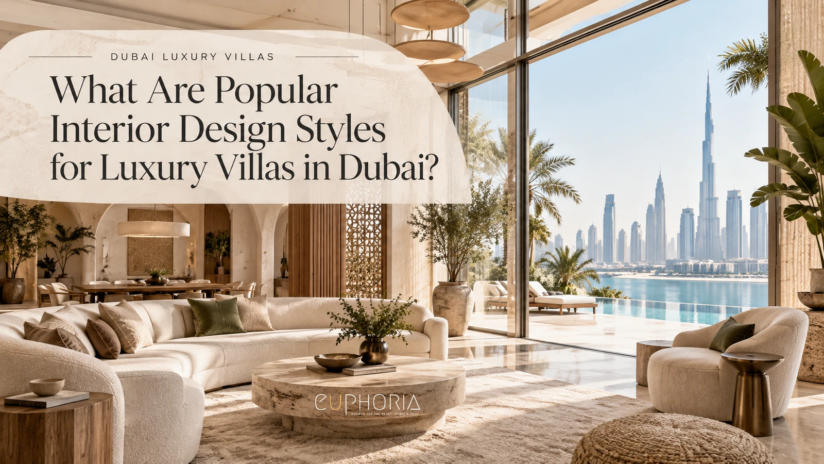
A small sofa in a large Dubai Tuscan-style living room looks abandoned. A pair of oversized linen sofas flanking a substantial stone coffee table, with a pool visible through an arched opening behind, looks like somewhere worth spending a Friday afternoon.
If you are struggling to position these heavy pieces, our guide to modern living room interior design tips and ideas covers how to arrange large furniture without crowding the space.
6. Indoor-Outdoor Flow That Makes the Whole Property Feel Liveable

A continuous material language that runs from the interior through to the terrace, pool surround, and garden. No visual threshold and jarring transition.
For example:
- The same stone that floors the living room appears on the terrace.
- The same timber that frames the interior windows appears in the pergola overhead.
A Dubai villa where the indoor-outdoor connection is seamless, where you step from travertine living room floors onto travertine pool surrounds without interruption, delivers something a closed-box interior cannot replicate. The whole scale of the property becomes a liveable space rather than interior footage with an outdoor add-on.
How to Design a Modern Tuscan Interior: Step-by-Step

Step 1: Assess the Layout Before Touching Anything Else
Tuscan-style interiors require an open flow between the primary living areas alongside direct access to the garden and high ceilings. You must resolve any structural issues first because no amount of premium finishes or furniture will fix a poorly configured floor plan.
Step 2: Lock In the Fixed Surfaces
The floors, walls, and ceilings establish the temperature of the entire property. You should select natural limestone or wide plank solid wood for the main rooms while reserving terracotta tiles for entranceways and kitchens.
Coating the walls in warm ivory Venetian plaster and adding heavy timber treatments to the ceilings ensures the space feels authentic before any furniture arrives. If you miss the mark on these foundational elements, no decorative pieces will correct the mistake.
Step 3: Layer Materials One Space at a Time
You need to introduce your architectural finishes deliberately across the home instead of packing everything into a single area. A property featuring masonry in the entrance and textured walls in the living room feels carefully curated. Forcing reclaimed wood, exposed brick, and plaster into one room simply looks like a supply warehouse, making restraint your most vital design decision.
Step 4: Choose Furniture at the Right Scale
Selecting massive pieces like a ten-seat dining table for a family of four works perfectly because the proportion of the furniture to the room matters most. You are framing the space rather than just filling it, so anchor oversized linen sofas and substantial coffee tables around permanent architectural features like an arched window or a stone fireplace. For the sitting room specifically, these Tuscan living room ideas translate the style seat by seat.
Step 5: Set the lighting before you call the project done.
Lighting is consistently underfunded in these villa projects. You should install one forged iron chandelier per key space and rely on wall sconces alongside concealed LED strips to provide ambient warmth. When adding decor, choose restrained pieces like a single handwoven rug or warm pottery sourced from different makers instead of buying a matching retail set.
Tuscan Design Across Dubai Property Types
Tuscan Villa With Pool Design

A Tuscan villa integrates the pool directly into the landscape by using travertine or limestone surrounds. Building a solid timber pergola with clay roof tiles creates an alfresco dining area that matches the interior finishes perfectly. When the warm evening lighting turns on, the entire property feels like one unified environment instead of a separate house and yard. The heart of the style is the kitchen, and Tuscan kitchen design has its own rules.
Tuscan-Style Townhouses

Designing townhouses or multi-level properties via a specialized Duplex Interior Design service in dubai requires precise planning because limited space increases the impact of every material decision.
You should concentrate the design identity in the main entrance and living spaces. Applying a limewash feature wall in the lounge and installing timber ceiling beams over the dining table ensures high-quality finishes define the compact home.
Adapting Tuscan Design for the UAE Context
Expert Insight: The most successful clients stop trying to perfectly replicate a holiday home they visited in Siena. Dubai has much stronger sunlight, larger properties, and a completely different lifestyle. We translate the core logic of material honesty and warmth to fit local architecture instead of just copying specific Italian details. This approach successfully adapts the spatial philosophy for people actually living in the UAE. If you are torn between the two sun-baked cousins, this Tuscan vs Mediterranean style comparison settles it.
This approach successfully adapts the spatial philosophy for people actually living in the UAE, much like how we blended warm earthy elements with traditional cultural roots in our Cherrywoods Villa project.
Common Mistakes That Turn a Tuscan Interior Into an Expensive Disappointment

1. Using excessive dark surfaces
Applying deep brown tones across your floors and ceilings makes the property feel incredibly heavy under Dubai sunlight. While dark colours look dramatic at night, they become oppressive by morning, so you must lighten these foundational surfaces to keep the space comfortable.
2. Relying on themed decor
Filling shelves with mass-produced wrought iron or fake antiques creates a cheap themed look. While a highly specific theme like The Labubu Bedroom works brilliantly for a playful kids’ space, authentic Tuscan character comes directly from structural masonry and timber, making loose accessories a minor finishing touch rather than the main focus.
3. Blocking the natural light
Hanging heavy drapes over large windows destroys the sunlight this style absolutely requires. Without strong natural light flowing freely through the home, expensive stone looks dull, and textured plaster appears completely flat.
4. Confusing the design styles
Installing blue and white ceramic tiles turns the space into a coastal Mediterranean cottage rather than a rooted country estate. A design team that confuses these two distinct aesthetics has completely misunderstood your project.
5. Buying from a single catalogue
Purchasing all your furniture from one retail collection makes the room look like a generic package deal. Authentic interiors were assembled gradually over time, so you need to deliberately mix different makers and eras to achieve the right atmosphere.
6. Stopping at the glass doors
Ending your design at the living room exit ruins the aesthetic if the terrace just features plain tiles and plastic chairs. The exterior plot is a crucial part of the home and must continue the same material language.
The Homes People Actually Want to Come Home To
The Tuscan-style interior survives because material honesty and human warmth never go out of fashion. The generous scale and intense sunlight of Dubai villas provide the ideal environment for this aesthetic. Achieving an authentic result depends entirely on your initial decisions regarding layout and architectural finishes. Get those foundations right, and the property naturally becomes a permanent home. A villa interior design company familiar with these communities can adapt Tuscan warmth to local light and scale.
Most Tuscan-style villa projects in Dubai fail at the material and layout stage, not the decor stage. Euphoria Interiors works with villa owners to get those decisions right from the beginning, from space planning to material sourcing and full execution.
If you are planning a new build or renovation, book a consultation to review your layout and material strategy before work begins.
Key Takeaways
- Modern Aesthetics: If the palette is too stark or cold, the space will feel uncomfortable regardless of how expensive the materials are.
- Material Dominance: If the stone, plaster, and wood are wrong, no amount of furniture or decor can correct the space later.
- Space Requirements: Without proper scale and ceiling height, Tuscan elements feel forced rather than architectural.
- Visual Harmony: Over-layering rustic elements without restraint quickly turns the home into a themed space instead of a liveable one.
You can find more ideas in our piece on Tuscan bathroom ideas.
For more on this, see our guide to Tuscan bedroom design.