

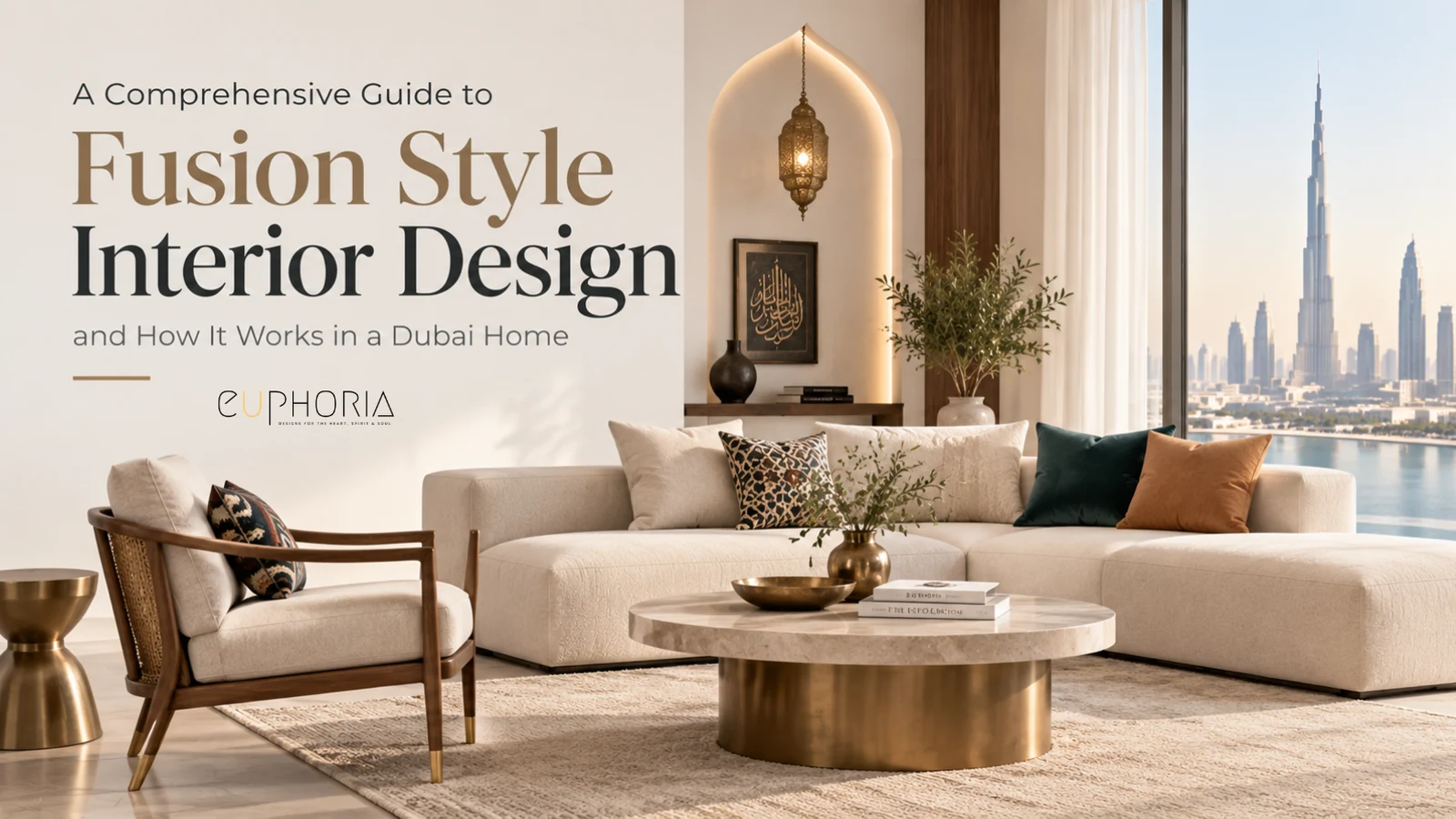
Fusion interior design is changing how homes in Dubai are being shaped today. Frank Lloyd Wright once said that architecture gives soul to a civilization, and in a city as culturally layered as Dubai, that idea now extends well beyond architecture into interior spaces.
Homeowners are no longer choosing between East and West, old and new, or classic and contemporary. Instead, they are combining them with the intention to create spaces that reflect how they actually live. This shift is not about following a trend. It is about building interiors that hold identity, function, and meaning at the same time.
If your Dubai home feels like it needs something more, something that reflects your personality, your travels, your culture, and your ambitions all at once, this guide is your starting point. Keep reading, because what follows will completely change how you think about your living space.
What Fusion Interior Design Really Means
Most people read fusion design at one level: visual. They see two styles in the same room and call it fusion. It actually operates across four layers, and all four need to work together.
Visual: The combination of styles, materials, and finishes that signals more than one design tradition. This is the surface. It is real, but it is the result of the other three layers, not the starting point.
Cultural: Every design tradition carries meaning. Arabesque geometry reflects a mathematical and spiritual worldview. Wabi-Sabi roots itself in the philosophy of impermanence and natural aging. A fusion design that operates at the cultural level respects those origins. Fusion design that ignores them turns meaningful objects into props.
Functional: A beautifully layered room that nobody wants to sit in for more than twenty minutes has failed. Functional fusion means layout, furniture, lighting, and materials all support how the people in that home actually live.
Emotional: A well-executed fusion interior should feel like the people who live there. It carries their history and reflects their identity. This is why no two fusion interiors should look the same.
Most homeowners get stuck at the visual level and wonder why the room still feels off. The answer is almost always that the cultural, functional, and emotional layers were never touched.
Why Fusion Works So Well in Dubai
Over 88% of Dubai’s population is expatriate; a home here might belong to an Emirati family, a British-Indian couple, or a Lebanese-Filipino household. Each brings a different aesthetic history and a different idea of what home should feel like. Dubai’s modern architecture gives you a neutral starting point for layering different design traditions.
Arabic design brings heavy craftsmanship, intricate details, and a focus on hosting, but contemporary design brings the opposite effect, offering clean lines, empty space, and quiet order. In Dubai, they need to share the same room. Fusion interior design is the system that makes that work without forcing either tradition to compromise its identity.
A Six-Step Method to Build Your Room’s Layout and Style
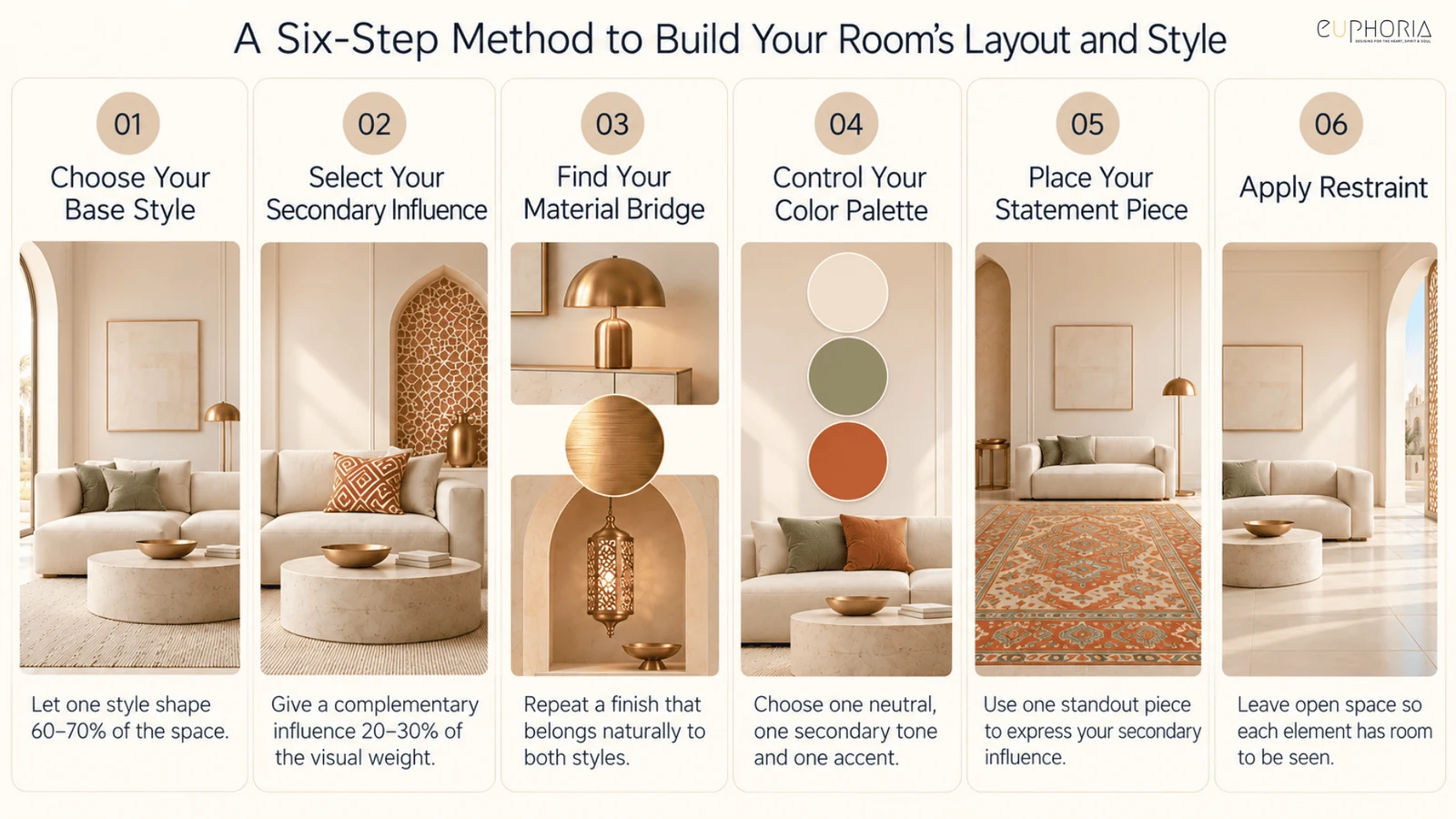
What follows is a six-step framework that works for a one-bedroom apartment in Business Bay or a five-bedroom villa in Arabian Ranches. Use it to build your room’s layout and style.
Step 1: Choose Your Base Style
One dominant design language governs 60 to 70 percent of the space. In Dubai homes today, this is usually contemporary minimalist, modern Arabic, or Japandi. Once chosen, it is consistent. Everything else responds to it.
Step 2: Select Your Secondary Influence
The secondary influence carries 20 to 30 percent of the visual weight. It might be a cultural tradition, a historical period, or a material philosophy. It should create productive tension with the base, not conflict.
Step 3: Find Your Material Bridge
This is the most underrated step. The material bridge is a finish that exists naturally in both your base and your secondary influence. Brass appears in both contemporary interiors and traditional Arabic design. Natural stone bridges the Japandi and Mediterranean styles. Use it consistently. It is what makes a fusion room feel cohesive and deliberately sourced.
Step 4: Control Your Color Palette
Three tones maximum: a dominant neutral, a secondary tone, and one accent. The accent is where cultural identity often lives most powerfully. One strong color used with restraint does more than five competing ones.
Step 5: Place Your Statement Piece
Every fusion room needs one object that carries the full weight of the secondary influence. A large piece of Arabic calligraphy. A hand-knotted antique rug. A sculptural lantern. This piece anchors the fusion narrative, so everything else does not have to repeat the message.
Step 6: Apply Restraint
Once the base, secondary influence, bridge material, palette, and statement piece are in place, stop. Negative space gives every other element room to be seen.
Want to see a combination before buying anything? 3D virtual home staging lets you test it first.
Setting Up Open-Plan Zones to Guide the Eye Naturally
Before a single material is chosen, spatial planning determines whether fusion design will actually work. Spatial planning is the reason many fusion interiors look right on paper but fail in reality.
Open-plan layouts are standard in Dubai homes. They create visual continuity, which is a good thing. They also mean that a design decision in one zone immediately affects how the adjacent zone reads.
Zoning creates definition without walls. Rug placement, furniture arrangement, ceiling treatments, and lighting shifts all signal where one area ends and another begins. In a fusion interior, different zones can carry different cultural emphases. The living area leads with Arabic influence. The dining area shifts toward contemporary European. Each zone tells part of the story without the full narrative being crowded into one space.
Poor spatial planning creates bottlenecks in both movement and attention. When everything competes for focus simultaneously, the effect is overwhelming. A good spatial plan creates a sequence: enter, read the base style clearly, move through the space, and let the secondary influence emerge gradually. By the time you are settled, the two feel like a natural conversation.
Balancing Base Materials with Sharp Contrasts and Cultural Textures
Material selection is where fusion interior design either becomes luxury or becomes confusing. The difference lies entirely in how the materials relate to each other.
| Category | Examples | Proportion | Role |
|---|---|---|---|
| Base materials | Marble, linen, oak, porcelain | 50-60% | Visual foundation |
| Contrast materials | Glass, polished steel, dark stone | 15-20% | Sharpness and tension |
| Cultural inserts | Textiles, ceramics, carved screens | 15-20% | Identity and warmth |
| Luxury accents | Brass, onyx, bronze | 5-10% | Cohesion and richness |
Base materials cover the largest surfaces and should make no cultural statement on their own. Their job is to provide a calm field. Cultural inserts are specific and meaningful, and they need a neutral base around them to register with any visual power. Overuse strips them of impact entirely. Luxury accents like brass and marble have the advantage of belonging naturally to multiple design traditions simultaneously, making them reliable bridges.
Handmade pieces bring the cultural layer in naturally, as our guide to artisanal elements in Dubai interiors shows.
Matching Calm Anchor Furniture with Meaningful Accent Pieces
Anchor furniture such as sofas, dining tables, and bed frames to align with the base style. These are the structural pieces that set the room’s spatial logic. The secondary influence does not belong here at full volume.
Accent furniture is where the secondary influence speaks. A side table with carved geometric detailing. A chair with a cane back panel. A chest with lacquer work. These introduce the fusion element without destabilising the whole.
Successful pairings combine calm anchor pieces with meaningful accents. Let’s look at a few examples below:
- Contemporary modular sofa in warm sand linen + Moroccan kilim cushions + hammered brass tray table
- White oak dining table + mix of contemporary chairs + one or two rattan-back chairs
- Japandi-style bed frame + hand-embroidered bedspread + single carved wooden side table
- Matte grey kitchen island + open shelving with hand-painted ceramics
Modular furniture deserves specific mention in Dubai homes. Households change, hosting patterns shift, and families grow. Modular configurations let a fusion interior adapt without a full redesign.
Highlighting Your Statement Pieces with Ambient and Accent Lighting
Good lighting unifies a fusion interior. Generic lighting exposes its inconsistencies.
Statement lighting carries the most design weight in a fusion room. A reinterpreted mashrabiya-pattern pendant or a geometric chandelier in aged brass can anchor the cultural layer more powerfully than almost any other single object. The statement fixture belongs firmly to the secondary influence.
Ambient lighting establishes the room’s mood. In Dubai, where natural light is intense and directional for most of the year, warm-toned concealed LED coves and dimmable downlights that wash walls rather than pool on floors prevent the cold, flat quality that unfiltered harsh light creates.
Accent lighting is a precision tool. Directional spots on a calligraphy canvas, integrated shelf lighting on ceramics, and a picture light above a textile panel. It controls the hierarchy of attention, drawing the eye to the most meaningful pieces and letting the supporting elements recede.
Importance of Cultural Intelligence in Design
Successfully using cultural references requires an actual grasp of their deeper meaning. This distinction separates fusion interior design from what might be called “cultural decoration,” where objects from different traditions are used as props without regard for their meaning or context.
Arabesque and Islamic Geometry
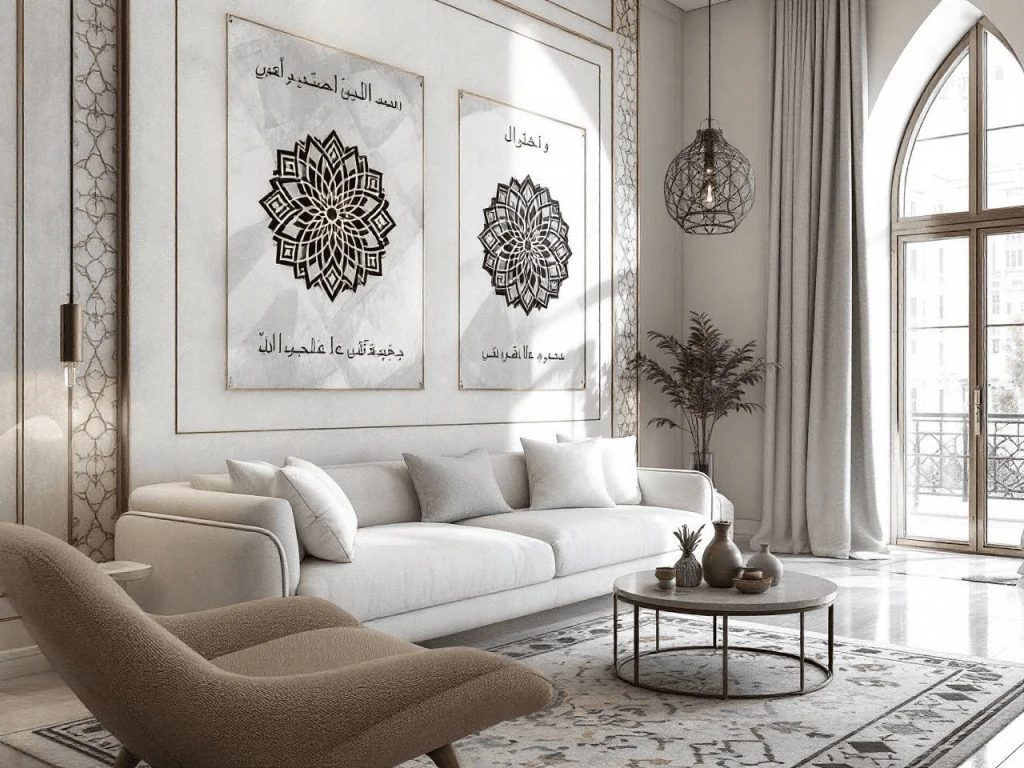
Arabesque motifs and Islamic geometric patterns are mathematically sophisticated design systems with spiritual significance. Use them when the quality of execution is high, and they serve as a genuine design anchor. Avoid them when they appear as a token gesture or in poor-quality mass-produced form.
Wabi-Sabi
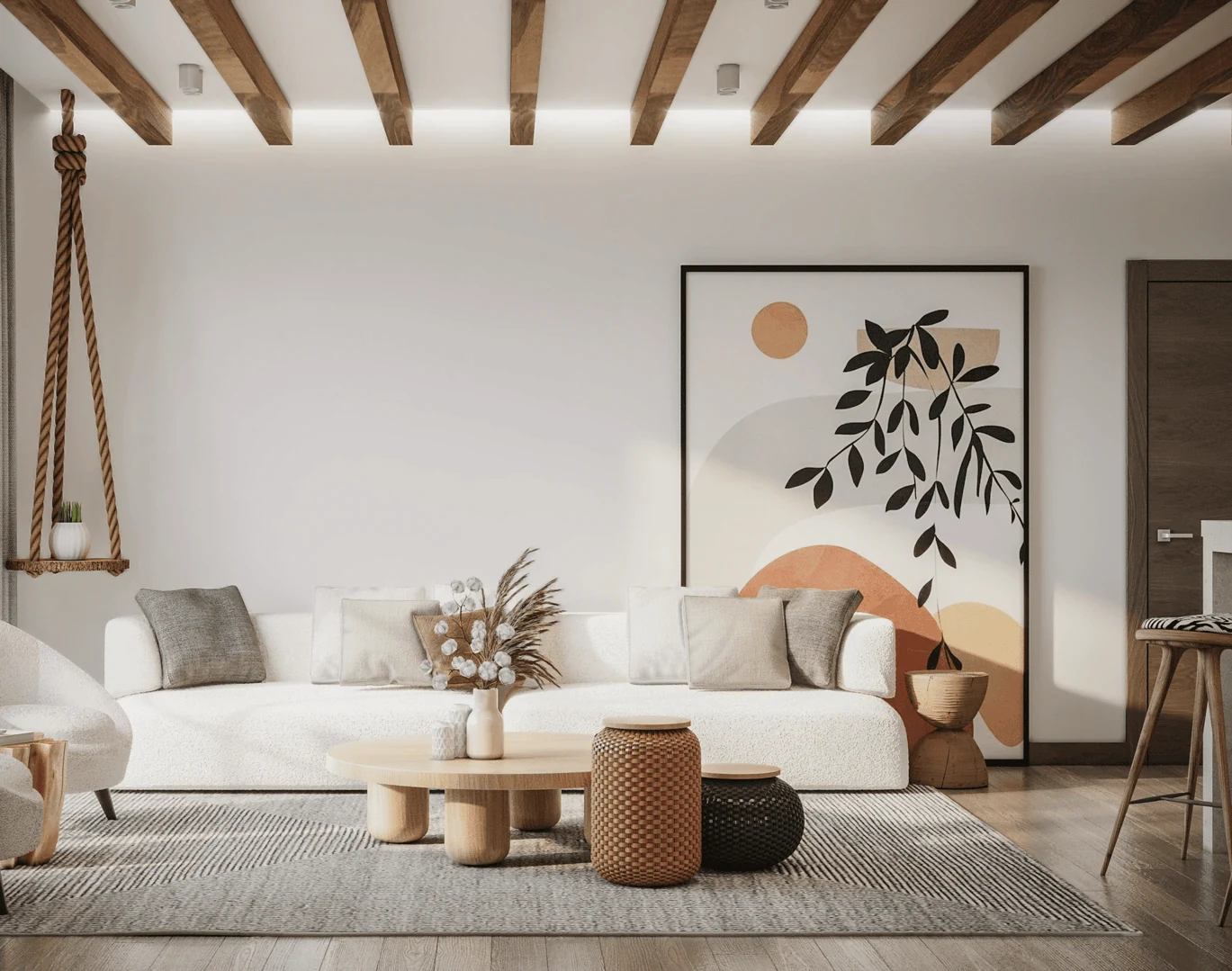
Wabi-Sabi values imperfection, natural aging, and simplicity. It works in fusion interiors as a material philosophy: raw plaster, unfinished wood, hand-thrown ceramics. It works less well when applied as a visual style without the underlying values of restraint.
Hygge
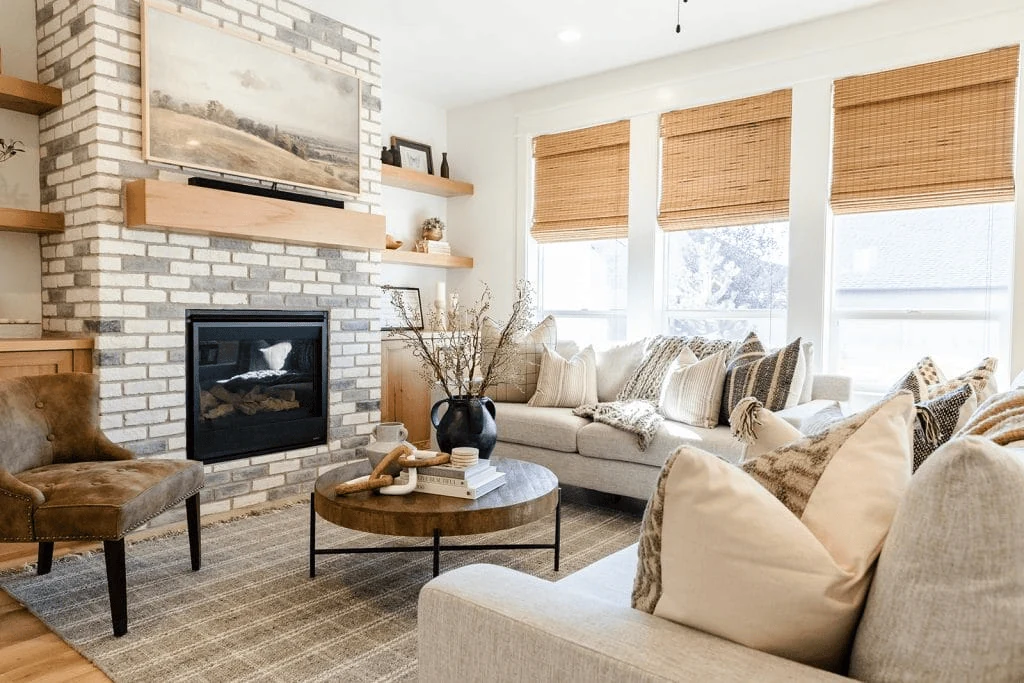
Hygge focuses on comfort and togetherness. You can achieve this through soft lighting, layered textiles, and furniture arranged to encourage conversation.
Feng Shui
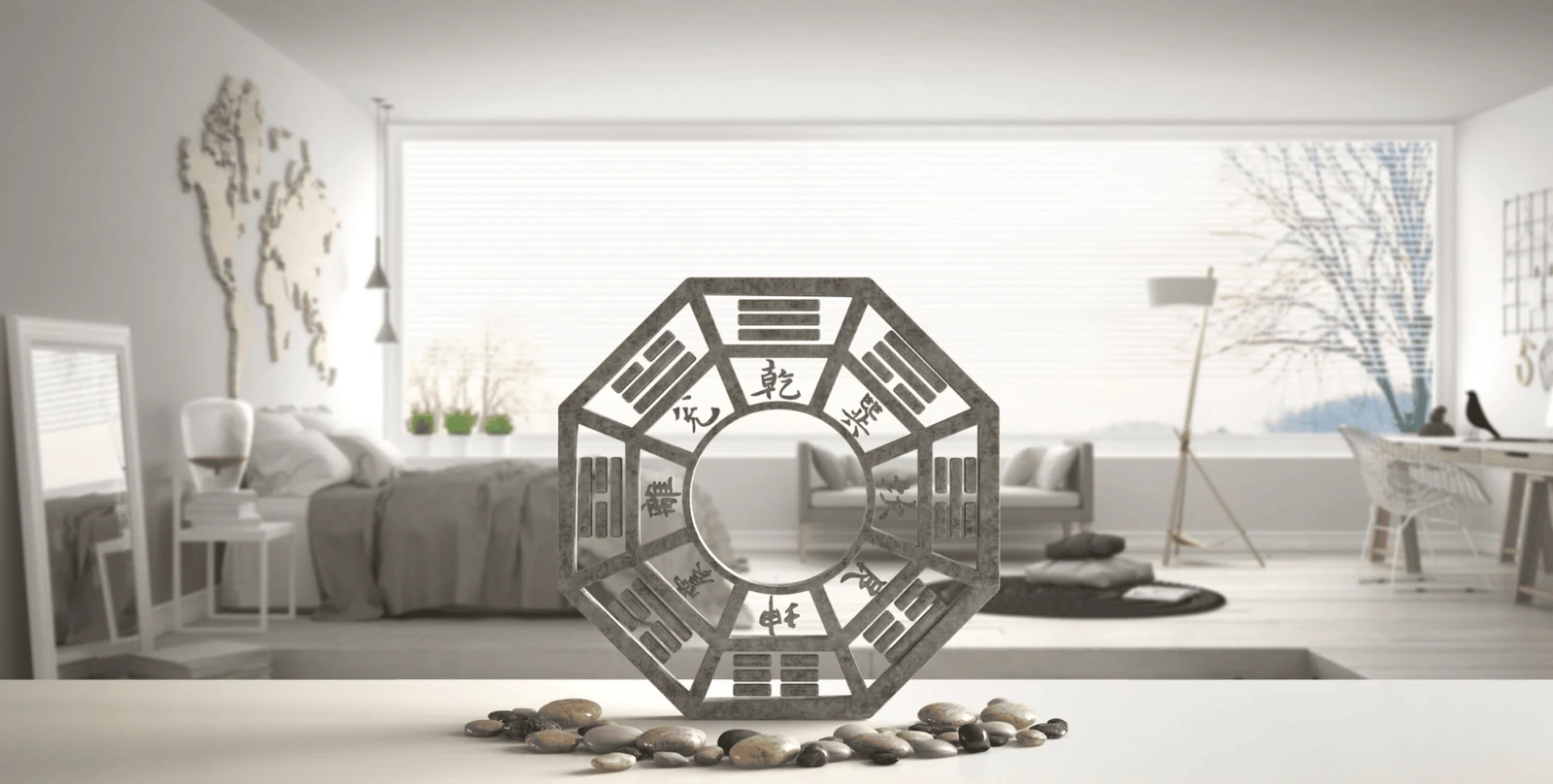
Feng Shui governs the relationship between spatial arrangement and energy flow. Its practical applications in a Dubai home include attention to entrance orientation, the placement of furniture relative to doors and windows, and the avoidance of certain material combinations in specific zones. It is best applied structurally during the planning phase rather than as a surface adjustment.
Vastu
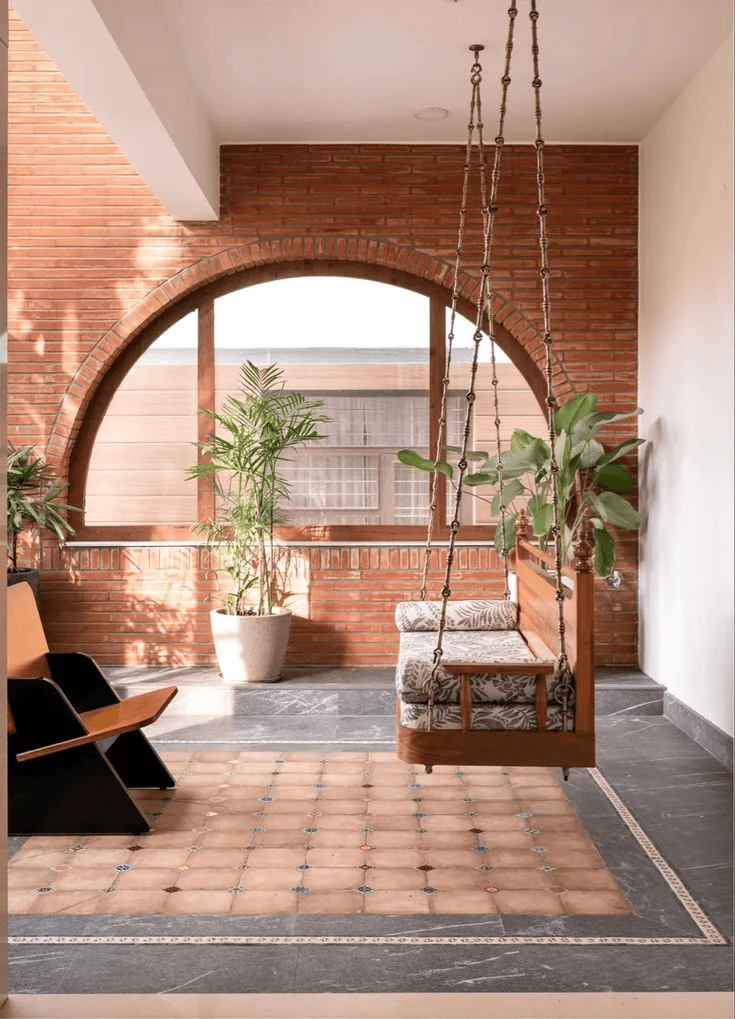
Vastu Shastra similarly governs spatial orientation and material placement according to directional principles. Like Feng Shui, its most meaningful application is at the spatial planning stage.
How to Apply the Rules of Fusion to Your Living Room, Bedroom, and Kitchen
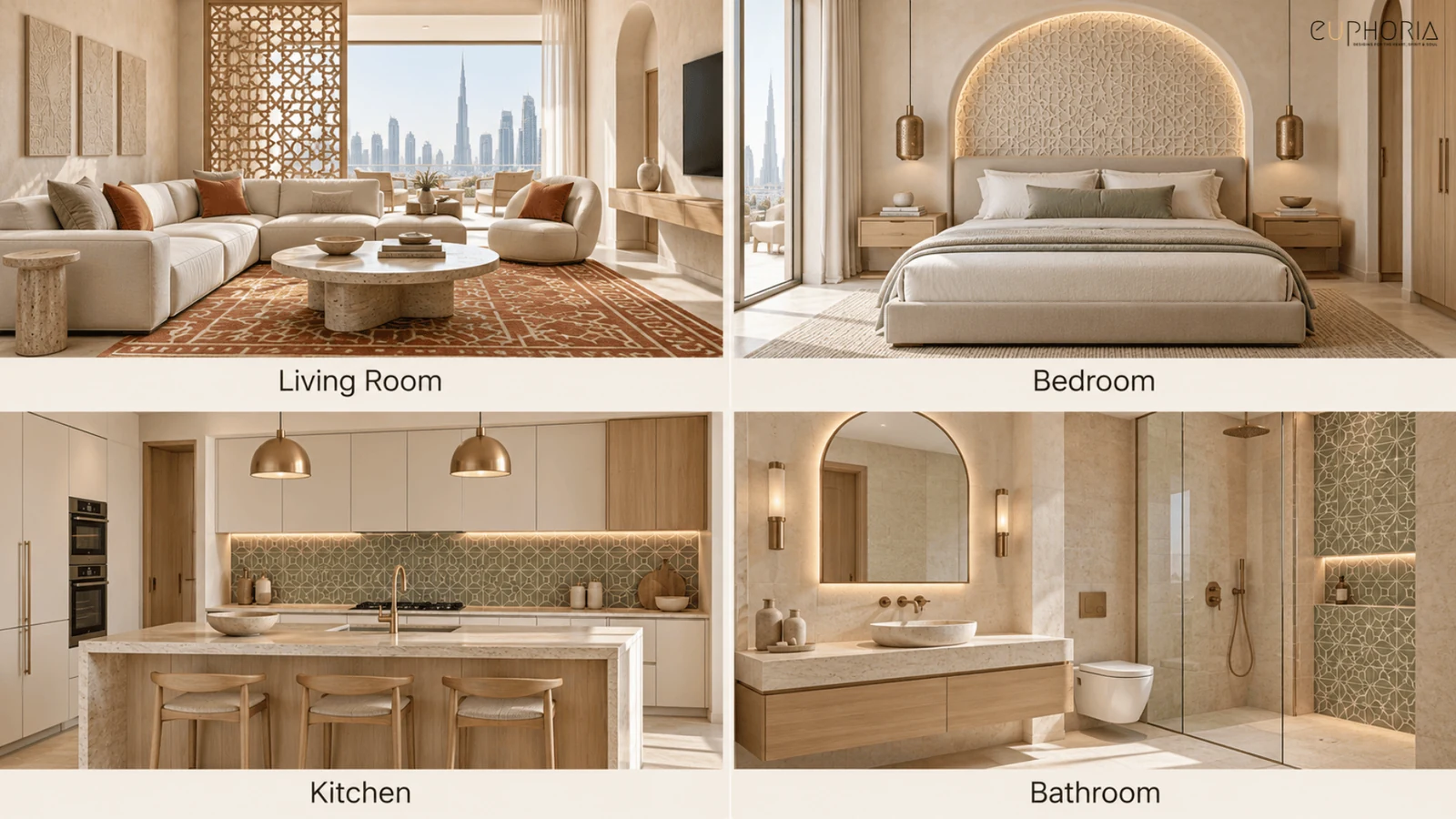
| Space | What Works for Fusion | What to Avoid |
|---|---|---|
| Living Room | Contemporary sofa base, artisan rug defining the zone, one feature wall (geometric tile or calligraphy), traditional statement lighting. | Multiple feature walls, competing cultural references, objects scattered on every surface. |
| Bedroom | Neutral contemporary bed frame, cultural influence kept to textiles (woven throws), warm ambient lighting, and one meaningful art piece. | High-contrast feature walls, multiple patterns close together, and cold dominant surfaces. |
| Kitchen | Handleless matte cabinetry (base), hand-painted geometric backsplash (cultural insert), brass/bronze fixtures (bridge). | Competing finish types on cabinets, decorative objects that collect grease and dust. |
| Bathroom | Large-format stone base tile, single geometric accent tile insert, hand-hammered basin, or brass fittings. | Multiple tile patterns in a small space, materials unable to withstand humidity. |
Dubai-Specific Practical Considerations
For Dubai homeowners, the physical environment dictates design just as much as aesthetics.
Heat: Summer temperatures regularly exceed 45°C. Untreated natural wood near south or west-facing glazing can warp. Certain synthetics fade rapidly through glass. Select materials with thermal performance in mind alongside aesthetics.
Dust: Dubai’s dust is fine, frequent, and relentless. Rough-weave textiles, open-pore wood finishes, and intricate geometric tilework collect dust at a significantly higher rate than smooth surfaces. Be honest about maintenance commitment before selecting these materials.
Light: Intense directional light for most of the year affects how colors and materials are perceived. A warm-toned palette that reads beautifully under diffused light can look washed out under direct sunlight. Layer window treatments and choose materials that perform across different light conditions.
Privacy: For many Dubai households, a clear separation of guest and family zones acts as a strict cultural requirement. A fusion interior that ignores this fails the functional layer regardless of how it looks.
Common Mistakes in Fusion Interior Design
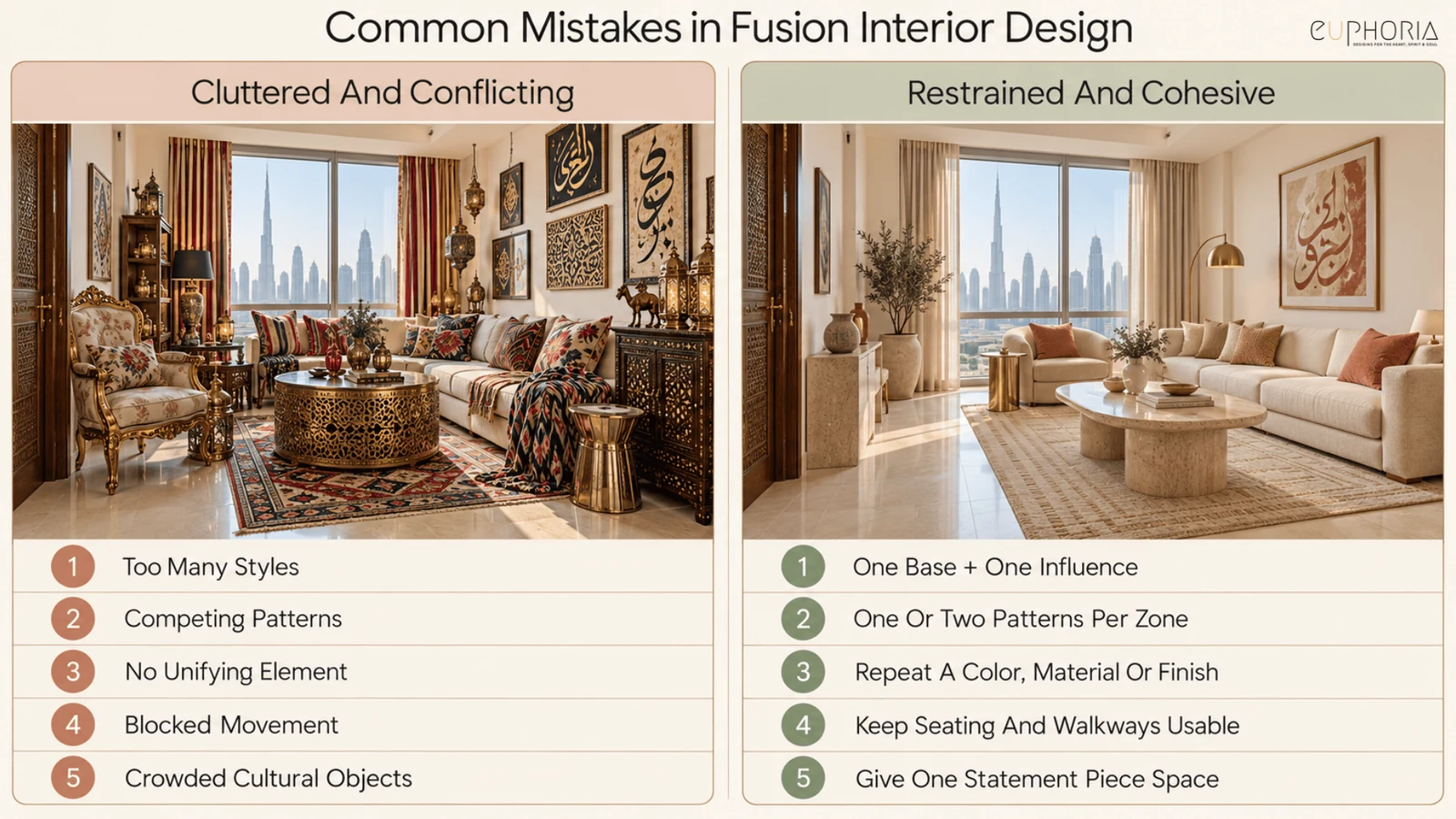
1. Too many styles at once.
Three or more distinct design traditions in a single room are almost always too many. Each additional influence dilutes the others. The result is a space that feels busy and uncertain rather than rich and layered. Two is the functional maximum. One dominant, one secondary.
2. Too many patterns in proximity.
Pattern mixing is a specific skill. A geometric rug, a floral cushion, a stripe curtain, and a printed throw in the same seating area create visual noise that no amount of color coordination can resolve. Limit active patterns to one or two per zone. Let solid textures carry the rest.
3. No unifying element.
Without a unifying element, whether that is a color tone, a material, a finish, or a spatial logic, a fusion room is simply a collection of furniture from different sources. The unifying element is what makes the difference between a designed space and a furnished one.
4. Ignoring function.
A room that sacrifices comfort for visual interest fails as a living space. Furniture that cannot be sat in comfortably, surfaces that cannot be cleaned easily, layouts that interrupt natural movement patterns, all of these are functional failures that no amount of aesthetic quality can compensate for.
5. Over-decorating cultural elements.
One piece of Arabic calligraphy makes a statement, but five in the same room will become wallpaper. So, cultural objects need space around them to carry weight.
Using Blank Space to Make Your Favorite Objects the Center of Attention
Good design requires restraint. Blank spaces allow your statement pieces to stand out. Before adding another item to a room, ask yourself if it brings something entirely new to the space.
The practical test: Stand at the entrance and look at the whole room. If your eye does not know where to settle first, there are too many elements competing. A well-designed fusion interior has a clear visual hierarchy: your eye finds the statement piece first, moves through the space in a planned sequence, then rests.
Empty surfaces, open floor areas, and gaps between objects stand as deliberate design decisions. They give the elements around them room to be seen. Remove everything from a surface and only add back what passes this test: does this object contribute something that nothing else here already does? If not, leave it out.
Why a Calm Minimalist Base is the Smartest Choice for City Apartments
The most sophisticated direction in fusion interior design right now applies a genuinely minimalist base with one or two precisely chosen fusion elements carrying the full cultural weight of the design.
A minimal fusion interior might have white plaster walls, large-format marble tile floors, and furniture in two neutral tones. Within that disciplined base, a single large Arabic calligraphy canvas, a hand-knotted rug with almost no other soft furnishing around it, or one brass light fixture of traditional form in a completely contemporary space.
The restraint of the base makes the fusion element more powerful. Because everything around it is calm, that one cultural reference stands with a clarity and authority it would never have in a busier space. This approach is also lower maintenance, better suited to Dubai apartment living, and ages well because the base layer is stable while the accent layers can be changed over time.
A calm base should still feel warm, which our guide to turning cold minimalism into a cosy space covers. Renting? Our affordable rental home design tips keep the changes reversible.
Turning Diverse Design Traditions Into One Cohesive Living Space
Fusion interior design functions as a complete decision-making system. It asks: how do you build a home that is genuinely yours when your identity, culture, and life experience span more than one tradition?
In Dubai, that question applies to most households. The six-step system in this guide, base style, secondary influence, material bridge, color discipline, statement piece, restraint, acts as a framework for rooms that look exactly right. The best fusion interiors feature elements chosen with total clarity.
If you are planning a residential project in Dubai, Euphoria Interiors helps you build fusion design systems that reflect your identity and daily routines. Get in touch to start the conversation.