
If your home were a conversation, would it be a soothing whisper or a celebratory shout? Most of us sit somewhere between wanting to bin everything we own and wanting a third velvet armchair because the colour makes us happy. It is the question the team at Euphoria Interiors works through with almost every client before anything gets specified.
Choosing between minimalism vs maximalism is not really about how much fits into a floor plan. It is about how your brain handles the world around it.
Our own take on the bolder end sits in this guide to maximalist living room design, where texture and colour build depth and personality.
Minimalism gets marketed as the cure for a cluttered mind, but it only works if you actually enjoy the quiet. There is no point perfecting a pared-back interior if the lack of stimulation leaves you flat. Equally, a maximalist space should feel like a curated gallery of your life, not a storage unit with a mortgage.
Here is how to find your visual volume, whichever direction you lean.
What Is the Difference Between Minimalism and Maximalism?
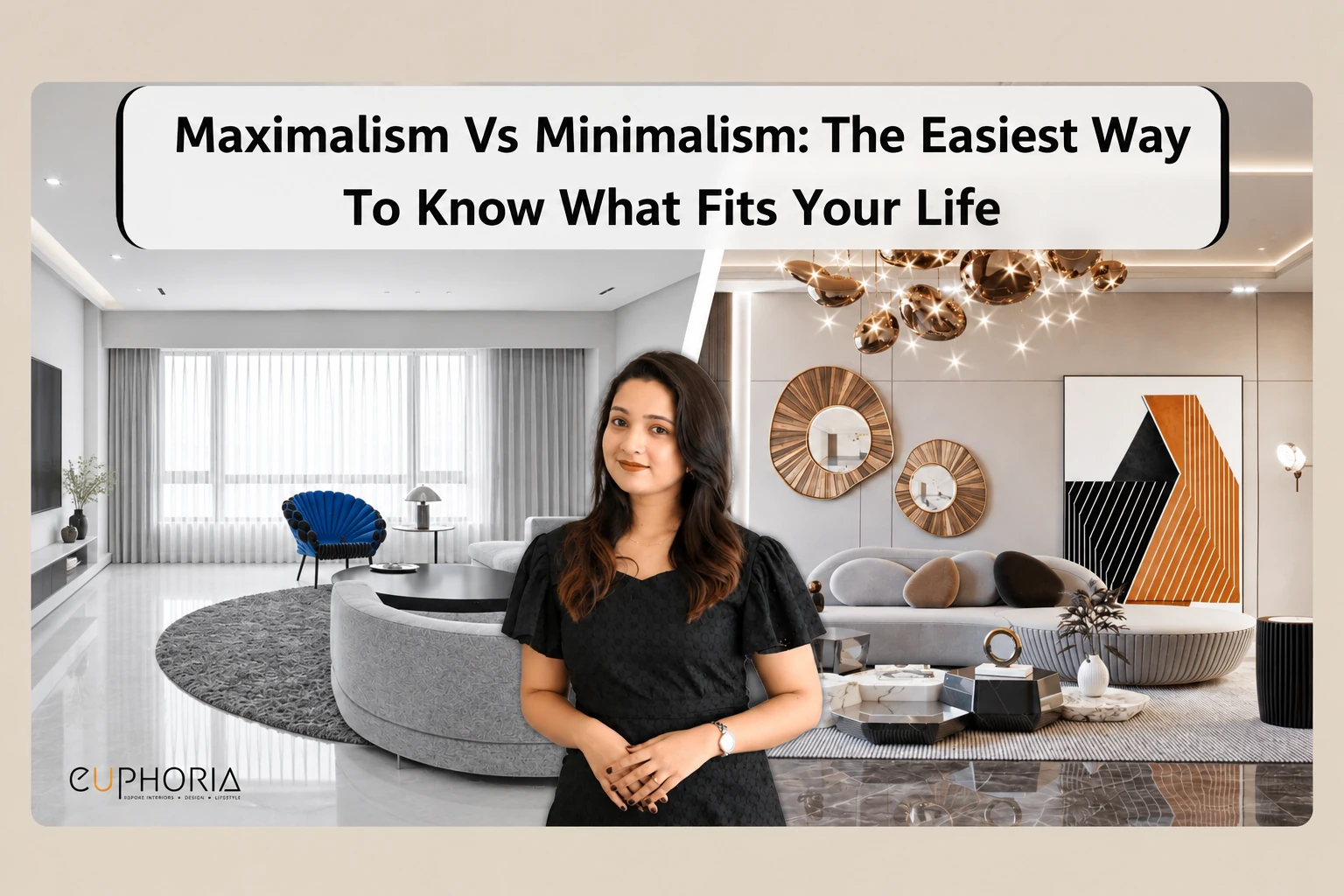
Minimalism is the art of enough, focused on the essential and the functional. Maximalism is the art of more, focused on personality, history and visual abundance. One reduces distraction, the other celebrates collection.
- The goal: minimalism aims for clarity by removing the unnecessary. Maximalism aims for stimulation by layering textures and stories.
- The palette: neutral and monochromatic against clashing pattern and saturated colour.
- The curation: in minimalism, every object earns its place through utility or beauty. In maximalism, objects stay because they carry a memory.
- The layout: minimalism prioritises negative space. Maximalism sees an empty wall as a missed opportunity.
Neither is about mess. Both require careful curation to work. That balance between form, texture and space is really the seven elements of interior design applied at different volumes.
The Minimalist Approach: Is Less Really Best for You?

Minimalism is more than a white sofa and one potted plant. It is a commitment to the idea that your surroundings affect your mental bandwidth. If you feel a physical weight lift when you walk into a tidy room, it is probably your natural fit.
The style relies on the edit, stripping away decorative noise until only the functional and beautiful remain.
- Intentional functionality: no filler furniture. If a chair is not sat in, it does not belong.
- The power of quality: with fewer items, craftsmanship and materials carry more weight.
- Visual uniformity: a cohesive palette, not necessarily stark white. Tones that bleed into one another read as expansive.
- The breathable room: the gap is the point. Empty wall and bare floor let the eye rest.
Practical reasons to go minimal
- Reduced maintenance: fewer items to repair, clean or replace, and no buy-break-replace cycle.
- Streamlined cleaning: clear surfaces cut your weekly chores dramatically.
- Better use of space: removing dead furniture opens walkways and makes small rooms work harder.
- Easier organisation: when everything has an unobstructed home, you stop losing things.
- Light and air: clutter traps dust and blocks daylight.
- Financial clarity: you stop impulse-buying small items, which adds up.
What to do next: pick one room. Remove everything you have not used in six months. Live with it for a fortnight before buying a single replacement.
How to Create a Minimalist Living Room
Restraint should not produce a room that feels unfinished. The aim is to highlight the architecture while keeping every seat comfortable, using a few hero pieces rather than a dozen supporting ones.
Prioritise the layout

The floor plan comes first. Arrange furniture to promote easy movement, and resist pushing everything against the walls. Grouping creates a natural conversation area.
Invest in multi-functional pieces

Look for furniture that works twice as hard: a coffee table with hidden storage, a sleek sofa bed. High utility without visible clutter.
Layer with texture, not objects

To stop a minimal room feeling clinical, use physical texture. A wool rug, a wooden side table, a linen curtain. Depth without clutter.
Control the palette

Keep a tight colour story. Most schemes rely on three tones: a primary neutral, a secondary tonal shade, and a single accent material such as brass or blackened steel.
Select meaningful art

Instead of a gallery wall, choose one large-scale piece. It gives the eye a focal point and defines the room without visual noise.
What to do next: tape out your furniture footprint on the floor. Cut the palette to three tones. Replace any two small artworks with one large one.
The Maximalist Approach: When More Is Just Right

If minimalism is a silent retreat, maximalism is a lively dinner party. It is widely misunderstood as simply having a lot of stuff, but real maximalism is an intentional, curated explosion of personality.
For a maximalist, a home is a living scrapbook that invites the eye to wander and discover.
Narrative decorating

Every object tells a story. Where minimalism prioritises utility, maximalism prioritises history: vintage finds, travel souvenirs, inherited pieces.
Colour and pattern play

Maximalism thrives on contrast, particularly the relationship between a floral wallpaper and a geometric rug. Handled well, it is the same instinct behind the artisanal elements shaping Dubai interiors: craft and pattern used deliberately.
The gallery feel

A maximalist room uses every surface. Walls covered in art, shelves packed with books, coffee tables styled with curiosities.
Sensory richness

Heavy fabrics like velvet, intricate carving, and a variety of light sources create a mood thick with atmosphere.
Is maximalism right for you?
- You are a collector: if hunting for antiques brings you real pleasure, a spare interior will feel like a self-imposed prison.
- Colour energises you: if white walls leave you uninspired, you need the saturated palette.
- You enjoy visual complexity: some people find a minimal room boring rather than calming.
- You want a conversation starter: maximalist homes are social, and they reflect their owners.
What to do next: group your collections instead of scattering them. Pick one wall for art. Add one heavy fabric before adding any more objects. The grandmillennial aesthetic sits firmly on team more, with its florals and fringe.
Can You Combine Both Styles?
Interior design is rarely a strict binary. Many homes now lean into a hybrid that uses minimalist structural foundations while allowing decorative flair.
- The 80/20 rule: keep 80% clean lines, neutral walls and functional layout. Use the other 20% for bold expression.
- The neutral canvas: white or soft grey walls let a velvet armchair or a large painting stand out without crowding.
- Curated clutter: group objects rather than scattering them. A collection of ceramics on one clean sideboard reads as a focal point.
- Texture as detail: a monochromatic room still feels full through wood, stone and heavy knits.
- Purposeful accents: one large ornate mirror does the work of ten small ones.
This hybrid is exactly what our guide to turning cold minimalism into a cosy space is built around, and it is the version most people actually want.
What to do next: keep the walls neutral. Choose one statement piece per room. Group, do not scatter.
Which Style Fits Your Life?

This is less about which photographs better and more about how you move through your day.
| Feature | Lean minimalist if… | Lean maximalist if… |
|---|---|---|
| Daily routine | You want a grab-and-go life with zero friction | You enjoy rearranging and nesting |
| Mental space | You are easily overstimulated and need a reset | You feel uninspired in empty rooms |
| Housekeeping | You want the house clean in thirty minutes | You do not mind dusting a collection |
| Shopping habits | You save for one forever piece | You love the thrill of the hunt |
| Social feel | You want your home to feel like a quiet gallery | You want it to feel like a warm hug |
The stress test
Still unsure? Strip one room of every non-essential item, books, candles, cushions and frames, and leave it bare for forty-eight hours.
- If you feel relief and find it easier to think, minimalism is your habitat.
- If the room feels dead and you itch to put things back, you are a maximalist.
Before committing money either way, it is worth seeing the room rendered. Our guide to 3D virtual home staging covers how to test a direction without buying anything, and if you are renting, our affordable rental home design tips keep the changes reversible.
Conclusion
The choice is not a permanent contract. Your home should evolve alongside your priorities. Whether you find peace in clean lines or energy in a room full of stories, the only correct style is the one that makes daily life easier.
Minimalism offers freedom from maintenance and visual noise. But if your heart is not in it, it can feel like living in someone else’s house.
Either way, the failure modes are the same ones covered in our rundown of common interior design mistakes and the top ten mistakes to avoid. Both styles fall apart for the same reasons: no focal point, wrong scale, bad lighting.
Not sure which side you sit on? Euphoria Interiors designs homes at both ends of that range and most points in between, so talk to our design team about your space.