


An alcove bed can stop a parent mid-scroll. The tucked-in frame, the soft lighting, the sense of a room that actually uses every centimetre of wall space, it looks like exactly what a child’s room needs. But behind that cosy first impression, real questions start to surface.
Will this still work when the child shoots up 10 centimetres in a year? Will changing the sheets be a weekly battle? Will the nook feel stuffy in a warm home? And what happens to the whole built-in design when the kid no longer wants a play corner and needs a proper study zone?
Designer Sarah Richardson has said she chose a neutral palette that would change easily as the baby grew, and the same thinking applies to a bed built into the wall. An alcove bed can absolutely work for growing kids, but the families who get the most out of it are the ones who plan for ventilation, mattress size, storage access, and future use before the carpentry even starts.
Keep reading, because this article answers all of it practically.
What Exactly Is An Alcove Bed?
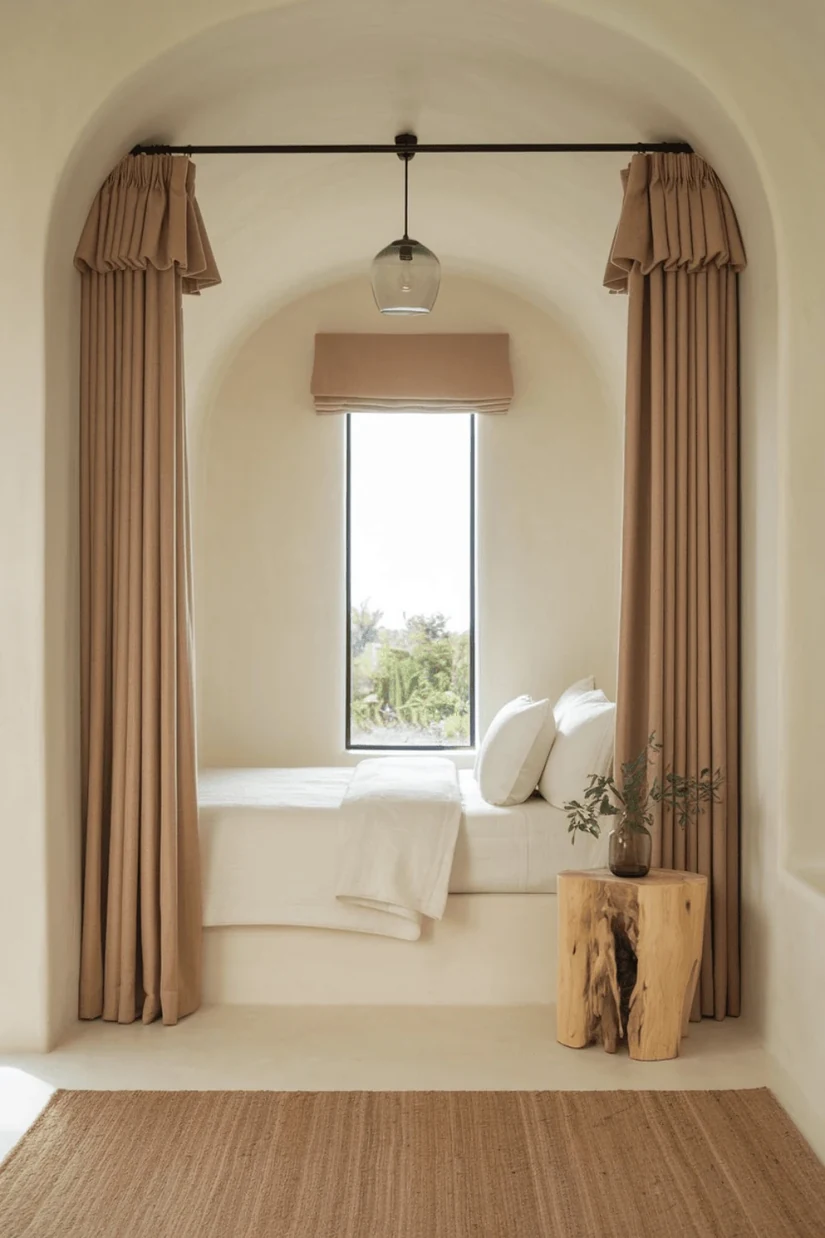
An alcove bed is a bed placed inside a recessed wall, niche, or built-in frame to create a tucked-in sleeping space that feels cosy, private, and space-efficient.
In practical terms, it is a sleeping area set into a wall recess, an unused corner, or a custom-built-in frame. The bed can be open on one side and enclosed on two or three sides, depending on how the room is designed. A recessed bed sits directly inside a wall recess.
A bed nook is a softer, more casual version of the same concept. A built-in bed is fixed into custom carpentry that cannot be moved the way a loose bed can. When you add storage, shelves, lighting, and paneling to that framework, you get a built-in alcove bed, which is the version most parents are picturing when they start looking into this idea.
The terms are often used interchangeably, and the differences mostly come down to how finished and integrated the final design is.
Are Alcove Beds A Good Idea For Growing Kids?
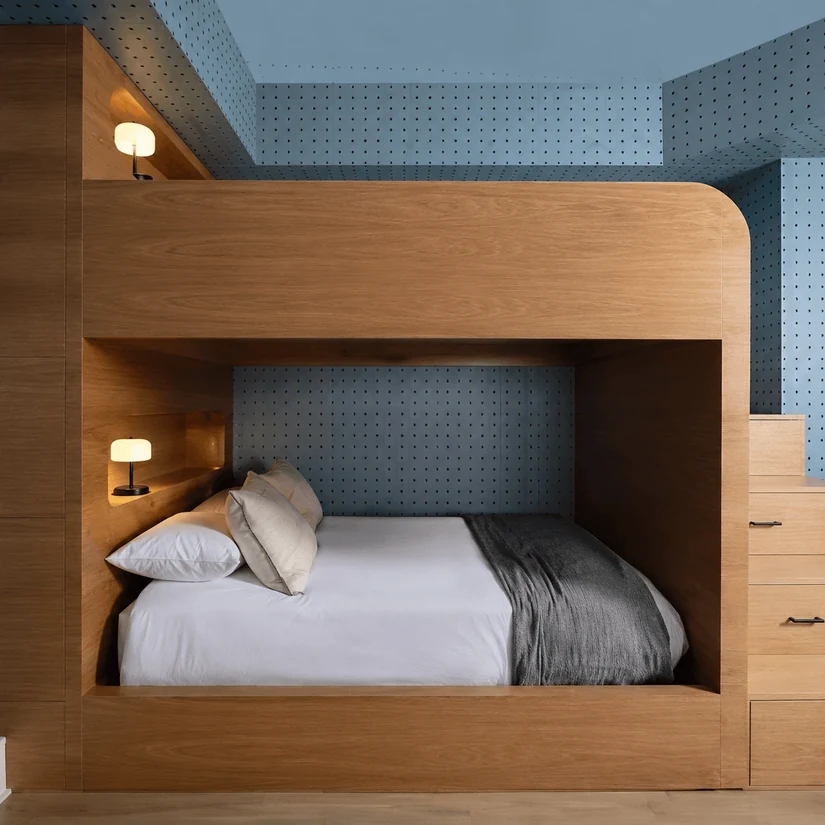
Yes, but only when it is planned with a twin XL or full-size mattress option, proper ventilation, easy access to fitted sheets, safe rounded corners, and storage that can later be adapted into a study zone or guest sleeping nook.
The families who end up disappointed are usually the ones who designed the alcove around the child standing in front of them, rather than the teenager who will be using the same room in four years. A growing child needs more length, more clearance, and more functional flexibility than a small cosy nook designed purely for aesthetics can offer.
When you plan for a twin XL mattress or a full-size mattress from the start, leave enough clearance for fitted sheet access, keep the nook breathable with proper ventilation, use rounded corners and a child-safe finish, and add storage that can shift as the child’s needs change, the alcove bed becomes one of the most practical things in the room. The key is that it should be designed for the child your kid is becoming, not only the child they are today.
Is Your Room Actually Right For An Alcove Bed?
Not every room is the right candidate. But when the layout fits, an alcove bed can genuinely change how the space works.
An alcove bed may work well if:
- The room has a dead corner, recess, or wall depth that currently goes unused.
- The existing bed is blocking movement or making the room feel cramped.
- Storage is a priority, and reducing loose furniture would help.
- The child needs more floor space for a play area.
- The nook can be built slightly larger than the current mattress size to allow for growth.
- The room might later serve as a guest sleeping nook.
- The wall space around the bed can support wall-to-wall storage to replace a bulky wardrobe.
- The bedroom has an awkward layout where standard furniture placement never quite works.
In short, it works best when the room has a natural space that a bed would fit into without forcing it, and when the family values a more custom, storage-integrated look over layout flexibility.
Getting this judgement wrong is one of the common interior design mistakes we see most often.
When An Alcove Bed Can Become A Problem
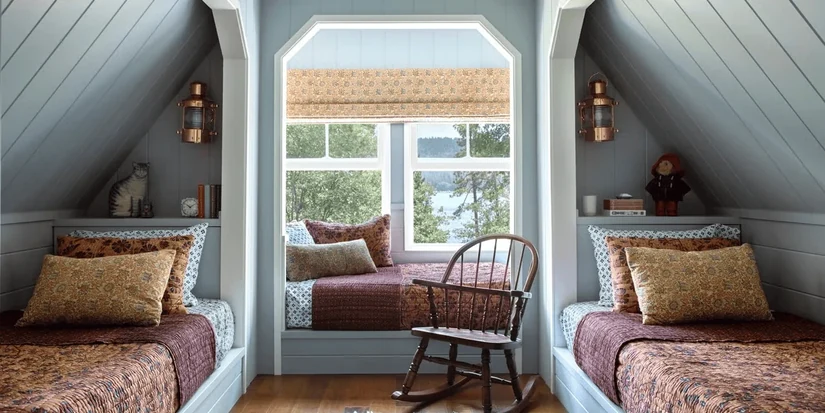
Honest design planning means knowing where this idea falls short, too.
A built-in alcove bed may not be the right move if the room layout needs to change regularly, because a built-in bed is almost impossible to rearrange. If the child is already close to needing a larger mattress and the nook is being sized for today, the design could become awkward within a year or two.
Rooms that are narrow, dark, or poorly ventilated can make a fixed nook feel claustrophobic rather than cosy, and if there is not enough clearance around the bed, fitted sheet access becomes a genuine chore every week.
Parents who are not ready for custom carpentry, or whose child strongly dislikes enclosed sleeping spaces, may find that a freestanding bed works better for their situation. And for UAE homes specifically, a built-in alcove bed designed with a heavy fabric enclosure or a fully boxed-in frame can feel stuffy during warmer months.
Design Warning: Avoid making an alcove bed too enclosed. In warm climates like the UAE, heavy privacy curtains or fully boxed-in designs can feel uncomfortable. A more open frame, soft paneling, or slatted side detail usually works better.
Pets complicate a low built in bed too, which our pet friendly interior design tips cover.
The Honest Pros And Cons
Here is a clear overview to help with the decision:
| Pros Of An Alcove Bed | What To Watch Out For |
|---|---|
| Saves floor space | Can reduce layout flexibility |
| Creates a cosy bed nook | Fitted sheet access can be harder |
| Adds alcove storage | Needs drawer clearance |
| Gives the child a defined sleep zone | Needs ventilation and soft lighting |
| Makes awkward layouts useful | Must be planned for future growth |
| Frees up a play area | A standard twin may be outgrown quickly |
| Can include under-bed drawers | Heavy shelves near the pillow area need care |
| Can later become a study zone | Custom bed design requires planning upfront |
The pros are real, but so are the cautions. A space-saving bed that has not been planned for a growing child can start to feel like a design limitation faster than expected.
8 Alcove Bed Ideas That Actually Work For Growing Kids
These are not pretty concepts. Each one is a practical design decision that makes the alcove smarter, safer, and more useful as your child grows.
1. Build It Bigger Than Your Child Needs Today
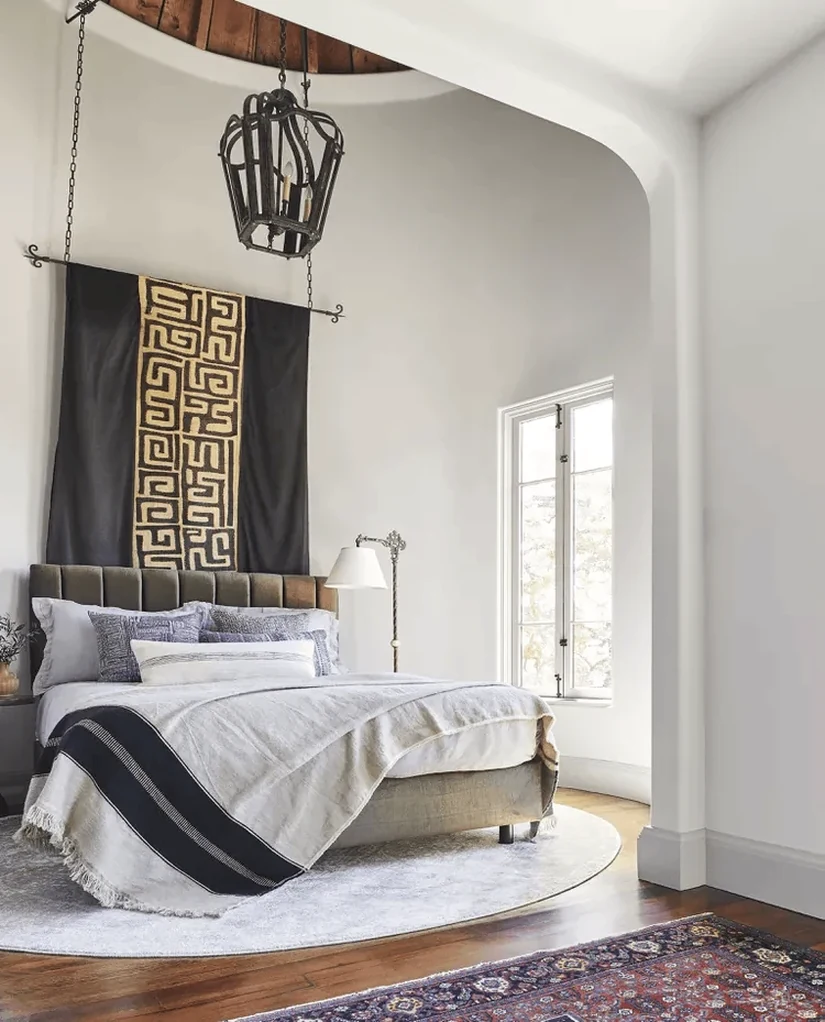
Design By William Hunter Collective
The most common mistake parents make is sizing the alcove around the child standing in front of them right now. Kids grow fast, and a nook that fits perfectly at age six can feel tight by age nine. For rooms that are narrow but tall, a twin XL mattress gives extra length without needing extra width, which makes it the smarter choice when you want the bed to last through the teenage years.
For rooms that have enough width and the family wants the design to feel genuinely comfortable long-term, a full-size mattress is worth considering from the start. The built-in frame should be sized with a little extra internal room around the mattress so the bedding is not crammed against the carpentry on every side.
Design Tip: Build for the teenager, not just the child using the room today.
2. Turn An Awkward Corner Into A Smart Sleeping Nook
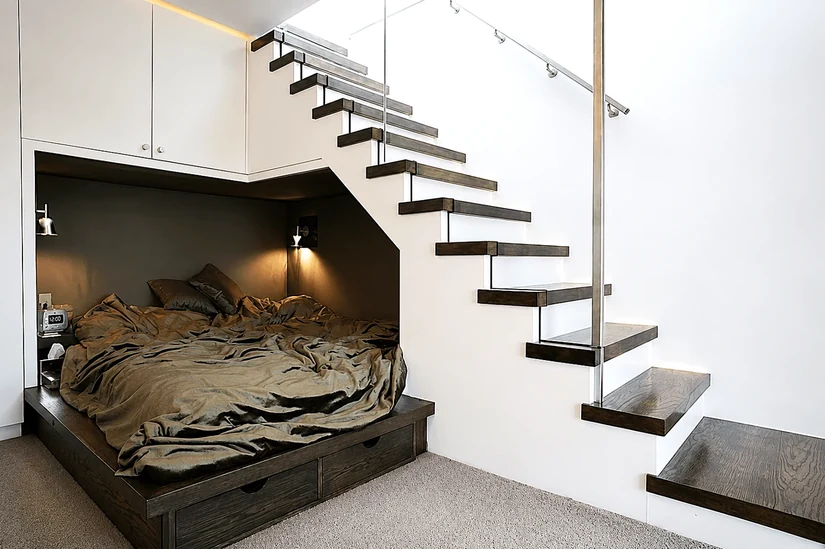
A small bedroom alcove bed is one of the most satisfying solutions for rooms where the layout never quite flows. An unused corner, a recessed wall, or a wall depth that is too shallow for a wardrobe but too prominent to ignore, these are all candidates for a bed nook that turns wasted space into something practical.
The key rule here is that the bed should not block wardrobes, windows, or natural movement paths through the room. When the niche sits in a genuinely dead area of the layout, the bedroom nook feels purposeful rather than forced.
Best for: Small bedrooms, awkward kids’ rooms, compact apartments, and rooms with recessed wall depth.
3. Add Under-Bed Drawers That Actually Open Properly
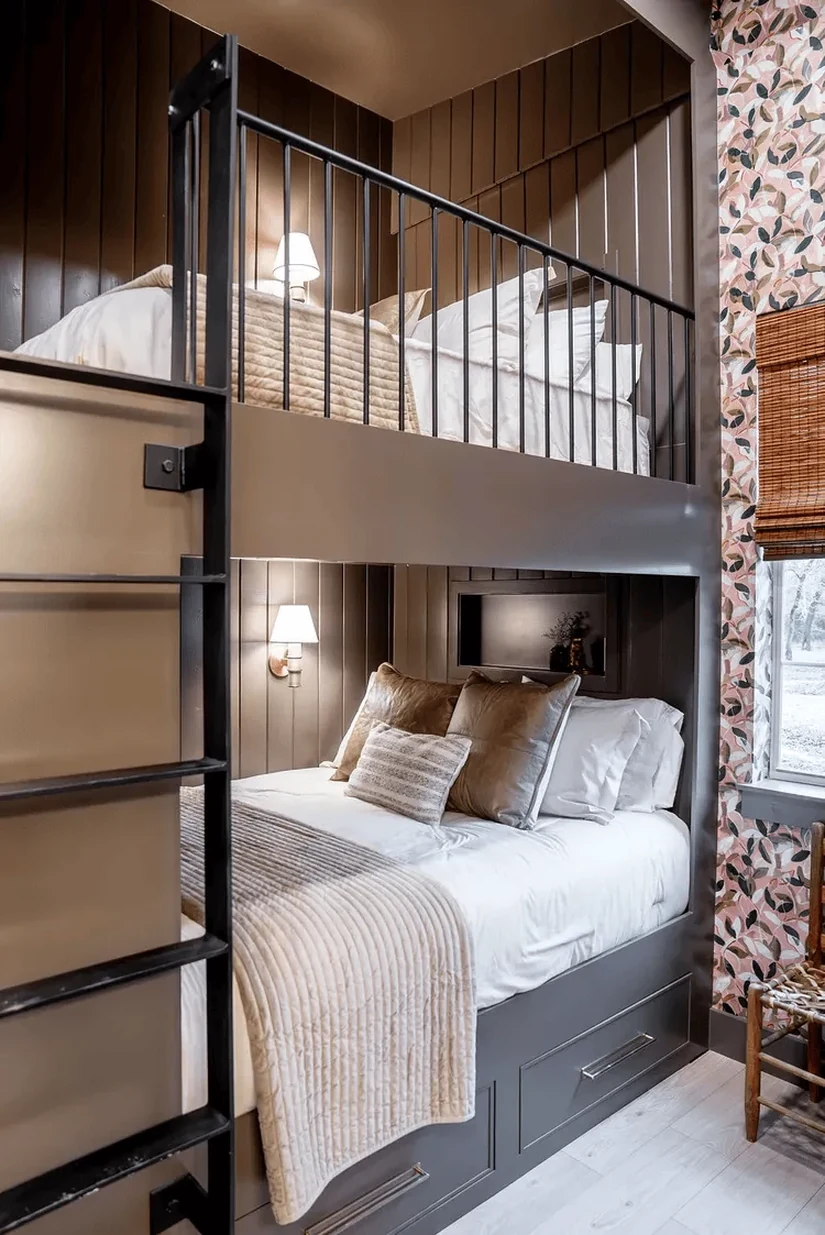
An alcove bed with storage can do the work of a full chest of drawers while keeping the floor open for a play area. Under-bed drawers are ideal for spare bedding, toys, school items, seasonal clothes, and sports gear. The part that often gets missed in planning is drawer clearance. If the drawers open into a rug, a nearby wardrobe, or another piece of furniture, they become almost useless within weeks. Wall-to-wall storage works best when the full drawer run is mapped out before the carpentry is finalised, not after.
Use under-bed drawers for:
- Spare bedding
- Toys
- School items
- Seasonal clothes
- Sports gear
4. Use An Arched Frame To Make The Bed Feel Softer
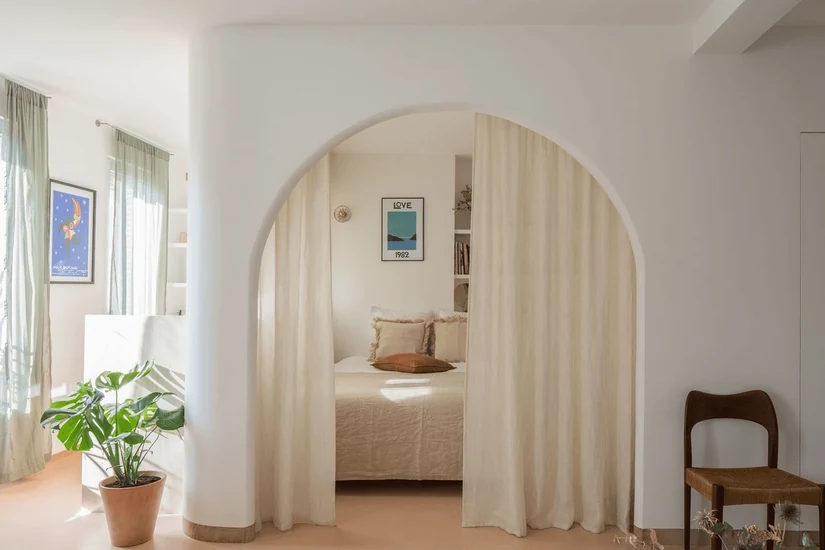
An arched alcove bed does something clever for a child’s room. It gives the sleeping space a clear visual identity without needing heavy decoration, and it softens the whole look compared to a flat rectangular frame.
For UAE homes, an arch is a particularly good alternative to a fabric enclosure because it gives the bed a sense of its own space while keeping the nook open and breathable. The arch does not need to be ornate. A clean, gentle curve at the top of the frame is enough to make the design feel considered without locking the room into a look it will outgrow.
Design Rule: Keep the arch simple and timeless so the room can mature with the child.
That softness is the same idea behind hygge interior design.
5. Add A Reading Light Before The Carpentry Starts
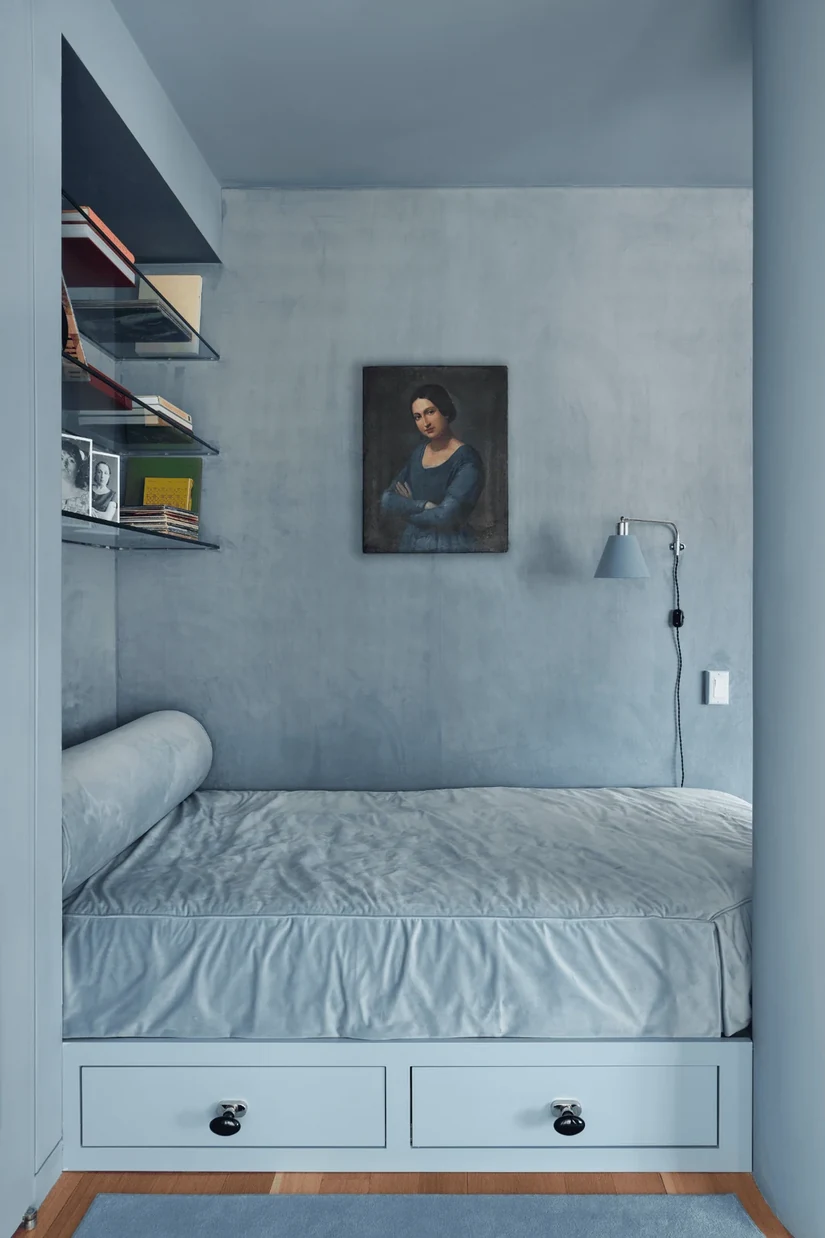
Lighting is what decides whether a bed nook feels inviting or claustrophobic. A soft reading light placed at the right height, a switch positioned near the pillow, and a small headboard niche for a book or glass of water make the alcove practical for independent use rather than just for sleeping. These details are easy to add but impossible to fix cheaply once the carpentry is done, which is why they should be planned before a single piece of wood is cut.
Plan before carpentry starts:
- Switch location
- Reading light height
- Charging point
- Shelf depth
- Ventilation gap
6. Choose Open Paneling Over Heavy Bed Curtains
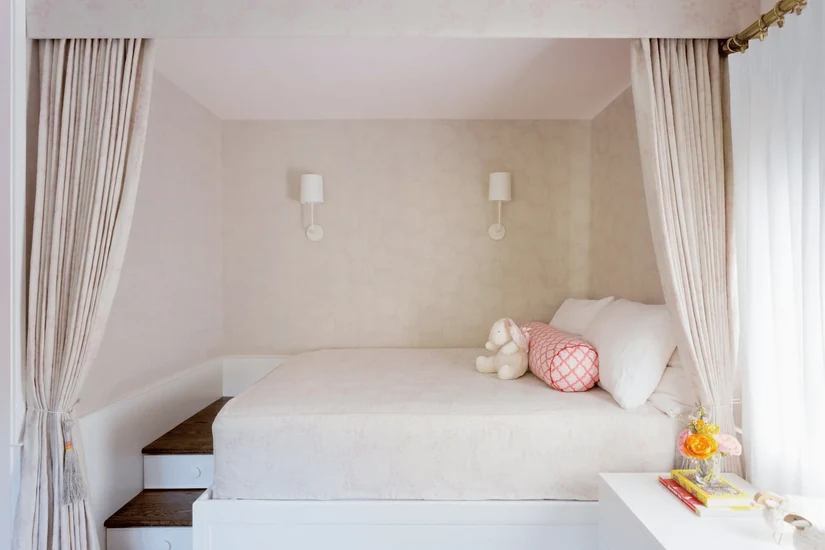
A privacy curtain can look charming in editorial photos and works well in cooler climates where the enclosed feeling adds genuine warmth. For UAE homes, it is rarely the right first choice. Open paneling, slatted sides, soft upholstered backing, a rounded frame, or a half-height partition all give the alcove a cosy bedroom nook feel without trapping heat or making the space feel airless.
A light washable sheer can be used as an optional styling layer if the family wants the option, but it should not be doing the work of enclosing the sleeping area entirely. The goal is a cosy bed nook that feels like a retreat, not a tent.
UAE-Friendly Note: In warm climates, keep the alcove breathable. Use open detailing and soft finishes rather than heavy curtains around the bed.
7. Wrap The Bed Wall With Storage That Feels Built-In
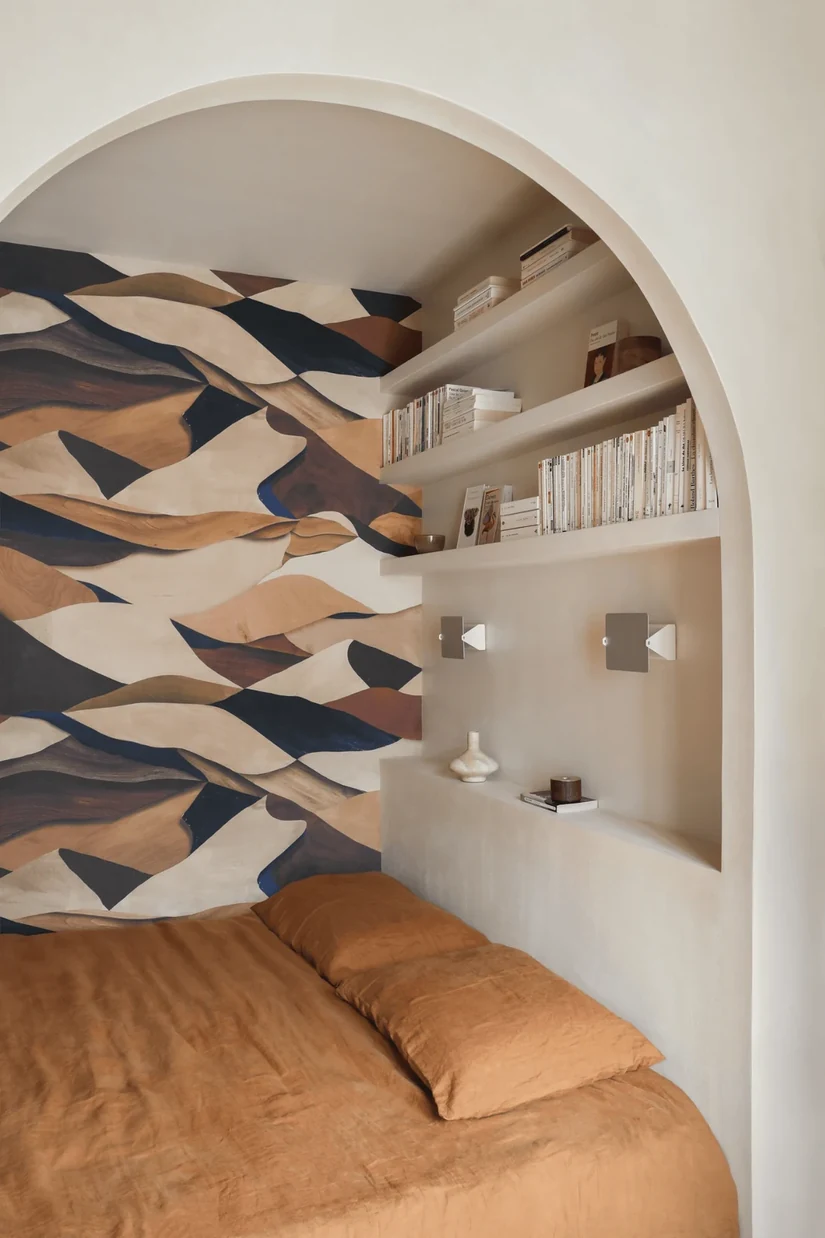
The best built-in alcove bed designs treat the wall around the mattress as one continuous storage opportunity rather than stopping at the bed frame itself. Wardrobes, open shelves, closed cabinets, and display niches can all be incorporated into the same wall to create a wall-to-wall storage system that removes the need for extra furniture in the room entirely.
The one safety note worth stating clearly is that heavy shelves directly above the child’s pillow area should be avoided. Secure fittings, rounded corners, and a child-safe finish are non-negotiable for anything mounted near where a child sleeps.
Safety Note: Keep heavy storage away from the pillow area and use secure fittings, rounded corners, and child-safe finishes throughout.
Planning wardrobes alongside the alcove? Our Kids Wardrobe Design Ideas walks through how to make the storage on either side of the bed feel like one continuous installation.
8. Design The Alcove To Become A Study Zone Later
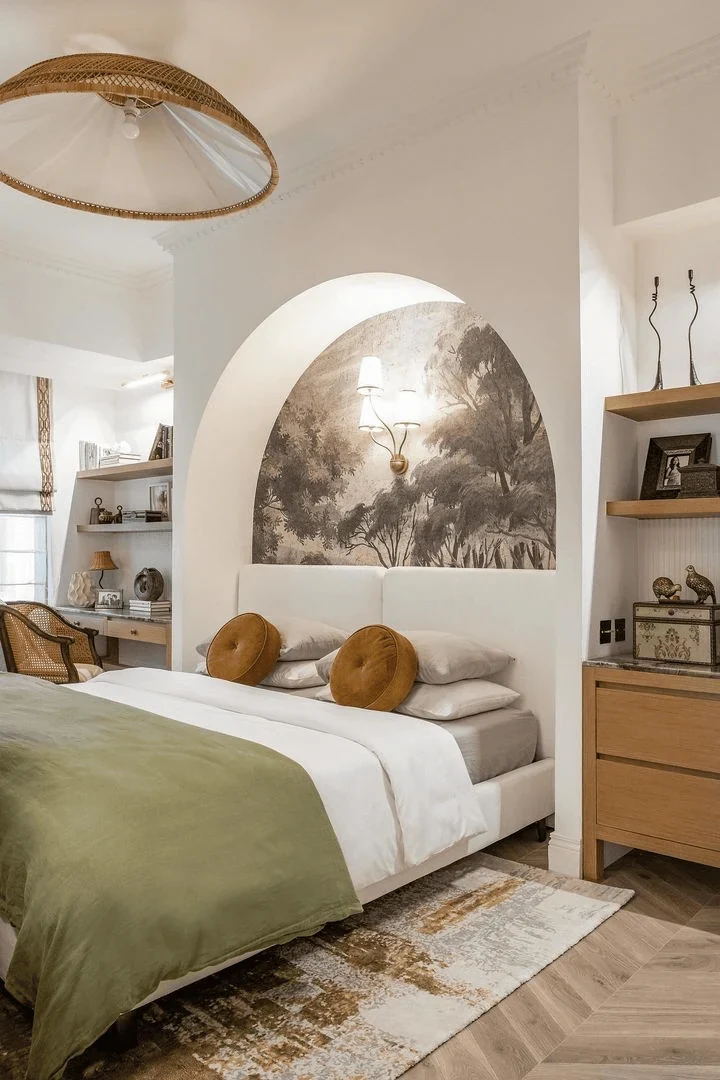
This is the idea that separates a well-planned alcove from one that will be ripped out in five years. The best alcove bed for kids is not locked into a single function.
As the child grows, the same niche that held the mattress can become a desk area, a bookshelf wall, a display niche, a reading corner, or even a guest sleeping nook for occasional use. Removable panels, adjustable shelves, neutral finishes, and flexible lighting all contribute to a design that can shift with the child rather than being left behind by them.
Later, the alcove can become:
- Study zone
- Reading nook
- Bookshelf wall
- Display niche
- Guest sleeping nook
Before finalising the alcove, it helps to think through how sleep, play, and study zones fit together in the same room. Our Kids Bedroom Design Ideas is a good starting point for that conversation.
Alcove Bed Sizing Guide You Need To Future Proof
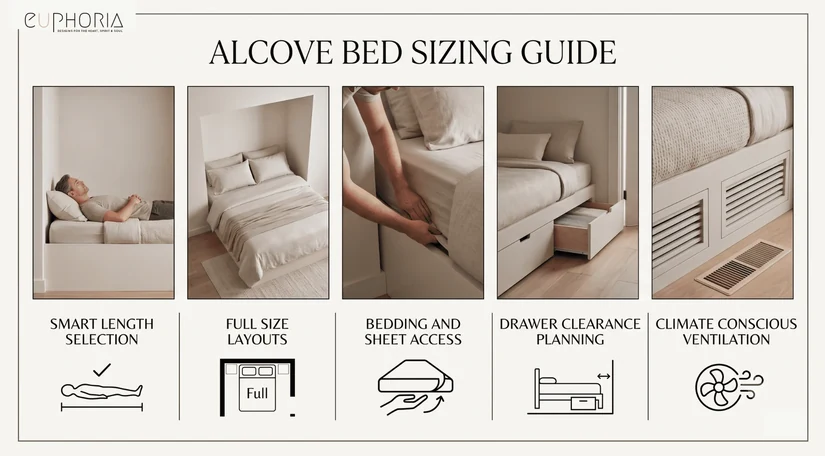
Sizing is where most guides skim the surface, and it is exactly where parents need the most detail. A standard twin mattress is 190 centimetres long, which works for younger children but can become limiting for a child who will grow into their mid-teens using the same bed.
A twin XL mattress adds around 15 centimetres of length and is the smarter choice when the room is narrow, but the child may grow tall. A full-size mattress works well in rooms that have a little more width and where the family wants the bed to remain genuinely comfortable well into the teenage years.
Beyond the mattress itself, the built-in frame should have a small amount of extra internal space on all sides so that the bedding fits without being crammed against the carpentry. Fitted sheet access is a real daily concern: if the mattress cannot be slightly lifted or slid, making the bed properly becomes difficult enough that most children simply stop doing it.
Drawer clearance needs to be mapped before building, not assumed. Ventilation gaps at the sides or back of the frame prevent the sleeping area from trapping warm air, which matters more in UAE homes than in colder climates.
| Planning Point | What To Check Before Building |
|---|---|
| Mattress Length | Choose a twin XL if the child may grow tall |
| Mattress Width | Use a full-size if the room allows long-term comfort |
| Internal Frame | Leave a little extra room around the mattress |
| Bedding Access | Make sure the mattress can lift or slide slightly |
| Drawer Clearance | Keep enough floor space for under-bed drawers to open fully |
| Lighting | Add a soft reading light inside the nook |
| Ventilation | Avoid sealing all sides too tightly |
| Storage | Keep heavy shelves away from the pillow area |
| Future Use | Plan if the niche can become a study zone later |
Safety Details That Matter More Than The Cute Factor
A kids’ room built-in should not only look beautiful. It should be safe to climb into, easy to clean, breathable, and practical for everyday use.
Safety in a built-in alcove bed for kids comes down to details that are easy to overlook when the focus is on how the room will look in photographs:
- Rounded corners on all exposed edges of the frame, because sharp carpentry corners at mattress height are a real hazard for children getting in and out of bed.
- Soft edges on the built-in frame, particularly anywhere a child might lean against or grab.
- Child-safe finish on all painted or lacquered surfaces, using low-VOC products that are safe for indoor air quality in a room where a child sleeps.
- Anti-tip fittings for any shelves or wardrobes built into the alcove wall.
- No heavy storage above pillow height, as anything mounted directly above where the child sleeps should be minimal, lightweight, and very securely fixed.
- Safe reading light placement that does not create a heat or electrical hazard near soft furnishings.
- No sharp handles near the mattress area, using recessed pulls or smooth knobs instead.
- Easy entry and exit, meaning the bed frame should not be so enclosed that a child cannot get out quickly in the dark.
- Proper ventilation built into the design from the start.
- A non-slip step if the bed platform is raised, sized correctly for a young child’s stride.
Keeping It Cool, Clean, And Low Maintenance
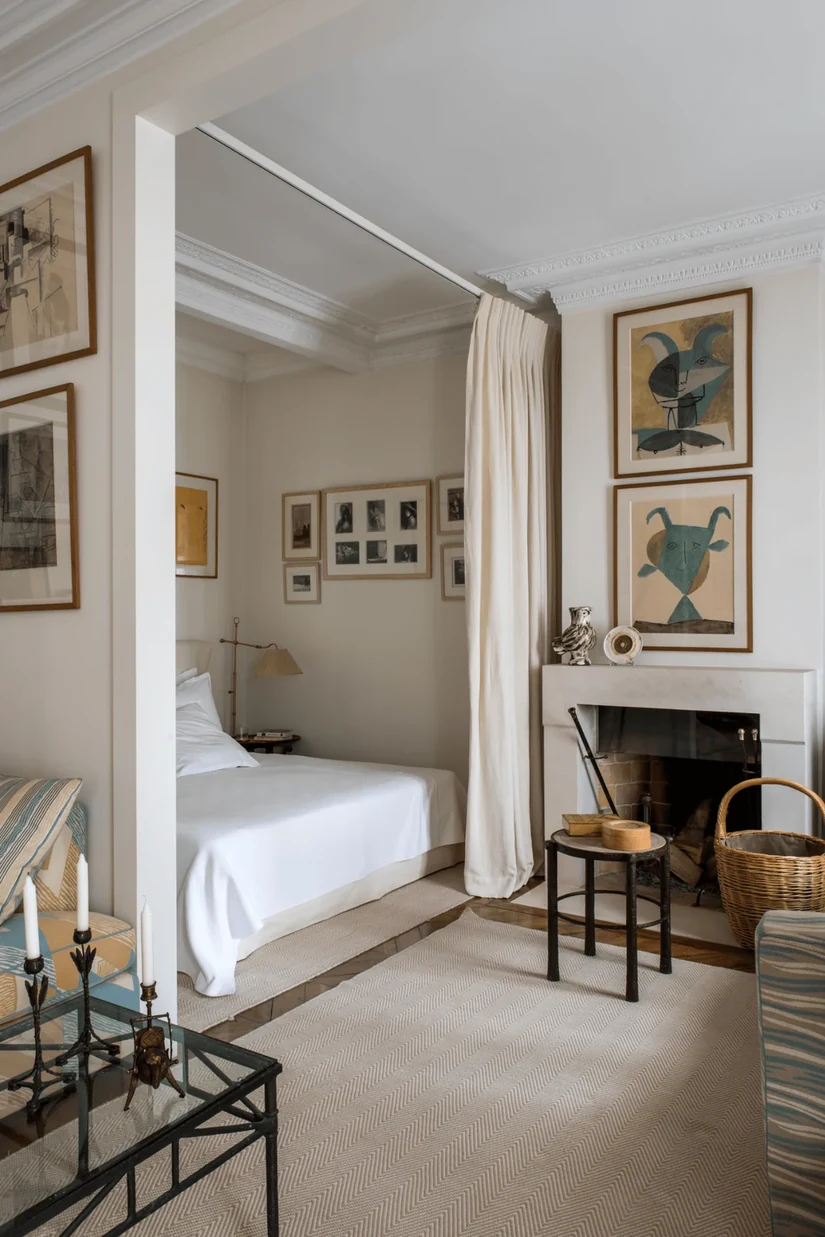
For families in the UAE and other warm-climate regions, the maintenance question is as practical as the design question. A bed nook that looks clean in photos but collects dust along the back panel, traps heat against the wall, or makes sheet changing a complicated weekly event will lose its appeal quickly.
Maintenance Rule: If the mattress cannot be lifted, slid, or reached easily, the alcove will become difficult to maintain, no matter how beautiful it looks.
Avoiding a fully enclosed design keeps air moving through the nook, which matters for both comfort and hygiene. Choosing a washable wall finish or wipeable paneling inside the alcove means the back and sides can be cleaned without repainting. Keeping bedding simple, with fewer layers and lighter fabrics, reduces the difficulty of making the bed in a tight space.
Under-bed drawers should open freely onto a clear floor area, and the tracks should be cleaned occasionally to prevent dust build-up. Removable cushions with washable covers are far more practical than fixed upholstery inside the nook, and avoiding deep dust-trapping side ledges inside the frame reduces the cleaning surface area considerably.
How To Stop The Alcove Looking Babyish By Age Ten
This is the worry that follows most parents after the design decision is made. A kids’ alcove bed that looks charming at age five can feel like a problem at age eleven if the carpentry is too theme-heavy or the colours are too nursery-specific.
The answer is not to make the room look grown-up before the child is ready. It is to keep the permanent elements neutral so the personality can live in the parts that change.
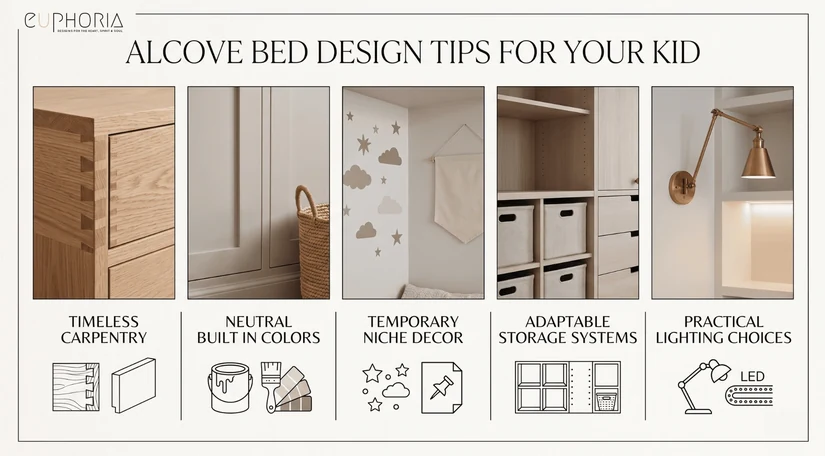
- Use timeless paneling on the alcove frame rather than theme-specific shapes or cartoon-inspired carpentry.
- Choose a neutral or softened colour for the built-in frame itself and let bedding and cushions carry the personality of the room.
- Use removable decals or framed art for the niche walls so the decoration can change without touching the carpentry.
- Keep shelves adjustable so the storage arrangement can shift as the child’s interests and school needs evolve.
- Choose lighting that works for a reader and a teenager, not just a young child.
- Use storage finishes that feel more mature as the child grows, swapping out colourful bins for organised baskets or boxes.
The alcove bed design itself should be the quiet background. The bedding, art, and accessories are what make it feel like the room belongs to a particular child at a particular age.
For ideas on keeping the room feeling fun without locking it into one age, our Fun And Functional Kids Room Decor Ideas has plenty to work with.
Our guide on how to turn cold minimalism into a cosy space helps when the room swings too plain.
12 Alcove Bed Mistakes That Are Easy To Avoid
Most parents only realise these at the wrong end of a carpenter’s invoice. Here is what to check before a single measurement is taken.
- Designing around the child’s current height. A growing child can add 15 centimetres in a year, and a nook sized for today will feel short sooner than expected.
- Choosing a standard twin when a twin XL mattress is the safer option. The extra length costs very little more at the planning stage.
- Ignoring the full-size mattress option in larger rooms. When the room has the width to support it, a full-size mattress gives the child a comfortable sleeping arrangement well into adolescence.
- Forgetting fitted sheet access. If the mattress sits snugly against three walls with no lift room, making the bed independently becomes almost impossible for a child.
- Making the built-in frame too tight. A frame with no breathing room around the mattress makes the alcove feel restrictive rather than cosy.
- Ignoring ventilation. Sealed on too many sides, even a beautiful nook can feel warm and airless, which is a particular concern in UAE homes.
- Using heavy curtains in warm climates. Full fabric enclosure in a hot climate makes the alcove uncomfortable for most of the year.
- Adding heavy shelves above the pillow area. Shelves directly above where the child sleeps should be lightweight, minimal, and very securely fixed.
- Forgetting drawer clearance. Under-bed drawers that open into a rug or nearby furniture stop being used almost immediately.
- Choosing sharp corners instead of rounded corners. Exposed carpentry corners at mattress height are a genuine safety concern for active children.
- Making the theme too childish. Permanent carpentry in a cartoon character or colour story locks the room into one age and forces a costly redesign sooner.
- Not planning a future study zone. The alcove will likely outlast the sleep-only phase of the child’s life. Building flexibility from the start saves a full renovation later.
So, Should You Build One? A Quick Decision Guide
Use this table to settle the debate before the planning conversation even starts.
| Situation | Should You Build It? | Why |
|---|---|---|
| Small room with awkward wall depth | Yes | It can turn dead space into storage and a sleep zone |
| The child is growing fast | Yes, with caution | Use twin XL or full-size planning from the start |
| The room needs layout flexibility | Maybe not | A loose bed may be easier to change later |
| Child wants a cosy sleep zone | Yes | A bed nook can feel secure and personal |
| The room is warm or poorly ventilated | Be careful | Keep the alcove open and breathable |
| You need more toy storage | Yes | Add under-bed drawers and shelves |
| The room may become a teen study room | Yes, if flexible | Design the niche to convert into a study zone later |
For more choices that hold their value, see our home upgrades you will never regret.
Ready To Design The Right Alcove Bed For Your Child’s Room?
Planning a built-in alcove bed that truly works for a growing child takes more than choosing a pretty frame. It takes thinking through mattress size, storage access, ventilation, safety details, and how the room will be used five years from now, all before the carpentry starts.
As one of the best interior designers for kids’ bedrooms, we work with families across the UAE to create children’s bedrooms that are safe, practical, and genuinely beautiful for every stage of childhood. If you are thinking about an alcove bed, a full kids’ room redesign, or simply want to make better use of an awkward bedroom layout, we would love to help you plan it properly from the start.
Get in touch with Euphoria Interiors to start your children’s bedroom design consultation today.