
You can choose exactly the right green and still dislike the kitchen. Put the same sage on a Shaker door and a flat front, and it already feels different. Add six drawer lines, a tall pantry wall, or an unfinished-looking island, and green kitchen cabinets can take the blame for decisions the colour did not make.
I used to stop at the colour too, but listening to our designers discuss joinery has made me pay more attention to door profiles, cabinet grids, end panels, and the way a run meets a window or doorway. Those details often explain why a green kitchen cabinet design feels busy, plain, or disconnected.
So, before you reopen the colour chart, look at the cabinetry carrying the green. Keep reading to compare 25 green kitchen cabinet ideas across door styles, islands, pantry walls, open sections, modern cabinetry, and painted finishes, so you can work out what is making the cabinets feel wrong before changing the green again.
25 Ideas For Green Kitchen Cabinets That Change More Than The Colour
The shade catches your attention first, but these ideas show how door shape, cabinet lines, and layout can change green kitchen cabinets completely.
Our kitchen design ideas cover the wider room, and our guide to green kitchen ideas compares every shade in one place.
1. Put The Same Green On Shaker And Slab Doors Before Choosing The Style
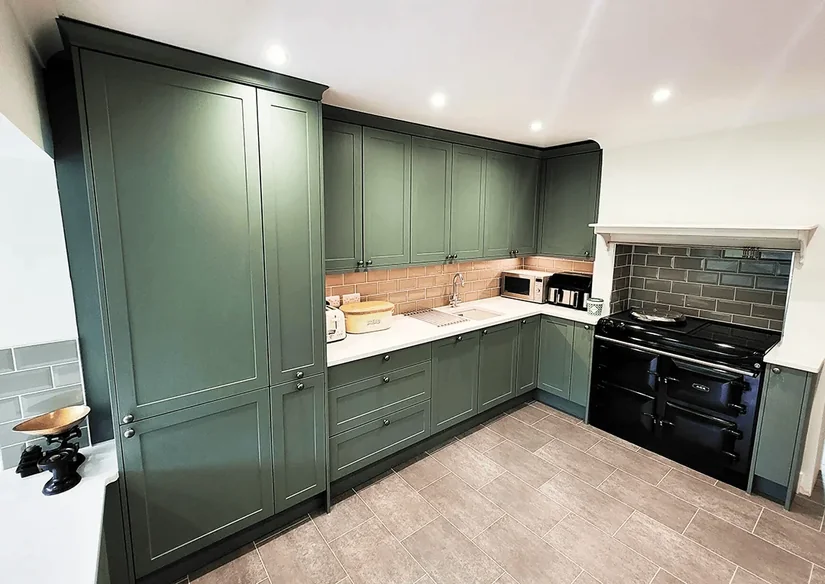
Like the sage, but not the door? A Shaker front adds a frame and shadow lines. A slab front spreads the green across one broader surface.
In a 2021 Journal of Vision study, Zoey J. Isherwood of the University of New South Wales and colleagues tested nine observers and found that perceived colour saturation and lightness interacted with 3D shape and surface gloss. It was not a cabinet study, but it supports comparing kitchen cabinet styles, not paint chips alone.
2. Give Light Green Cabinets Fewer Door Lines When The Wall Looks Too Busy
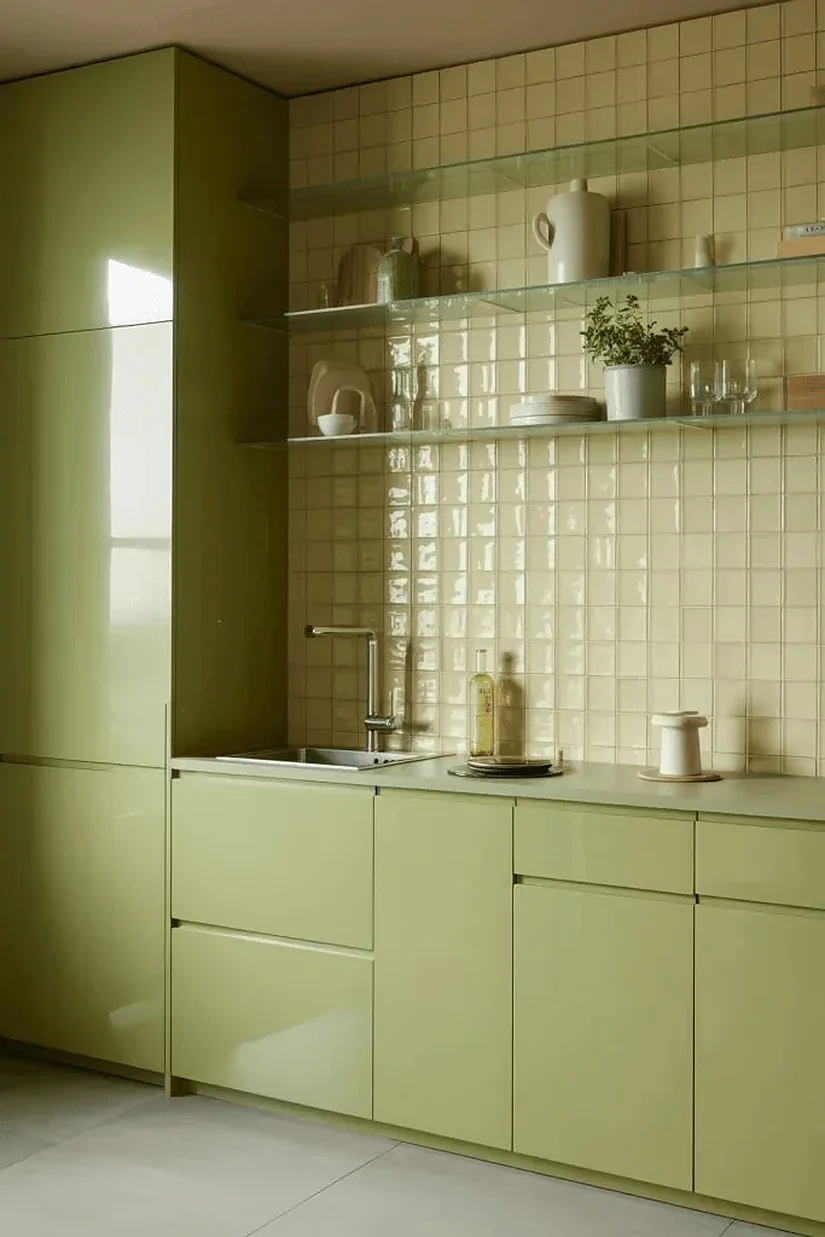
Light green kitchen cabinets can still look restless. Count the narrow doors, shallow drawers, and vertical joints before deciding the shade needs to be paler.
When I am researching a kitchen, I sometimes cover the paint name in my notes and count the cabinet divisions first. It sounds fussy, but it shows me when colour is being blamed for a busy wall. Try it on your drawing. Do fewer, broader fronts calm the green down?
3. Use Inset Cabinetry When Sage Needs More Architectural Detail
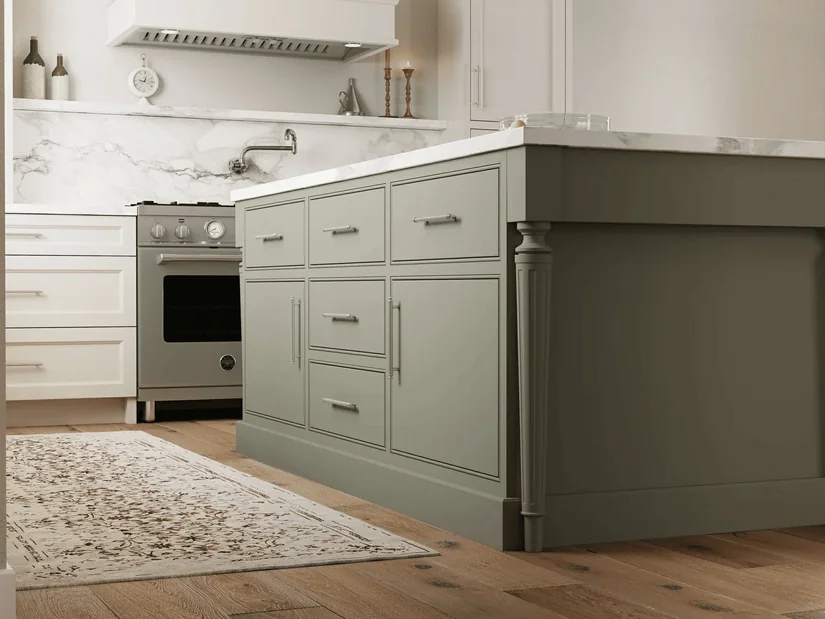
Does sage feel a little plain, so you keep adding patterned tile and decorative hardware? Pause there.
Inset cabinetry places the door within a visible frame, adding depth across sage green kitchen cabinets. Put an inset door beside a standard overlay front before adding another decorative surface. The cabinetry may already carry enough character, leaving the backsplash or hardware quieter.
4. Align Olive Cabinet Fronts Into One Cleaner Handleless Wall
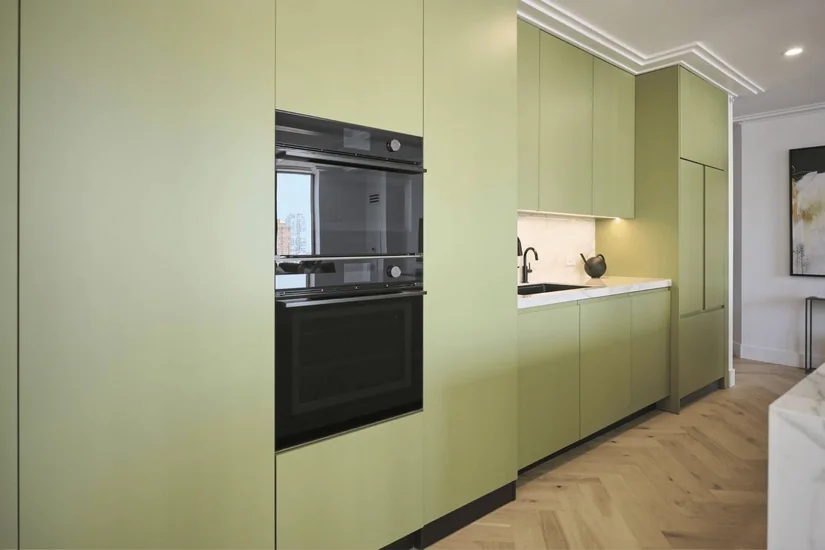
Olive green kitchen cabinets do not need to lean rustic. If you want a cleaner direction, study the whole cabinet wall before changing the metal.
Flat fronts, aligned door heights, integrated grips, and tall units on the same vertical grid can make olive feel more contemporary. Ignore the handles for a moment. Do drawer lines and tall doors break at unrelated heights? Fix that pattern first, then judge the hardware.
5. Let The Hob Show You Where The Cabinet Wall Should Centre
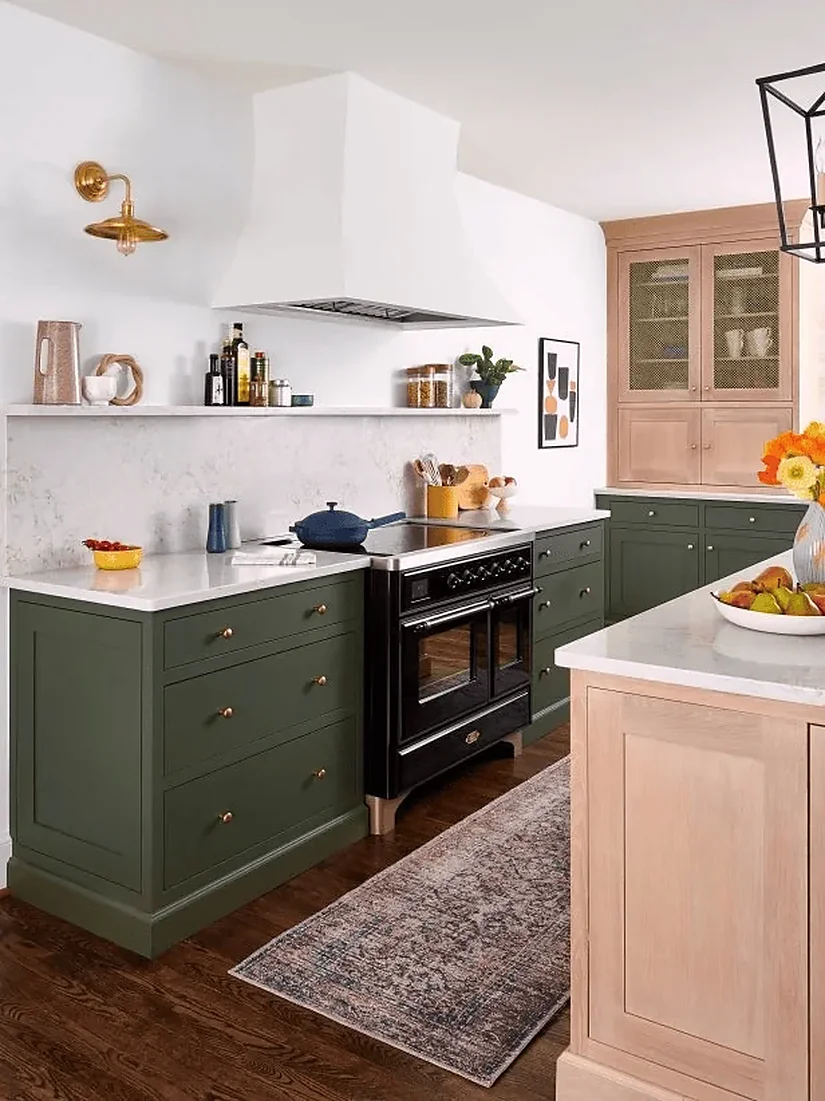
A long wall of green kitchen cabinets can feel unsettled even when you like every finish on it. Where is your eye meant to land?
Use the hob, range, or extractor as a starting centre, then trace the cabinet widths around it. Perfect symmetry is not compulsory, but random shifts can make the wall harder to read. Mark the cooking centre and see where the upper and lower cabinet lines drift away.
6. Group The Pantry, Fridge, And Tall Storage Into One Green Wall
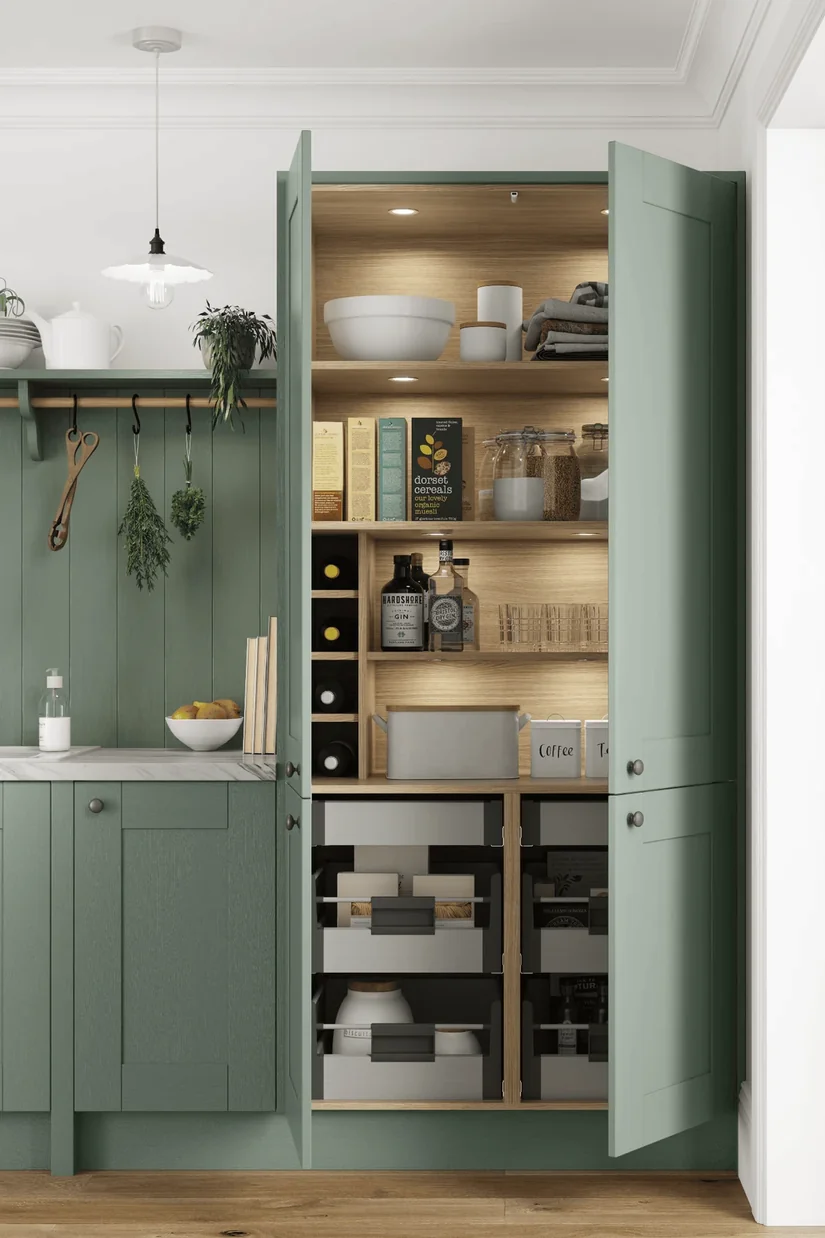
Three tall green units can still look like separate storage towers. When I read kitchen project files for an interiors piece, I pay closer attention to the straight-on cabinet drawing here. A finished render catches my eye first, but the drawing makes those towers easier to spot.
Read the pantry, fridge housing, and appliance cabinets as one wall before deciding on every door width. Broader kitchen planning becomes easier once the tall storage has a clear structure.
Our kitchen storage ideas cover what goes behind those doors.
7. Cut One Useful Open Niche Into A Full Green Cabinet Wall
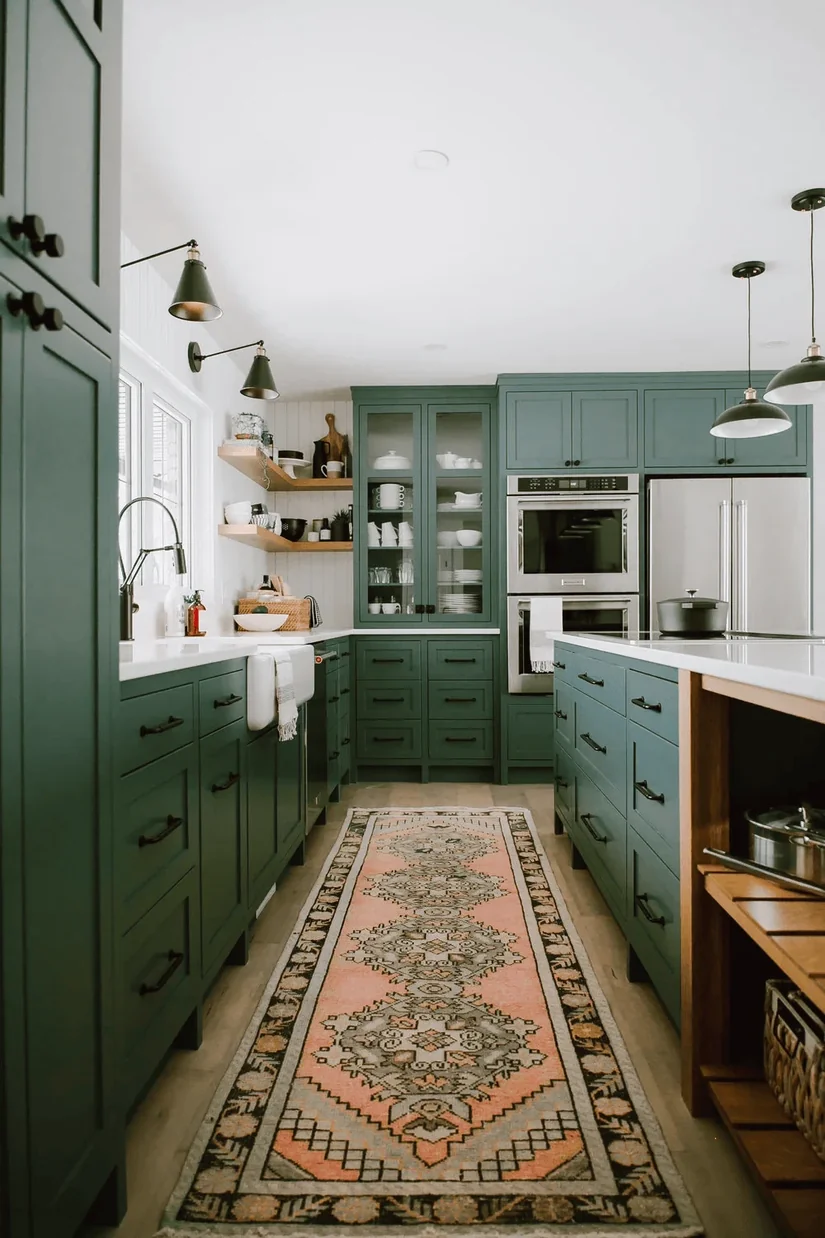
A wall of closed green kitchen cabinets can become repetitive, but an open shelf added only to “break it up” is not much of a solution.
Ask what you already do at that wall. Make coffee there? Reach for glasses? Plate food before serving? Let one real activity create the niche. The missing door changes the cabinet pattern, while the opening earns its place because you use it. Keep the rest closed.
8. Take Green Cabinetry Around A Doorway Instead Of Ending Beside It
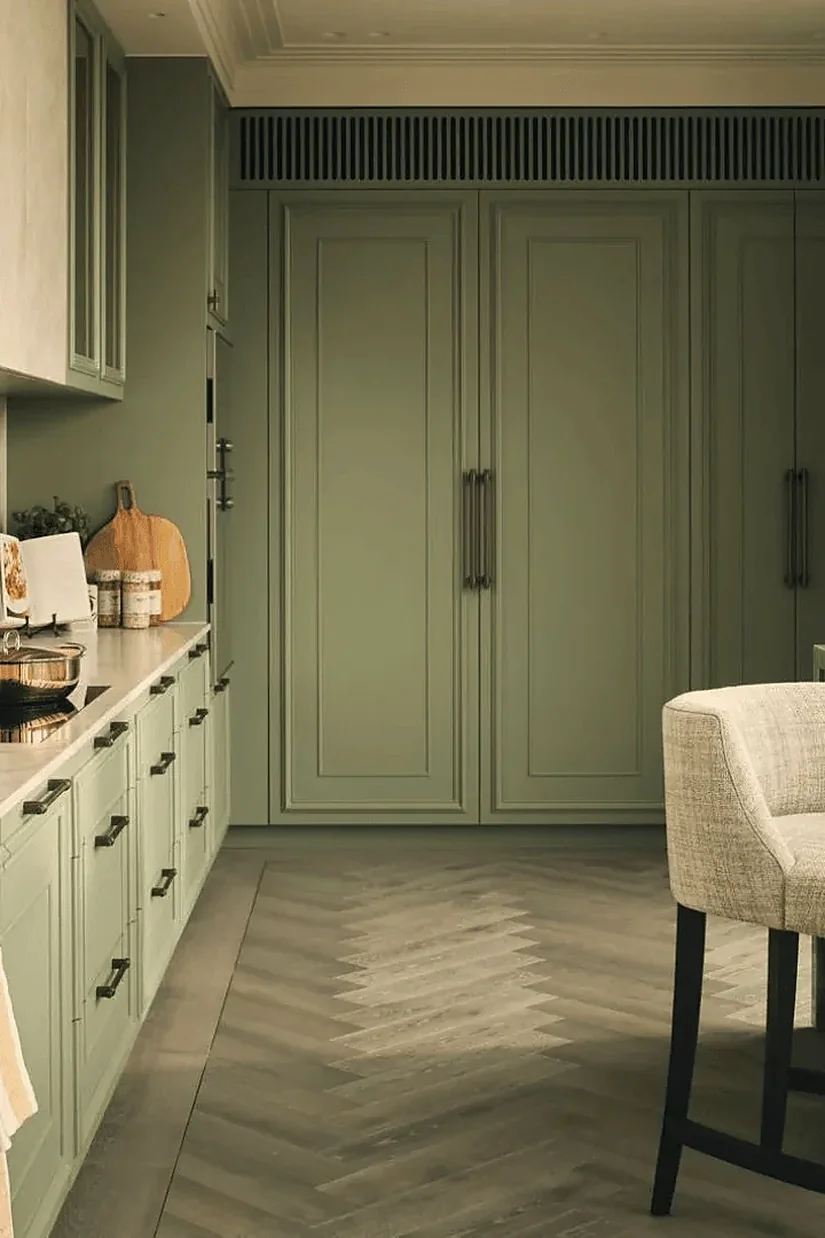
Ever seen a cabinet wall stop awkwardly at a doorway? Sometimes the opening needs to become part of the wall rather than the end of it.
Where the architecture and joinery allow, green kitchen cabinets can frame the doorway so both sides connect. Put the opening, wall edges, and storage on one drawing. You are checking if the cabinetry reads as one built-in composition, not filling every gap.
9. Add An Arched Cabinet Niche When Straight Green Joinery Feels Too Rigid
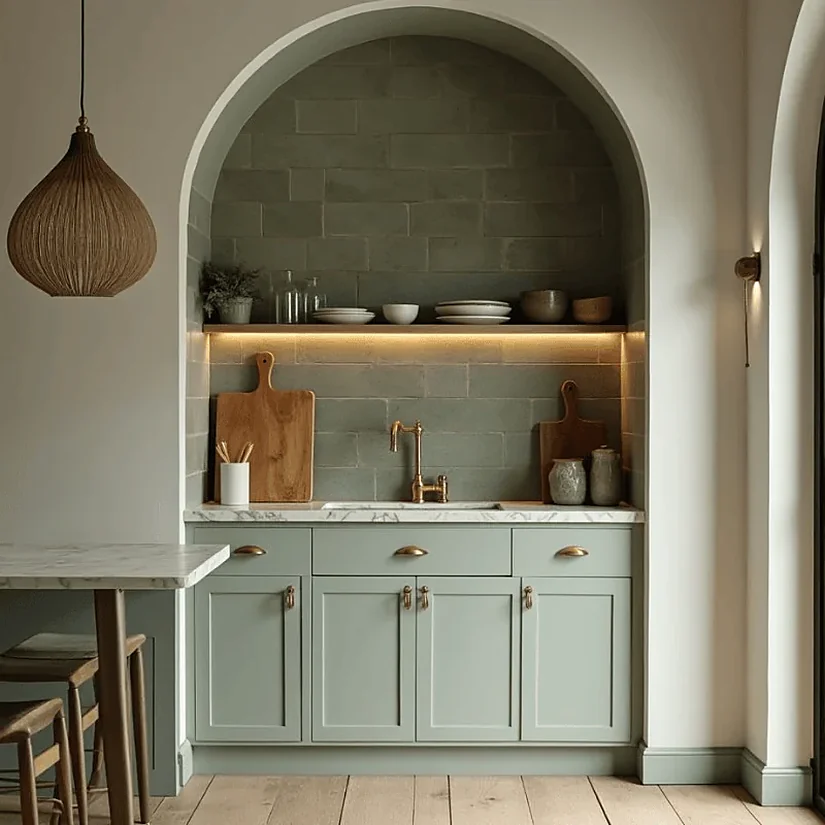
Tall doors, drawer lines, and vertical edges can make even soft green kitchen cabinets feel rigid. Before adding another colour, change one shape.
An arched niche can hold a coffee setup, serving pieces, or display shelving. Give the curve a real job first, then size it around that use. An empty arch added only because arches are popular can become another detail you have to explain.
10. Route A Shallow Pattern Into The Island Instead Of Adding More Colour
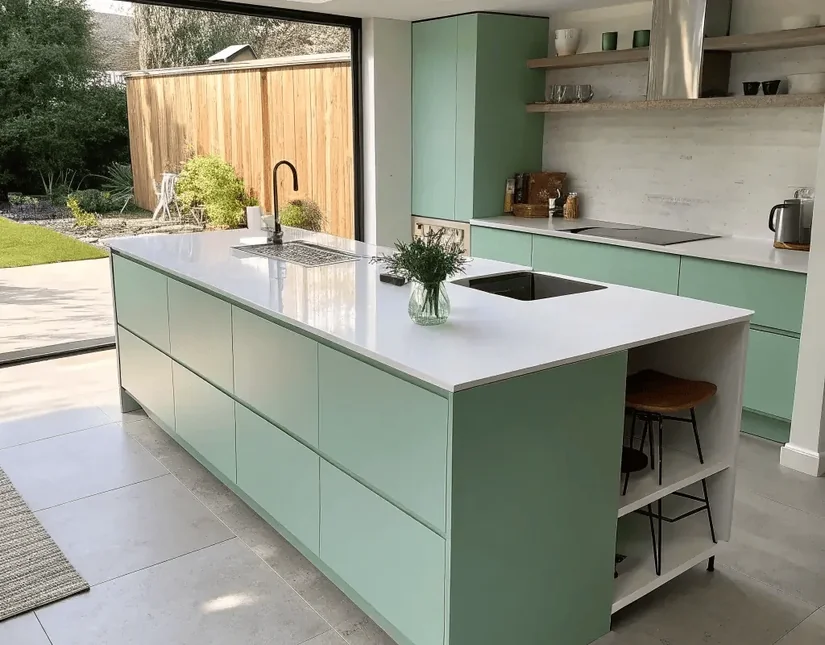
Your green island feels plain. Does that automatically mean it needs a second cabinet colour? Not really.
Try a shallow routed pattern or widely spaced linear detail on the outward-facing panel while keeping the working doors simple. The visible side gains texture, but the storage side stays quiet. Put the panel detail beside the stone. If both are active, simplify one before repeating the pattern.
11. Wrap The Green Island Ends Into The Same Kitchen Cabinet Design
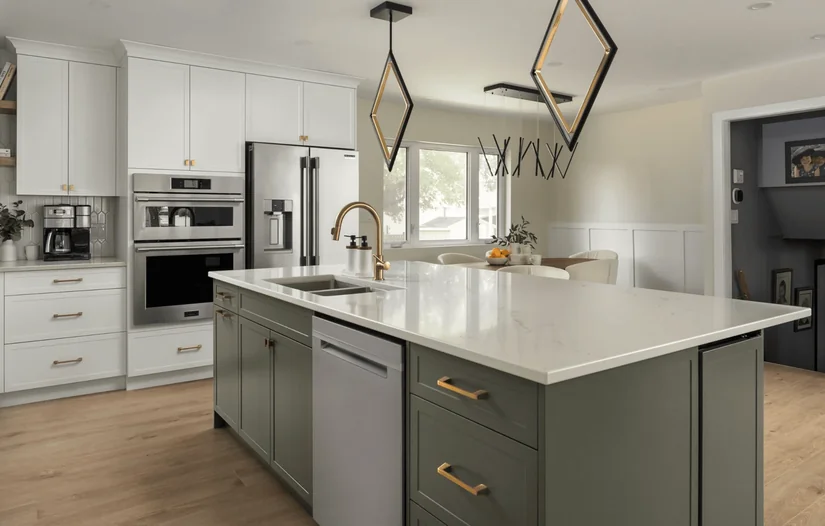
The working side of an island gets plenty of attention because that is where the doors and drawers are. From the dining area, the plain end panels may be what you see every day.
If this were my own kitchen, I would photograph the island from the adjoining room first. Continue a panel profile, recessed line, or cabinet pattern around the ends when it helps. Judge the island from the room, not only from where you cook.
12. Give A Green Island Furniture-Style Legs Instead Of Another Cabinet Base
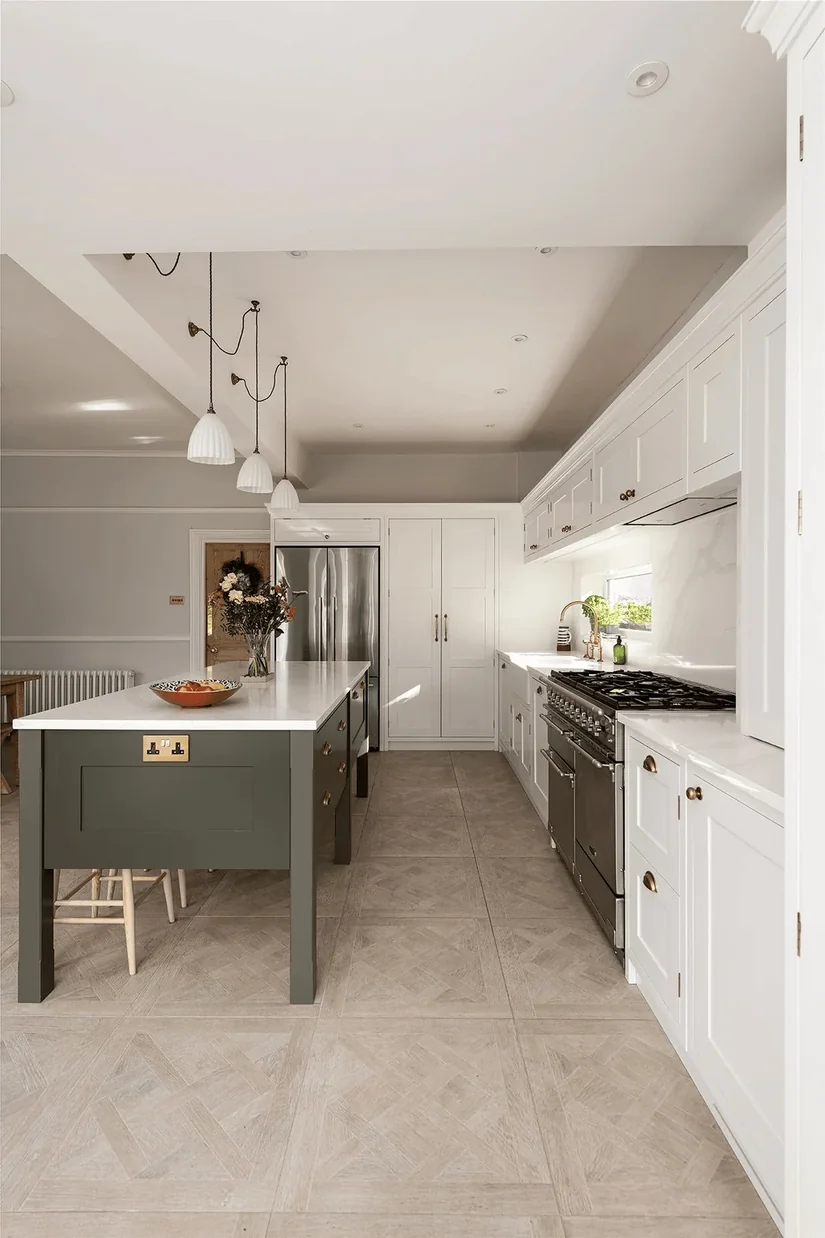
If the perimeter cabinets and island are both solid green rectangles, another colour is not your only way out.
Visible legs, a framed overhang, or a table-like end can change the island while keeping the same green. Put a boxed base beside a more open furniture-style end and judge the seating and movement around each. Keep the version that solves the room better, not the one with more detail.
13. Step Upper Cabinets Back Before They Crowd A Window
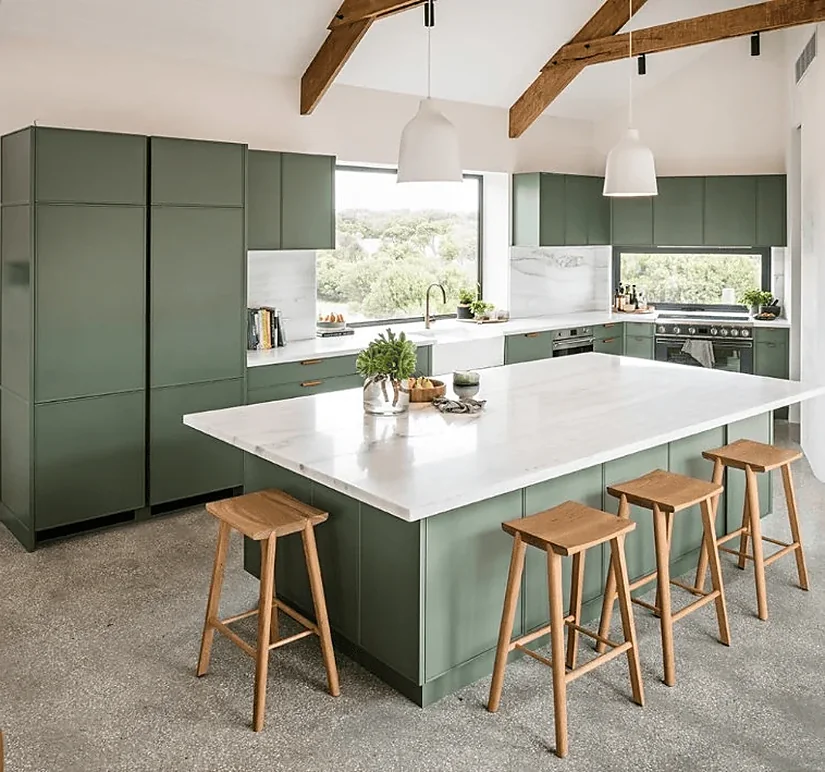
Light green kitchen cabinets can still crowd a window. The shade is pale, but a full-depth wall unit finishing hard against the opening may make the window feel squeezed.
Where the design allows, step the nearest unit back, reduce its depth, or use a narrower side profile. Draw the window and cabinet together. Before searching for a lighter green, check how much cabinetry is pressing into the opening.
These modern kitchen design ideas show the same restraint in finished kitchens.
14. Make The Extractor Hood Follow The Green Kitchen Cabinet Grid
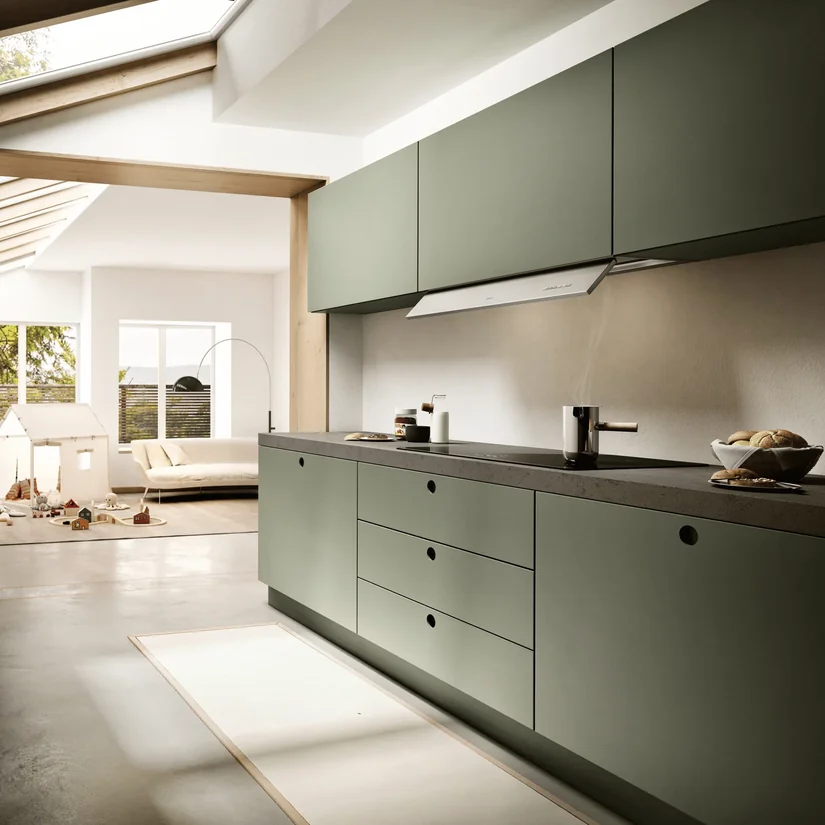
Sometimes the hood looks as though it arrived after the cabinet wall was finished. You see the green doors, then one extractor shape cutting through them with no clear relationship.
Trace the hood width, side cabinets, upper line, and cooking centre together. The hood does not need to be green. Its size and position need to make sense with the green kitchen cabinets around it. View the upper wall before choosing the surround.
15. Use One Narrow Open Bay To Separate Two Blocks Of Green Cabinets
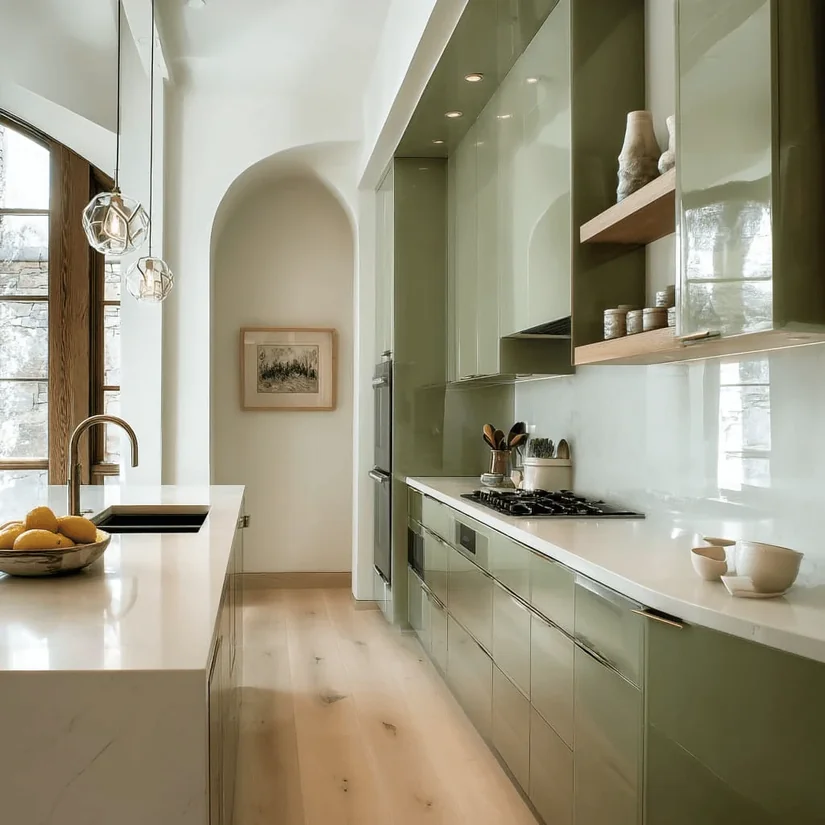
When tall cabinetry meets wall units at a corner, two green cabinet blocks can merge into one dense junction. A narrow open bay can create a pause without removing a full run of storage.
Use it for cups, serving pieces, or something you reach for. Nothing to put there? Keep the cabinets closed and work on the proportions instead. An empty “design moment” is not better simply because it interrupts the green.
16. Give Pista Green Cabinets A More Disciplined Door Grid
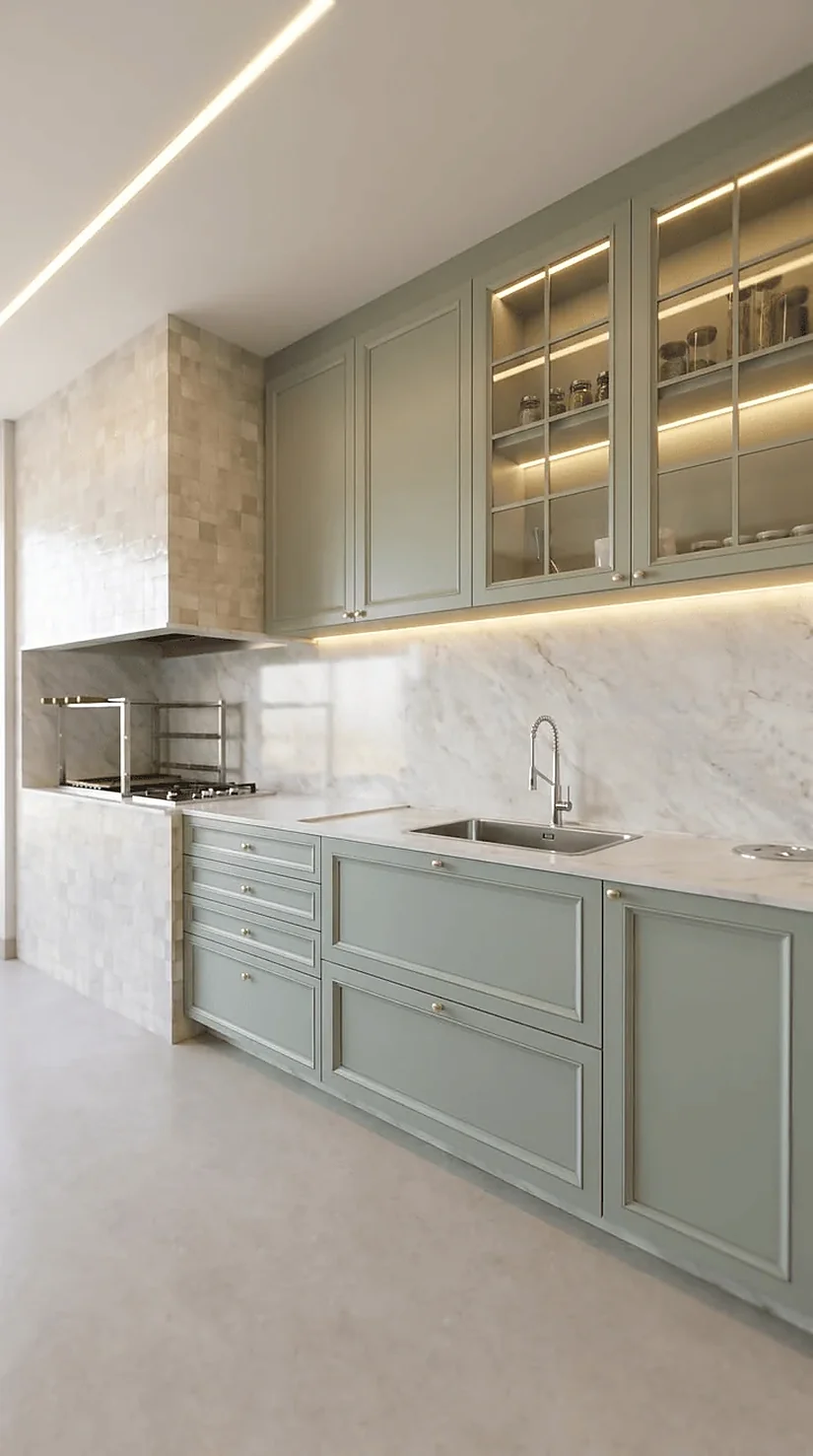
Pista green kitchen cabinets can feel playful, and that may be exactly what you want. But if the kitchen feels more irregular than fresh, look at the door grid.
Repeated upper-door widths, aligned drawer banks, or clear vertical joints can give the pale colour more structure. Mark the repeated dimensions. You do not need perfect maths, only enough order that every door does not seem to follow its own rule.
17. Insert Timber Inside One Green Cabinet Bank Instead Of Splitting The Kitchen In Half
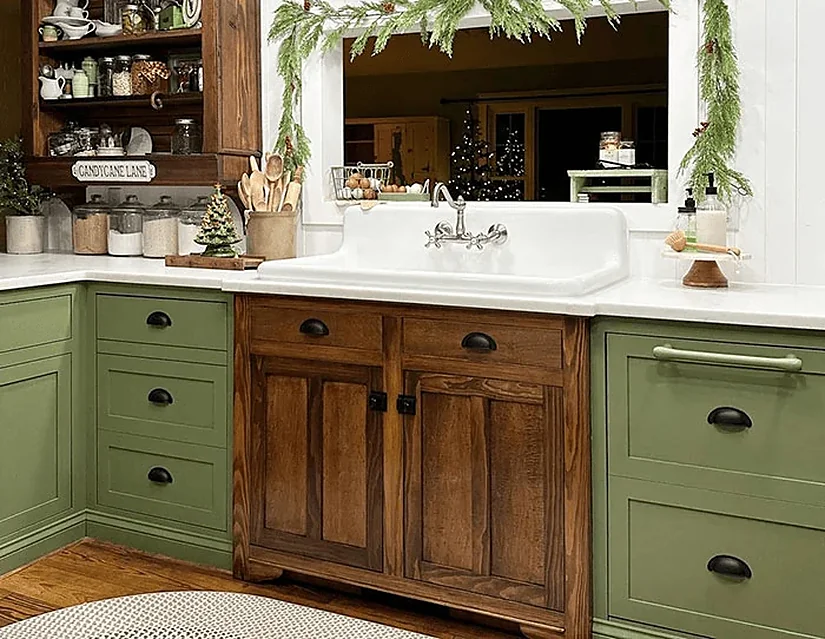
Green on one wall and timber on the other is easy, but it is not your only option. Put one timber drawer bank, appliance column, or open section inside a larger light olive green kitchen cabinet composition.
Sketch the cabinet blocks rather than relying on a flat mood board. Keep the timber as one zone. Alternating green and wood door by door can make the wall busier than the samples suggested.
18. Put The Deeper Green Inside A Recessed Kitchen Cabinet Opening
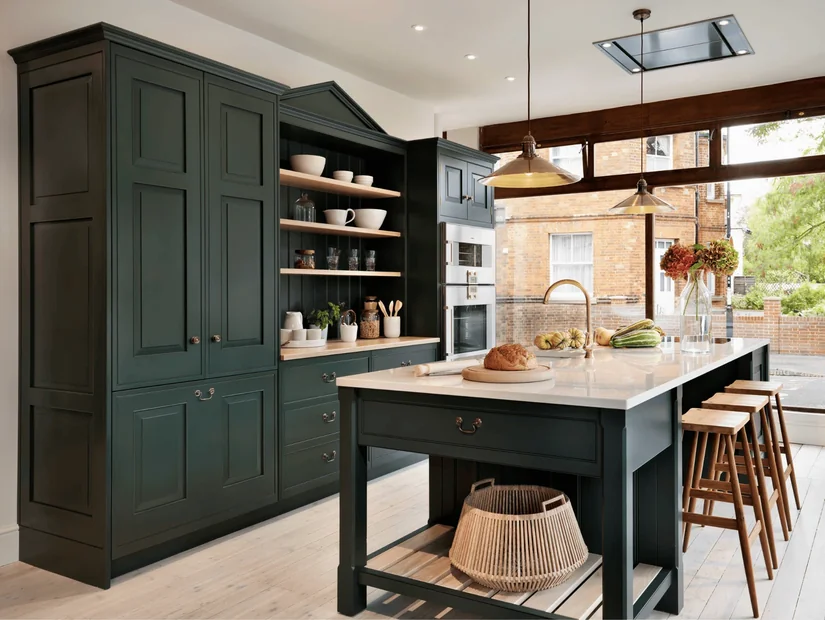
Still stuck between sage green kitchen cabinets and dark green kitchen cabinets? You do not have to turn that indecision into two rows of differently coloured doors.
Keep the main fronts sage or light olive, then use the darker shade inside a recessed pantry, serving niche, or open cabinet. The contrast sits further back. Try it there first. If that gives enough depth, the main cabinetry can stay quieter.
19. Use Mesh-Front Doors To Break A Run Of Solid Green Cabinets
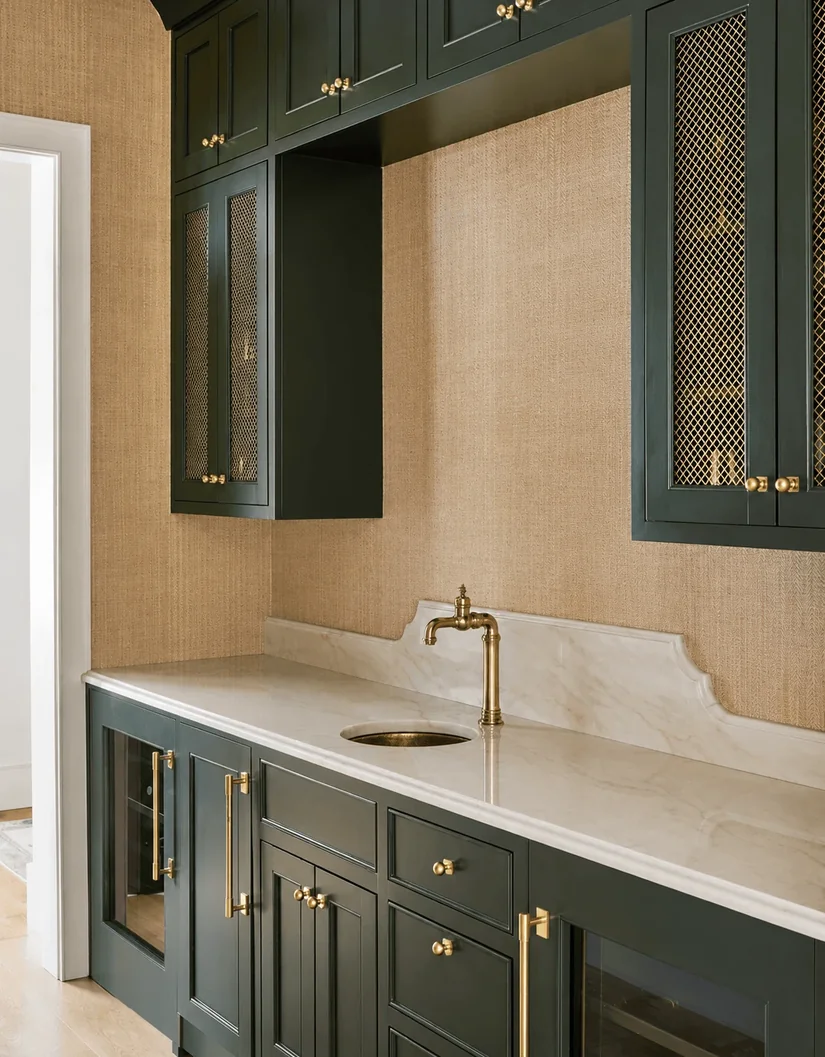
A long run of solid green kitchen cabinets can feel repetitive even with good door proportions. Fine metal mesh or a perforated front can change one dry-storage or display section without adding another green.
Look behind the door first. What will you see through it? Plates, glassware, or pantry clutter change the effect. Keep the mesh to one cabinet group and let the contents be part of the decision.
20. Do The Cabinet Lines Fall Apart At The Corner? Follow Them Around
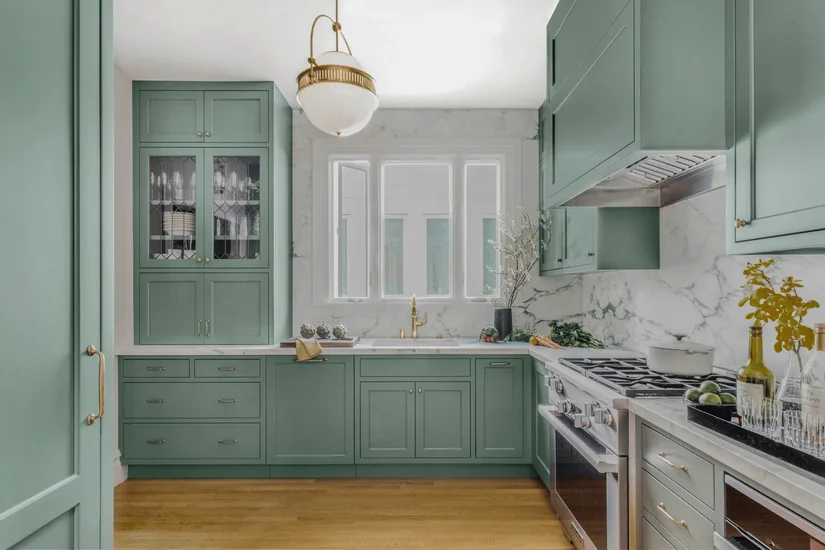
One green cabinet wall looks organised. Then it turns the corner and seems to start a completely different kitchen. Trace the drawer heights, door widths, handle lines, and corner junction across both walls together.
This is especially useful when comparing modular kitchen layouts. Do not read the walls separately. Follow the horizontal and vertical lines around the corner and mark the point where the pattern suddenly resets.
21. Take Sage Upper Cabinets Closer To The Ceiling When They Feel Like Separate Boxes
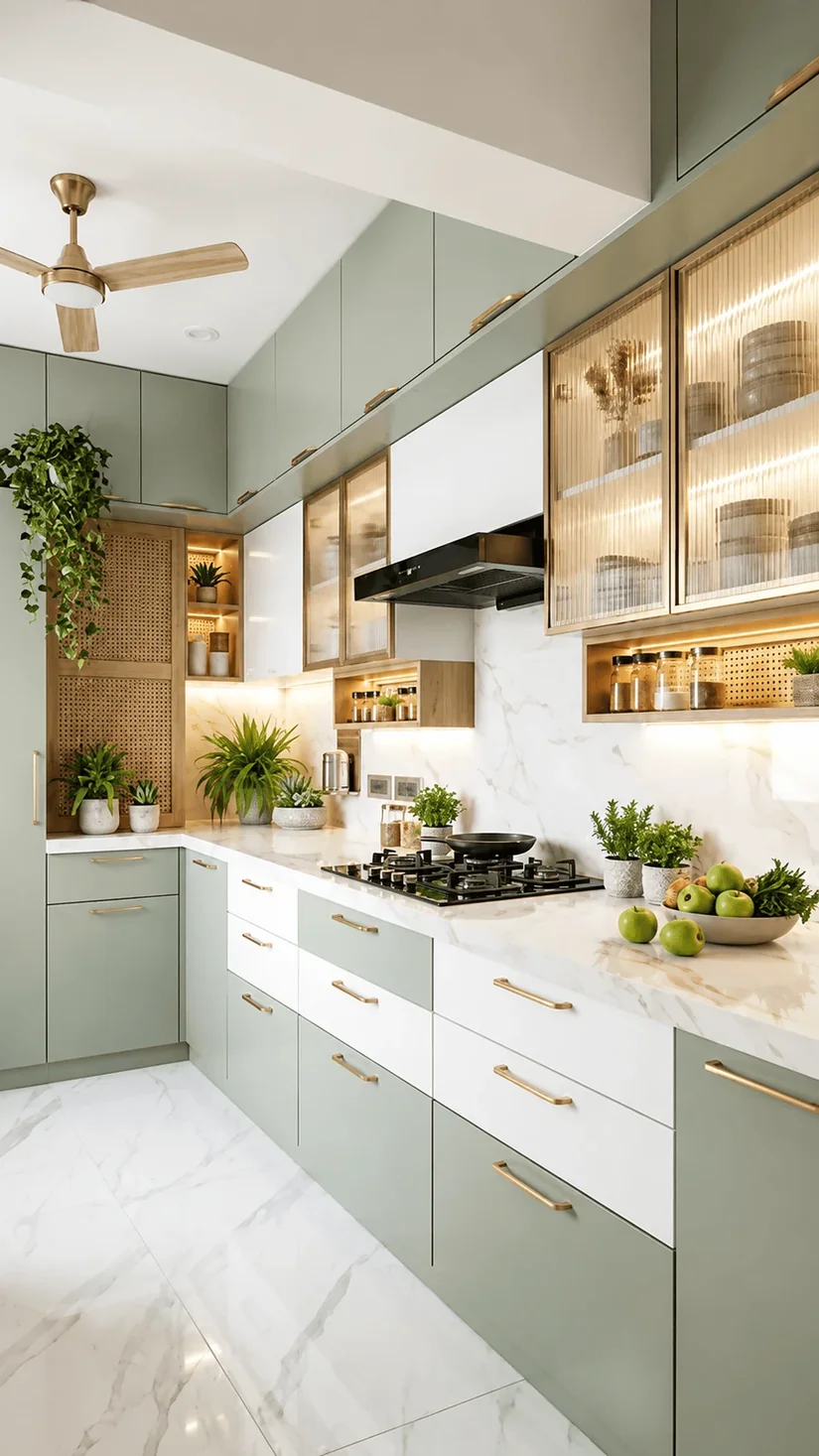
Do your sage green kitchen cabinets look like separate boxes with a leftover strip of wall above them? The green may be fine. The top of the wall may simply feel unresolved.
Where ceiling height, access, and the design allow, taller units or a planned top treatment can make the cabinetry feel built-in. Draw the upper wall first. Do not go ceiling-high by default, but do not leave the strip above by accident either.
22. Move The Microwave Into A Tall Green Unit When It Breaks The Upper Cabinet Line
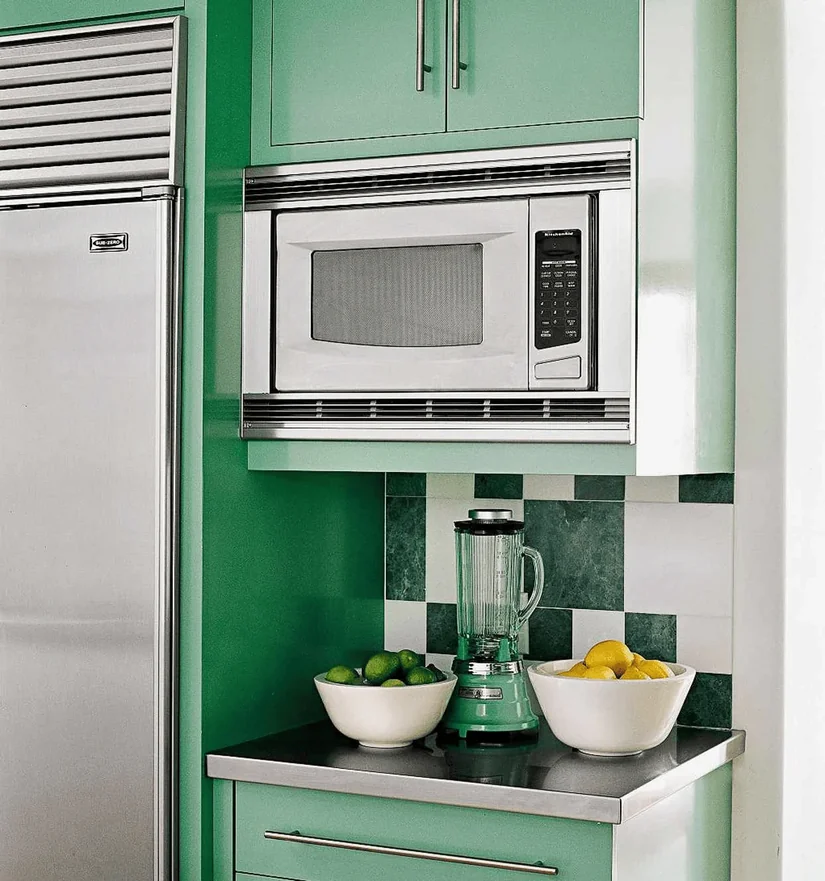
A visible microwave can interrupt an otherwise clean row of modern green kitchen cabinets. Where the appliance requirements and layout permit, integrating it into a tall appliance unit can protect the cabinet line above the worktop.
Mark every visible appliance face before finalising the doors. If you are still shaping the broader direction, these modern kitchen design ideas can help you see how cabinetry, appliances, and cleaner forms sit together.
23. Do The Green Cabinets Look Stranded On Either Side Of The Window?
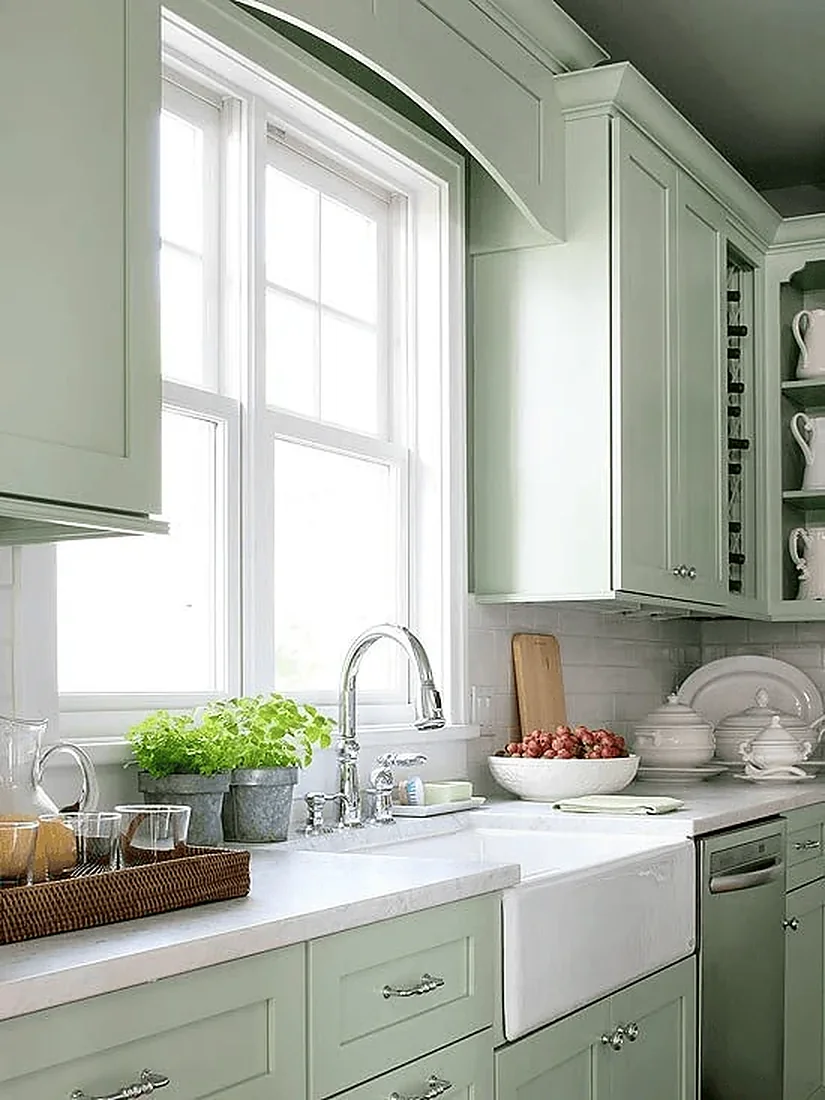
Tall green kitchen cabinets on both sides of a window can look disconnected. A shallow bridging cabinet or carefully designed upper joinery may connect the wall, but please do not fill the gap only because it is empty.
View the wall with and without the bridge. Does the window still feel open? Does the storage help? If the opening feels compressed, leave the cabinet banks separate. Not every gap needs fixing.
24. Let Painted Green Cabinets Keep Their Original Door Character
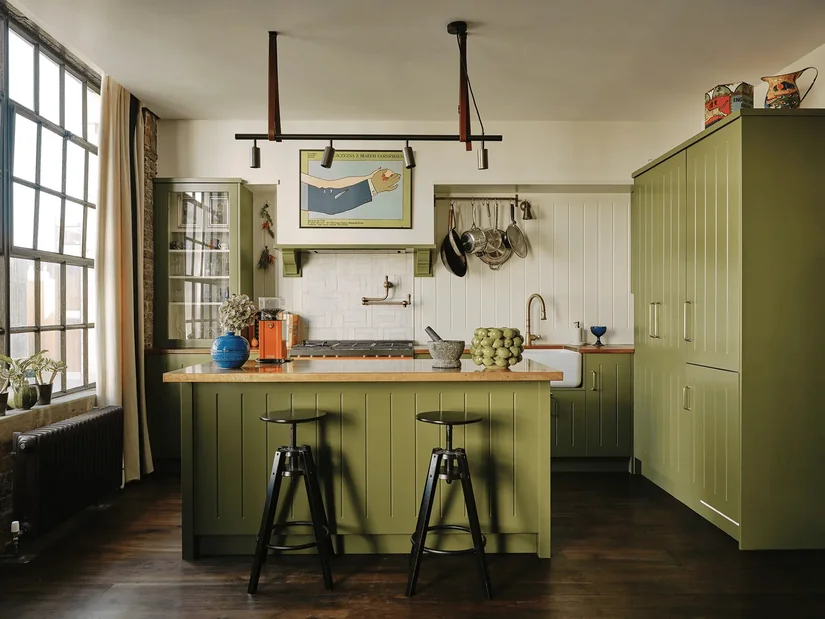
Before repainting, ask a slightly annoying question: do you dislike the cabinet door, or only its colour?
In one Reddit discussion about painting cabinets versus replacing doors, homeowners were already wrestling with that practical choice.
Oklahoma State University’s Salim Hiziroglu explains that MDF and particleboard have different surface characteristics in cabinet manufacturing. If the profile still suits your kitchen, identify the material and finish before assuming every door needs replacing.
25. Repeat A Cabinet Detail Before You Repeat The Green In The Next Room
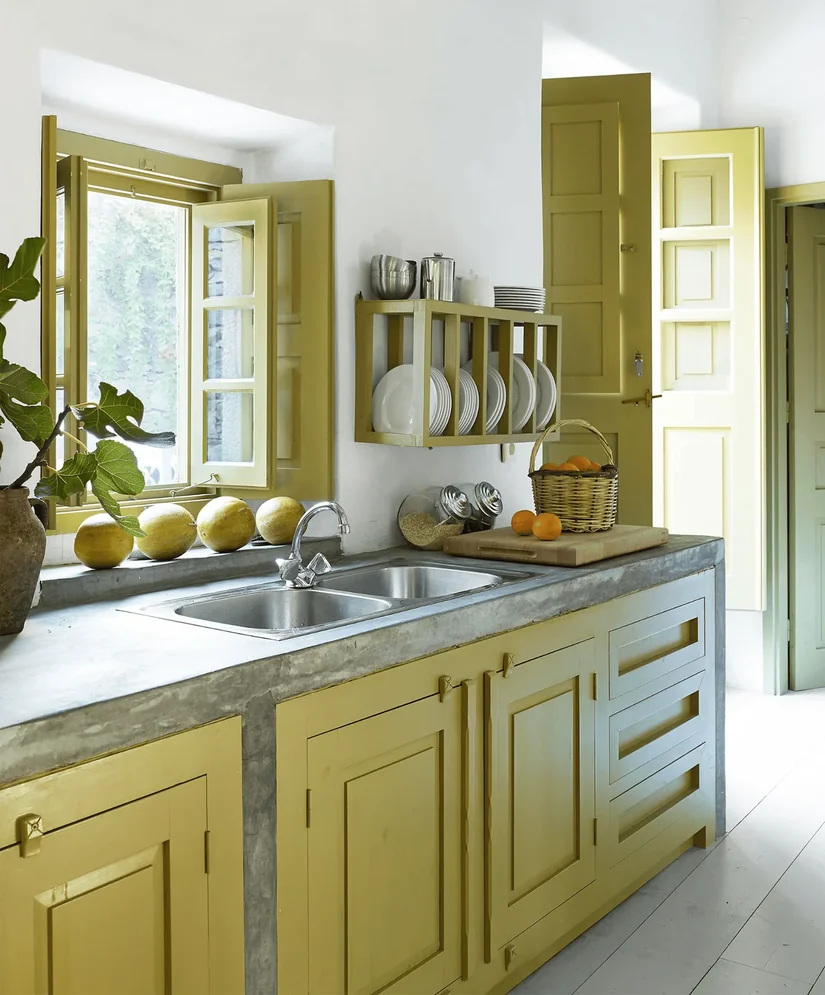
You finish the green kitchen cabinets, look into the dining area, and suddenly every cushion and ceramic seems to need a green version. Pause before the shopping basket fills up.
Repeat part of the cabinet language instead. The same mesh detail might appear on a bar cabinet, a timber insert in dining joinery, or a routed line on another built-in. That creates continuity without turning the open plan into a matching green theme.
Still Comparing Sage, Olive, And Pista? Look At The Cabinet Shape Next
Sage is soft, olive is earthy, and emerald is bold. You have probably read that enough. Those labels may narrow green kitchen cabinet colors, but not the finished cabinet wall.
Once two greens remain, stop adding paint names and study the cabinetry. Green kitchen color schemes often make more sense once cabinet shape, divisions, and appliances enter the decision.
| Green Cabinet Direction | Cabinet Detail To Compare | Check This Closely |
|---|---|---|
| Sage green | Shaker, inset, or slab doors | How many shadow lines cross the green |
| Light olive green | Tall units and material inserts | How the cabinet wall is divided |
| Pista green | Repeated door and drawer sizes | An irregular cabinet grid |
| Dark green | Broad fronts and corner joints | Too many visible cabinet divisions |
| Blue-green | Flat fronts and appliance placement | Broken upper cabinet lines |
| Emerald green | Simpler cabinet geometry | Colour and cabinet detail competing |
| Modern green | Slab fronts and aligned drawer banks | Inconsistent horizontal lines |
Pick the row closest to your shortlist and focus on the middle column. A door profile or cabinet grid may answer the question faster than five similar swatches.
Before You Change The Green Again, Read The Kitchen Cabinet Elevation
A cabinet elevation is the straight-on cabinet drawing. It is less exciting than a finished render, I know, but it can make confusing green kitchen cabinets easier to read.
- Circle every vertical joint. Are narrow doors cutting one green wall into small strips?
- Follow the drawer lines. Do neighbouring drawer banks align or stop at unrelated heights?
- Box the tall units together. Do pantry and appliance cabinets read as one wall or separate towers?
- Mark where the upper cabinets stop. Note windows, the hood, and open sections.
- Look at both island ends. The dining room may see them more than you do while cooking.
- Mark every visible appliance face. What does each one do to the cabinet grid?
- Check both sides of every corner. An organised first wall can become a confused second wall in an L-shaped kitchen.
If one area keeps bothering you, circle that cabinet group before reopening the colour chart. You may have found a proportion or alignment problem, not another reason to reject the green.
The worktop decides a lot of this too, which our guide to kitchen countertop materials covers.
Look Past The Green Before You Change It Again
You may already have the right sage, olive, pista, or forest green. The problem could be narrow fronts, awkward upper cabinets, a one-sided island, or a pantry wall split into separate towers.
Green kitchen cabinets are not a flat colour decision. The green sits across doors, drawers, frames, island ends, and whole cabinet walls. Change that composition, and the same colour can read differently.
Before rejecting another sample, name the line, proportion, opening, or junction that feels wrong. When cabinet form, storage, and layout need to work together, Euphoria’s kitchen interior design services can bring those decisions into one plan.
For the full range of door styles, see our kitchen cabinet designs.
If the kitchen already feels busy, read how to add colour without clutter.