
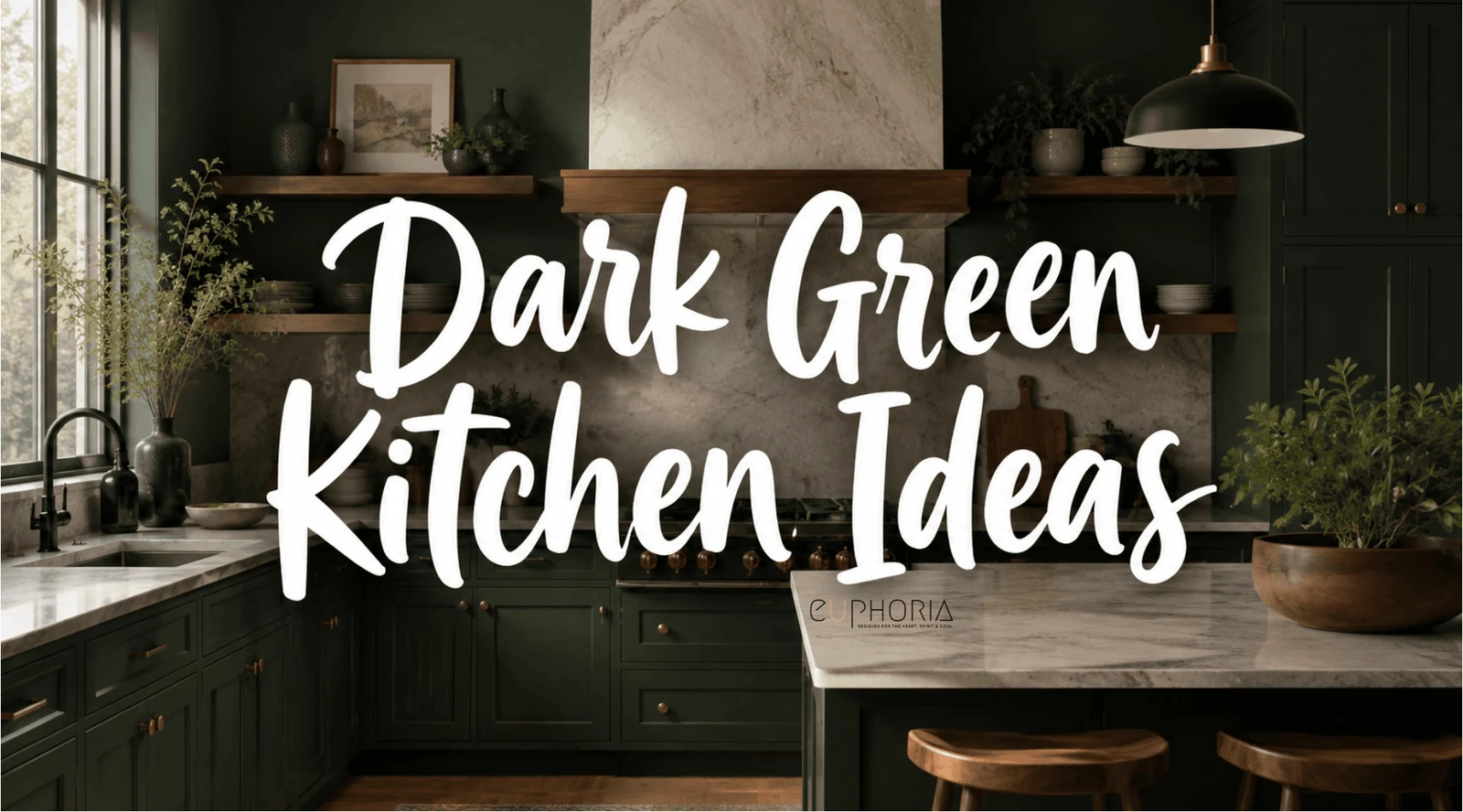
I kept saving pictures of dark green kitchens, but I could also understand the hesitation. A colour this deep can make one kitchen feel rich and considered while leaving another looking closed in, especially when it spreads across the cabinets, walls and worktops. So what separates the two?
One kitchen used almost-black cabinetry around a pale stone cooking area. Another concentrated forest green at the end of a narrow galley. Then I found an emerald kitchen without the usual brass finishes, and that stayed with me too. After comparing more examples and asking our designers what they notice first, I realised they start with the room, not the paint card. They look at the natural light, the layout, the worktop and flooring, and where the darkest colour will stop before narrowing down the exact green.
Keep reading to see where dark green works best in a kitchen, how it changes beside wood, stone, and black worktops, and what keeps the room from becoming one heavy block of colour. By the end, you will have a much clearer direction to explore this style.
26 Dark Green Kitchen Ideas I Kept Coming Back To
Some stayed with me for the colour, but most stayed because of what the kitchen did around it.
For the full picture, start with our kitchen design ideas, and compare shades in our guide to green kitchen ideas.
1. Frame White Appliances With Dark Green Cabinets Instead Of Hiding Them
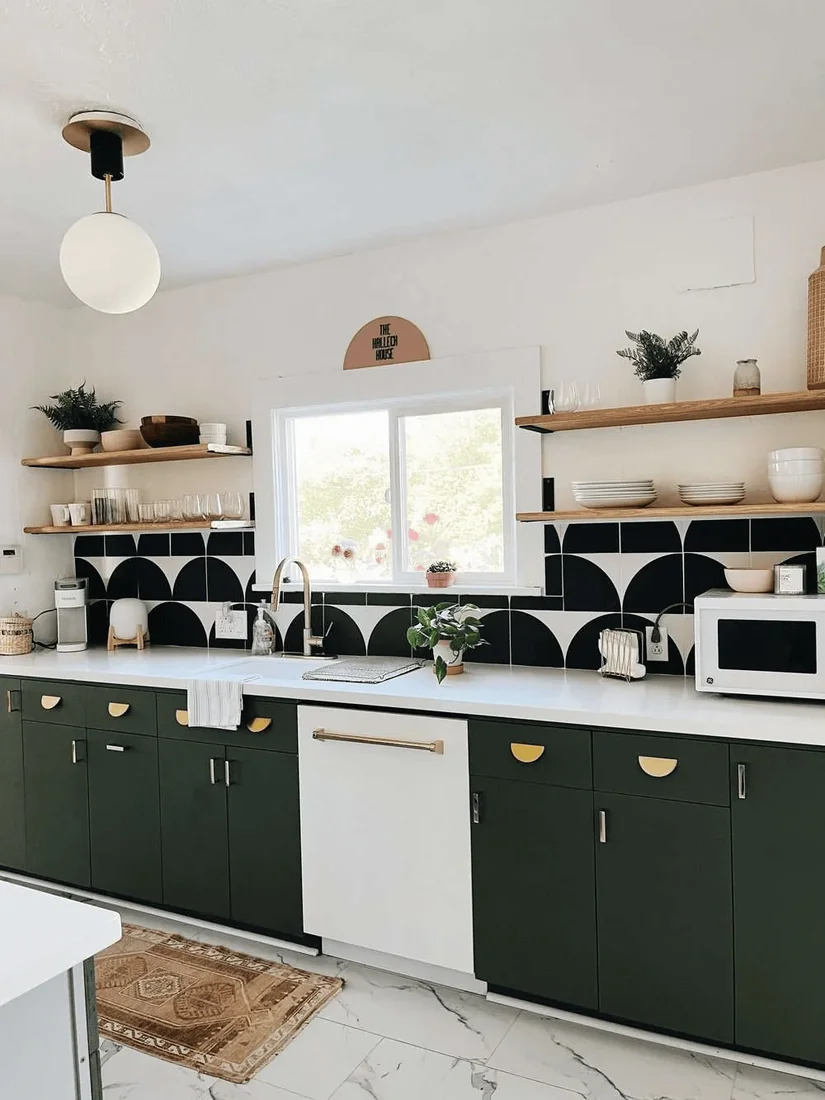
White appliances can make you hesitate once dark green kitchen cabinets enter the plan. I would not rush to panel them. Let the deep cabinetry frame a white range or refrigerator, then repeat that lighter note through the worktop or backsplash.
Repeat the appliance’s white in the worktop or backsplash so it does not sit alone. Research on visual perception calls this grouping by similarity. Elements that share a visible feature, such as colour, are more likely to be read as belonging together. It does not prove that every white appliance will work with dark green, but it explains why repeating white once can make the appliance feel planned rather than accidental.
2. Put The Dark Green In A Scullery Behind A Pale Main Kitchen
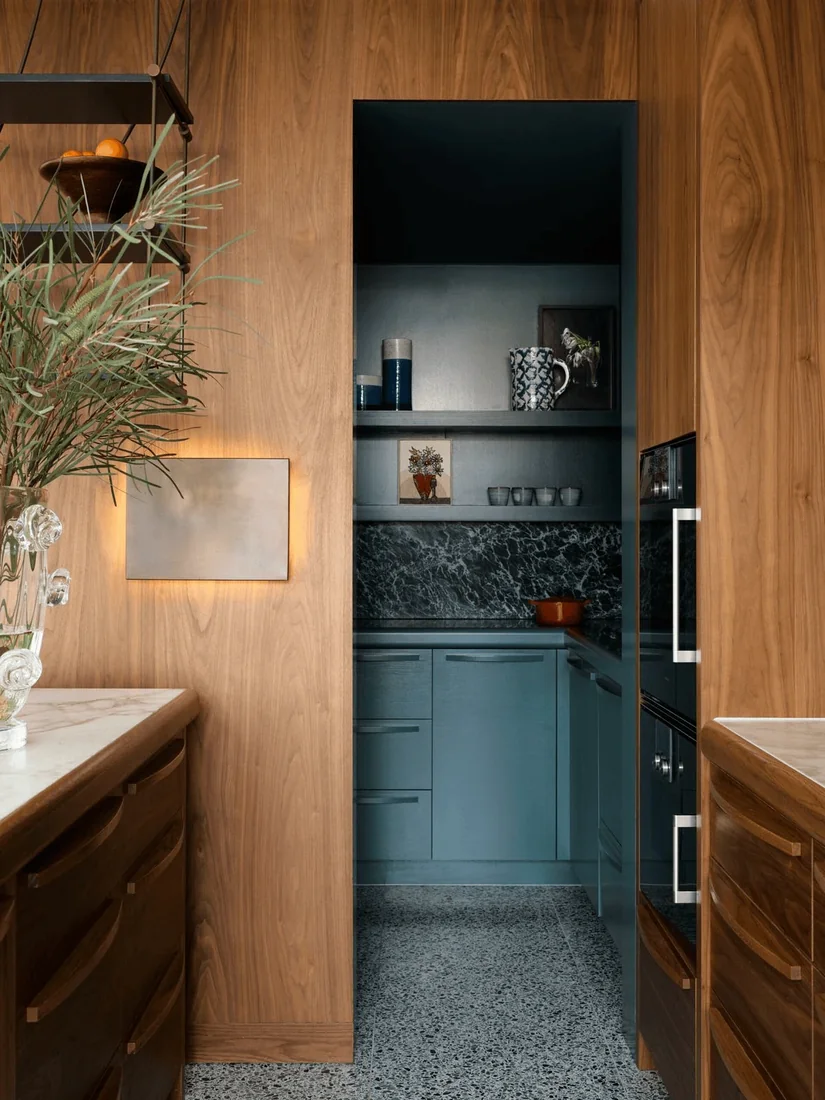
I kept noticing dark green used brilliantly in the scullery room behind the kitchen. Keep the main kitchen pale oak, cream, or soft stone, then let a scullery or back kitchen carry the deeper forest green cabinetry.
One thing I have picked up from listening to designers discuss these spaces is that the layout comes first. Work out what belongs in the scullery before deciding how much dark green the second room can carry. Our kitchen design guide explores wider planning in more detail.
3. Face A Dark Green Peninsula Towards The Living Area
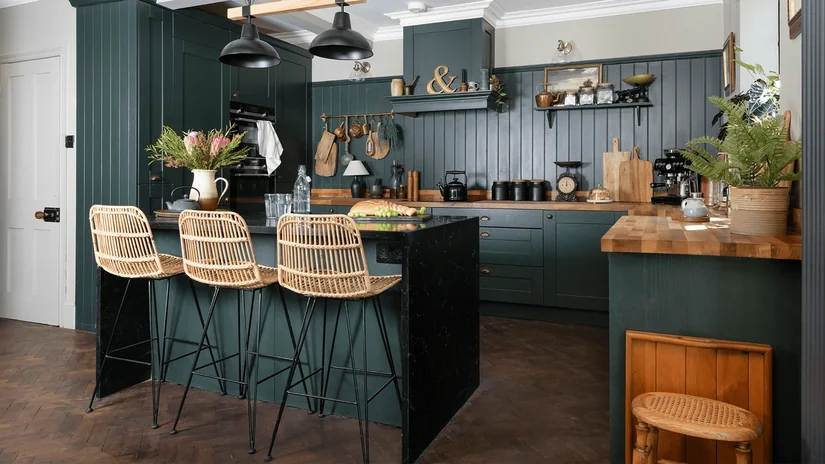
In the kitchen above, dark green is concentrated on the side of the peninsula that faces the living and dining area. From that part of the room, the colour reads as one clear block instead of being repeated through cushions, artwork and accessories.
There is research behind paying attention to placement. In a 2020 eye-tracking study, Ji Young Cho and Joori Suh found that applying the same colour combinations to different surfaces changed participants’ emotional responses and viewing behaviour. The research used simulated retail interiors rather than kitchens, so it does not prove this exact peninsula arrangement. It does support the wider point that where a colour appears can matter as much as the colour itself.
4. Turn The End Of A Galley Kitchen Into A Forest Green Focal Wall
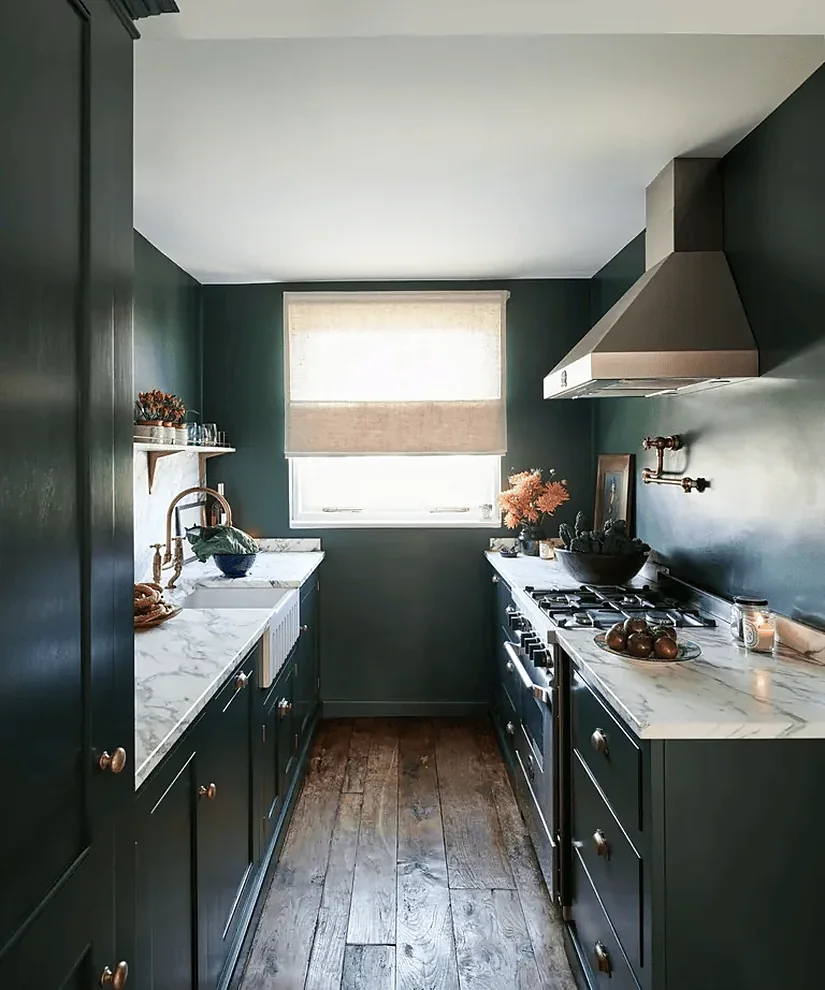
Using dark green on both long sides of a narrow galley can make the side boundaries feel closer. In a 2018 perception study, Christoph von Castell, Heiko Hecht and Daniel Oberfeld found that brighter bounding surfaces were perceived as farther away than darker ones.
The experiment used simulated rooms rather than kitchens, but it gives this layout advice a clearer basis. Keep the long cabinet runs lighter, then concentrate forest green on the short end wall, pantry or final cabinet bank. You still get the depth of the colour without darkening both sides of the passage.
5. Colour-Drench The Cabinets And Walls But Leave The Ceiling Pale
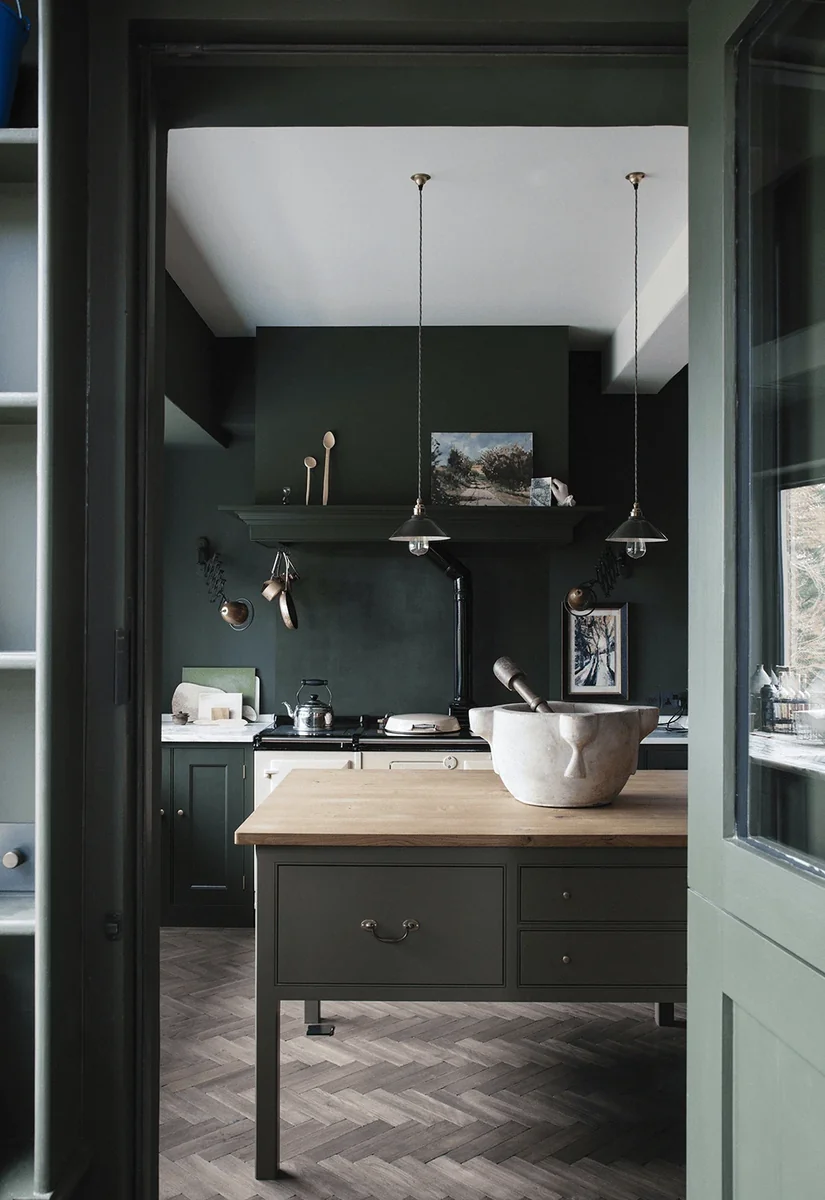
I used to assume that carrying dark green across the cabinets, walls and trim would make a kitchen overwhelmingly dark. Looking across colour-drenched examples changed my mind because the green never actually covered every surface. It stopped at a pale ceiling and lighter stone worktop. Those breaks keep the room from becoming one continuous dark envelope, so check where the green ends before deciding that the shade itself is the problem.
6. Add A Freestanding Dark Green Dresser To A Pale Kitchen
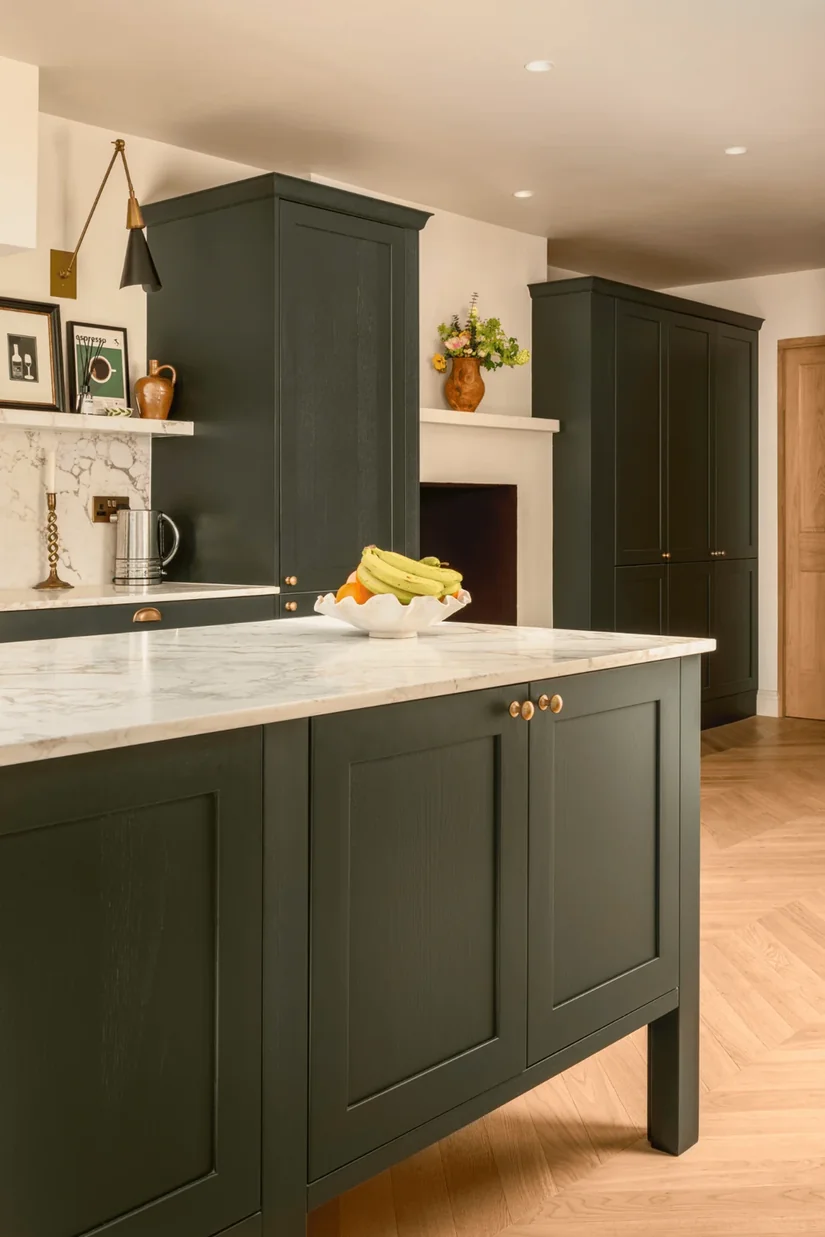
Built-in cabinetry can make dark green feel very permanent. A freestanding dresser or pantry cabinet gives the colour enough scale to matter while still reading as furniture.
I like this in a pale kitchen with natural timber because the green becomes one collected piece rather than part of the fitted run. Keep the nearby cabinetry quiet. Once the dresser is dark green, it does not need matching shelves, stools, and handles to explain itself.
7. Frame A Bright Stone Niche With Almost-Black Green Cabinets
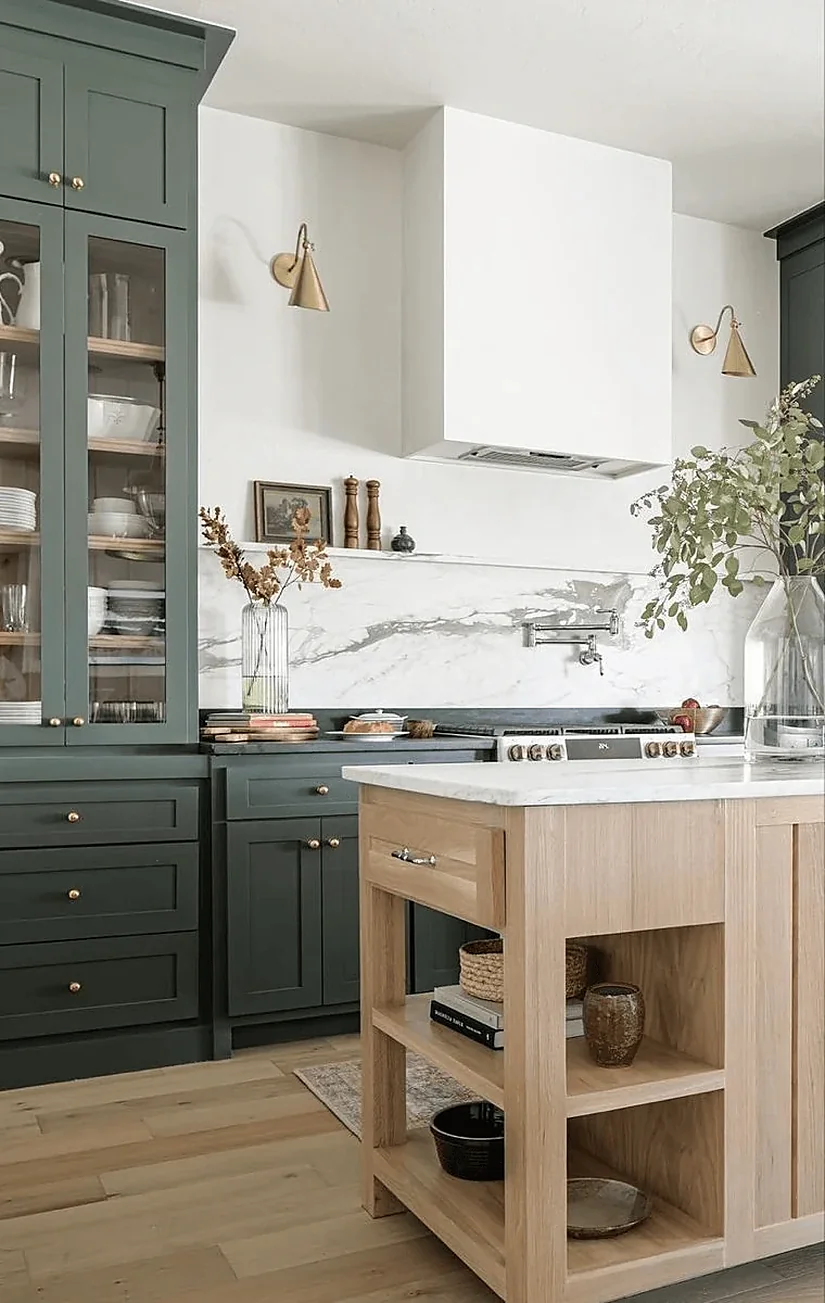
Almost-black green can make a full wall of tall cabinetry feel solid. Cut a bright working niche into the middle and line it with cream stone or pale quartzite, then add integrated lighting inside.
The dark green stays deep, but the niche gives your eye a bright place to land and physically breaks up the cabinet wall. This is one of the dark green kitchen ideas I would save for a long run of tall storage.
8. Pair Forest Green With Oak And Creamy Quartzite
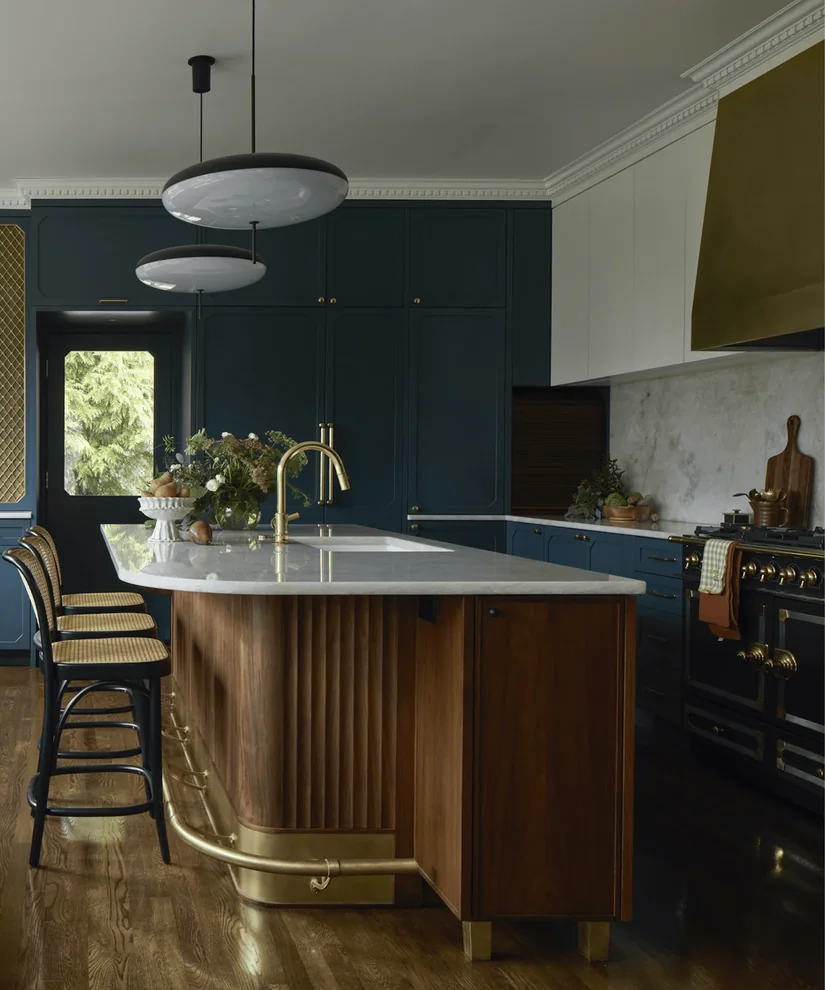
Oak changes forest green more than I expected. Beside walnut, the green feels deeper and warmer. Beside oak, the timber starts creating visual relief before the stone even enters the room.
Add creamy quartzite, and you get three clear depths without bringing bright white into the kitchen. I would approve this dark green kitchen with wood as one material set. Chosen separately, the relationship is much harder to read.
9. Take The Gold Out Of An Emerald Green Kitchen
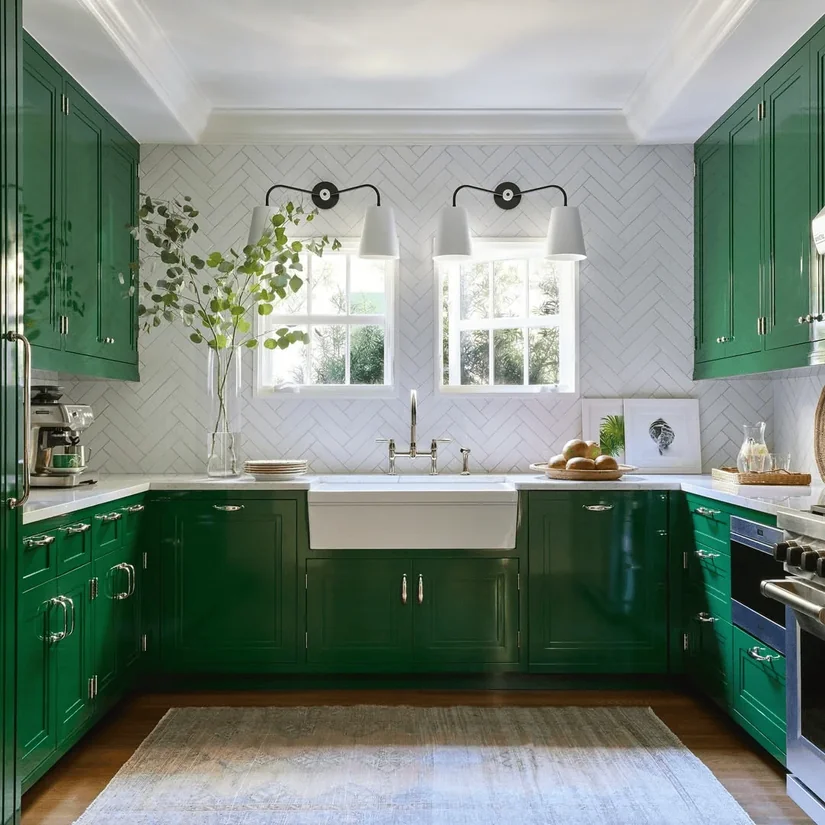
Before writing this section, I compared emerald kitchens finished with brass, black and silver-toned hardware rather than assuming nickel was automatically the better option. In the Brantley Photography example above, the emerald cabinetry is the only strongly saturated surface. The pale stone, white tile and silver-toned handles remain quieter, so the green stays visually dominant.
The Cho and Suh study in idea 3 also found that colour contrast and spatial application changed how participants responded to an interior. That is why the door sample, worktop, backsplash and metal should be reviewed together. If several finishes demand attention at the same time, simplify the door profile or tile pattern instead of adding another decorative element.
10. Keep Dark Olive, Walnut, and Limestone Low-Sheen
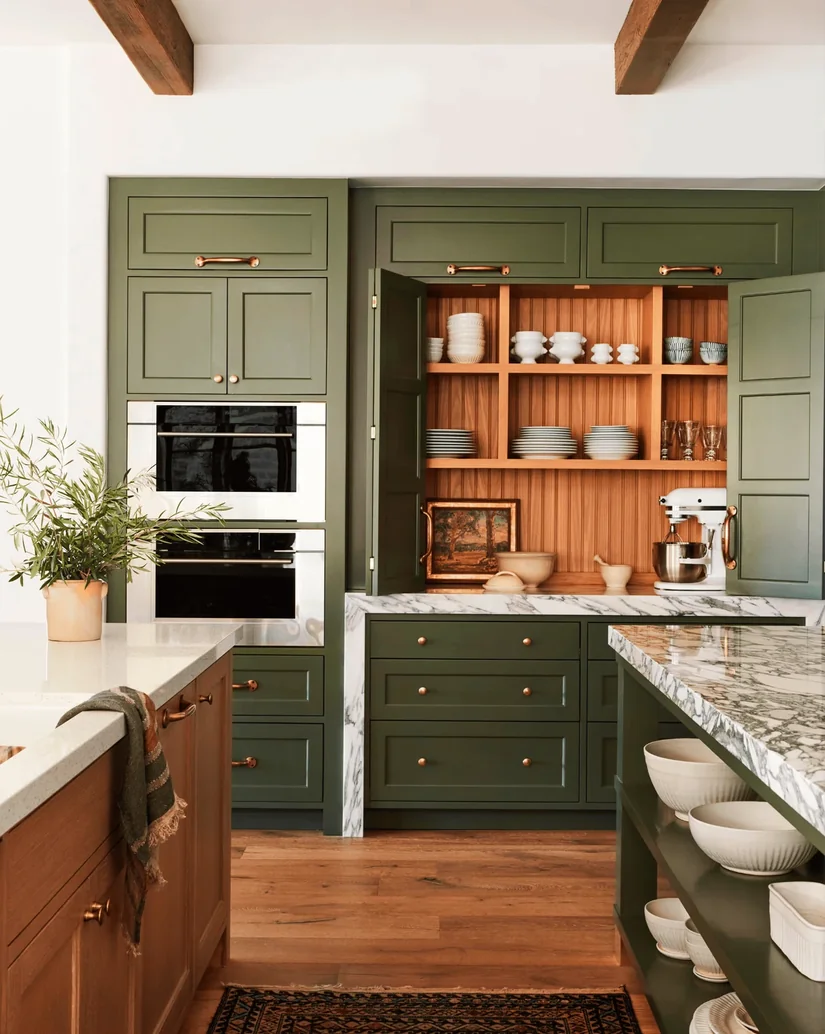
Dark olive beside walnut is already warm and deep. I would not make every surface reflective, either. Keep the cabinets matte or low-sheen, the walnut grain visible, and the limestone honed.
Lisa Wastiels and colleagues found in 2012 that perceived warmth of indoor wall materials correlated with colour and surface gloss. The study was not about kitchens, but it made me pay closer attention to sheen here. The same palette feels different once every surface starts reflecting light.
11. Make The Blue In Dark Green Look Deliberate
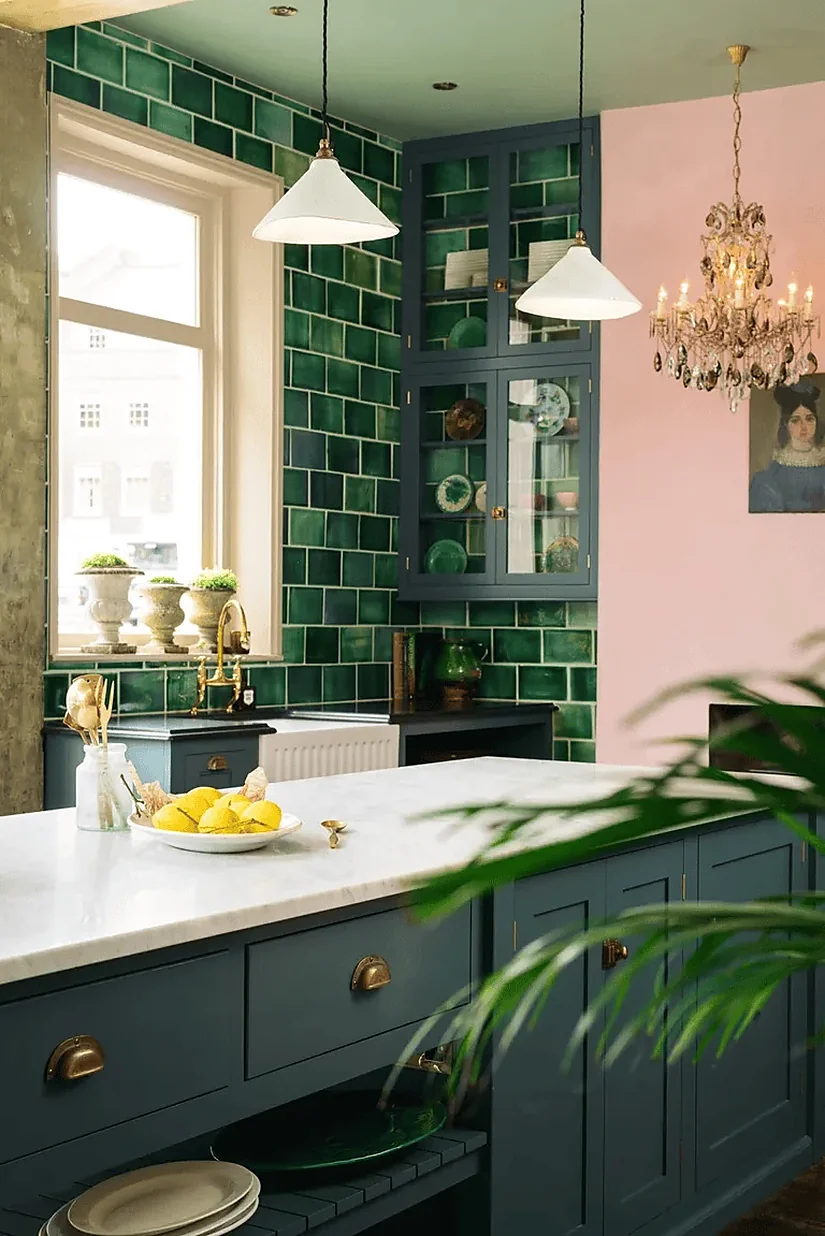
Some dark green kitchen colours lean blue once they cover a large cabinet run. Smoked timber and stainless steel can make that cooler direction feel intentional instead of accidental.
Smoked timber sits more comfortably between the blue-green cabinets and stainless steel, so the jump from colour to metal feels less abrupt. I would add one warm detail at most. Once the surrounding materials agree with the cooler green, you stop needing brass and beige to explain it away.
12. Give Dark Green Cabinets And Black Countertops A Pale Stone Backsplash
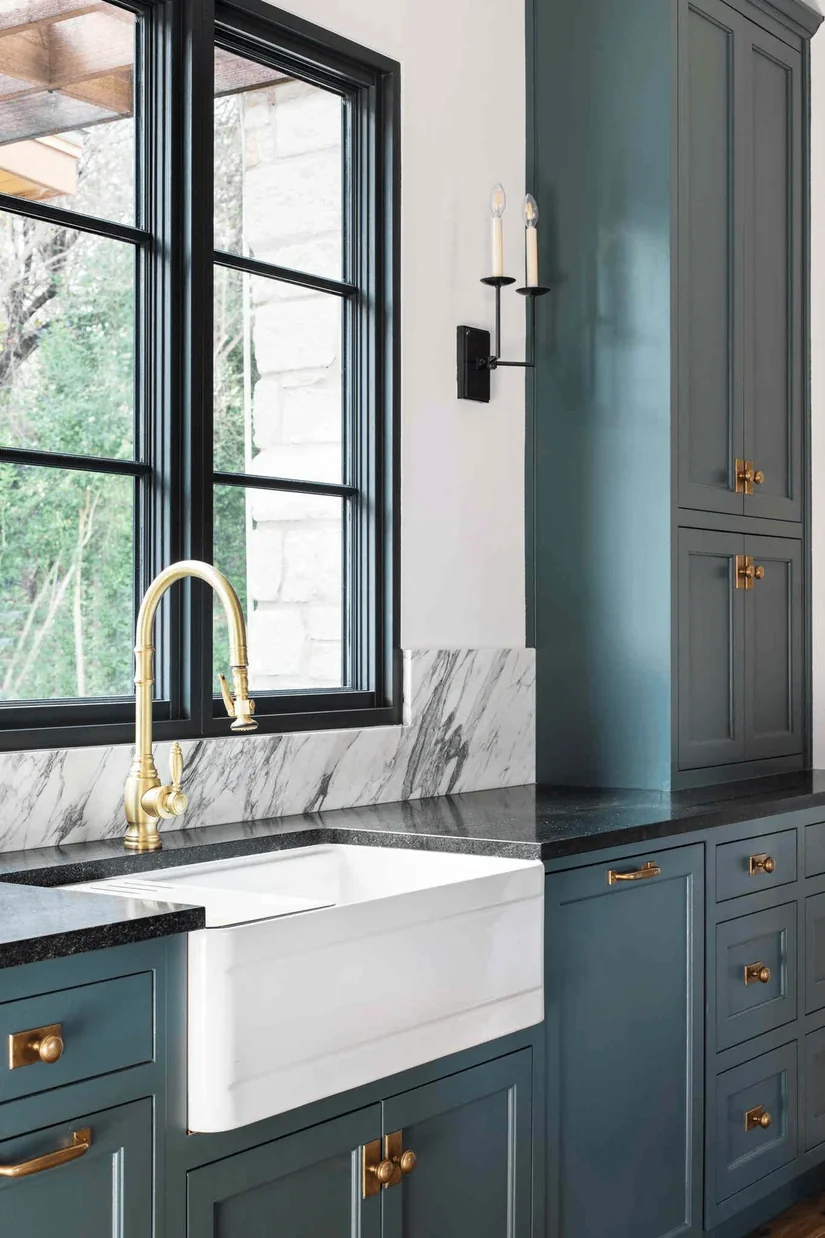
A black worktop changes the balance of a dark green kitchen. Pair dark green kitchen cabinets with black countertops, then give them a broad pale stone-look or warm off-white backsplash.
That lighter band separates the two dark surfaces before you start fixing the room with accessories. A black worktop is already doing a lot visually, which is why the wider choice of kitchen countertop materials matters before the cabinet colour is final.
13. Ground A Pale Kitchen With A Dark Green Checkerboard Floor
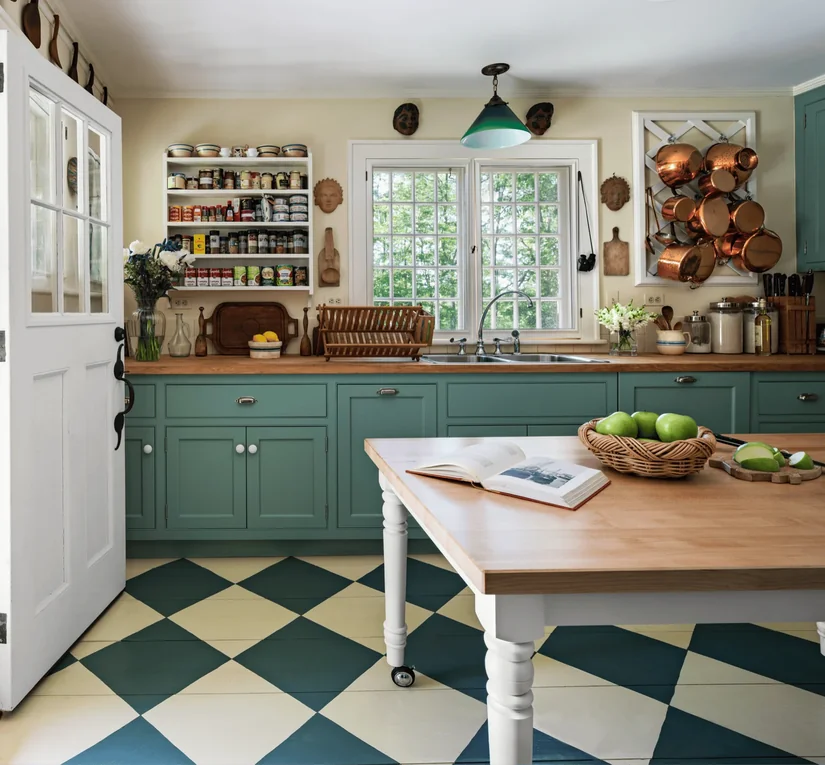
Dark green does not have to climb the cabinetry at all. A cream and deep green checkerboard floor can give a pale kitchen colour, rhythm, and a very clear point of view.
I would keep the cabinets quieter so the floor is not fighting Shaker detail, veined stone, and coloured walls at the same time. Check the tile scale carefully. Tiny checks can feel busy across a large kitchen, while oversized squares completely change the rhythm of the room.
14. Put Burgundy Stone Beside Dark Green Cabinets
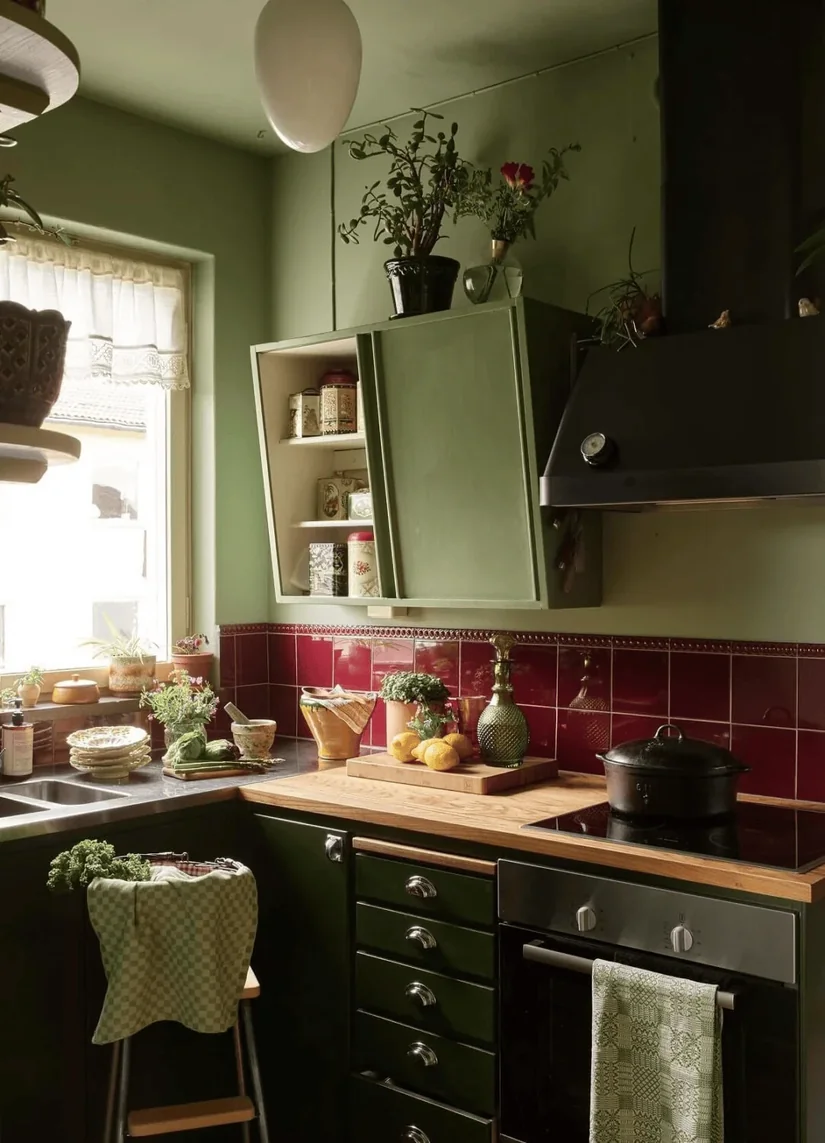
Dark green is paired with cream, oak, and brass so often that a red-toned stone can feel surprisingly fresh. Try deep green cabinetry with burgundy, oxblood, or red-veined stone on one backsplash or island surface.
Let the stone be the unexpected part. I would keep the floor and metal much quieter after that. One mistake I have learned to watch for while comparing bold material palettes is adding more drama because the first strong choice feels lonely. Usually, it just needs room.
15. Put Forest Green And Emerald Beside Terracotta Before Choosing Either
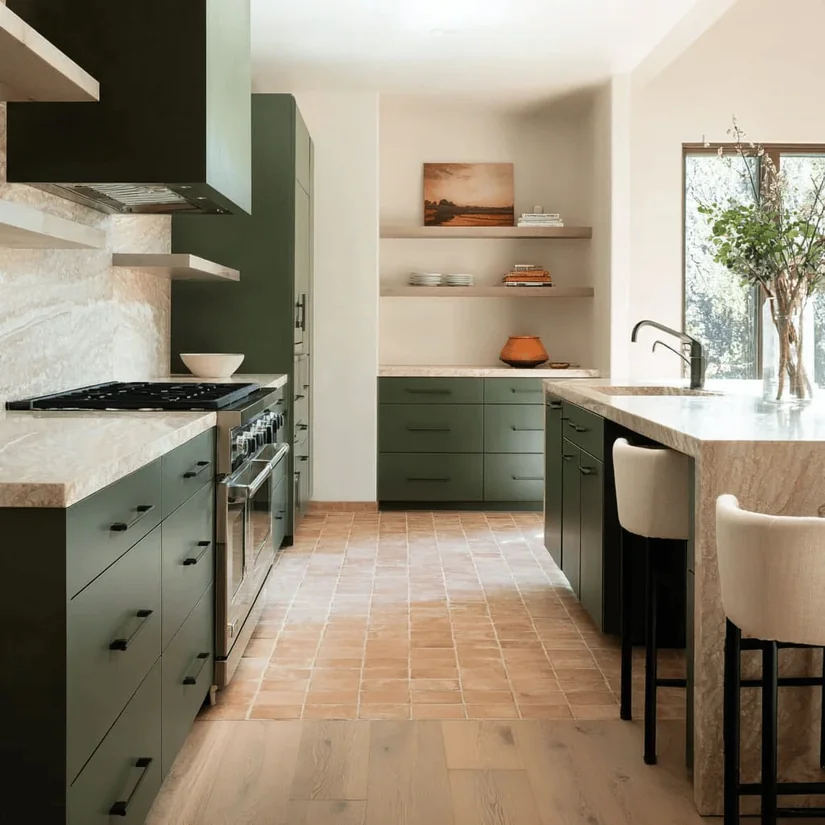
This was one pairing where the green family genuinely changed the whole kitchen. Muted forest green tends to settle into terracotta’s red-orange warmth. A cooler emerald creates a much sharper break.
Neither is automatically wrong, but they are not versions of the same palette. I would choose forest green for a softer, earthier dark green kitchen colour scheme and emerald when the contrast itself is part of the idea.
16. Use Uneven Dark Green Tile When One Flat Shade Feels Too Severe
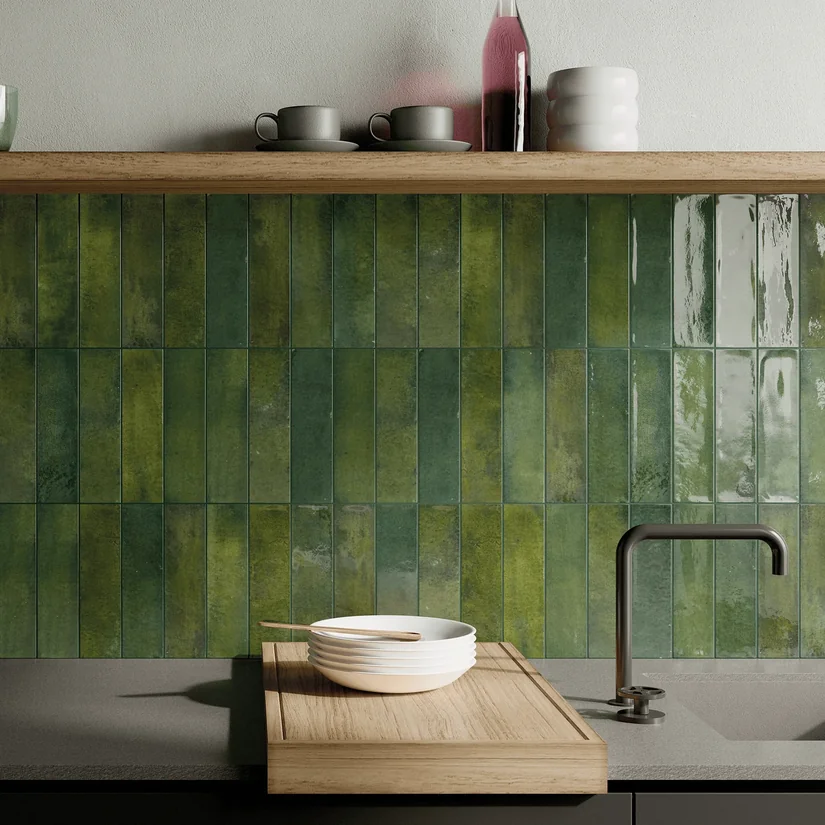
One perfectly flat, dark green can feel intense across a broad wall. Uneven glazed tile gives the colour small shifts without introducing another shade.
This is where handmade-look or zellige surfaces become useful. Our kitchen backsplash ideas show how much character the backsplash itself can carry. Keep the cabinet fronts simpler and look at a full tile sheet. One tile will never show the variation you are putting across the wall.
17. Give The Island A Fluted Dark Green Front
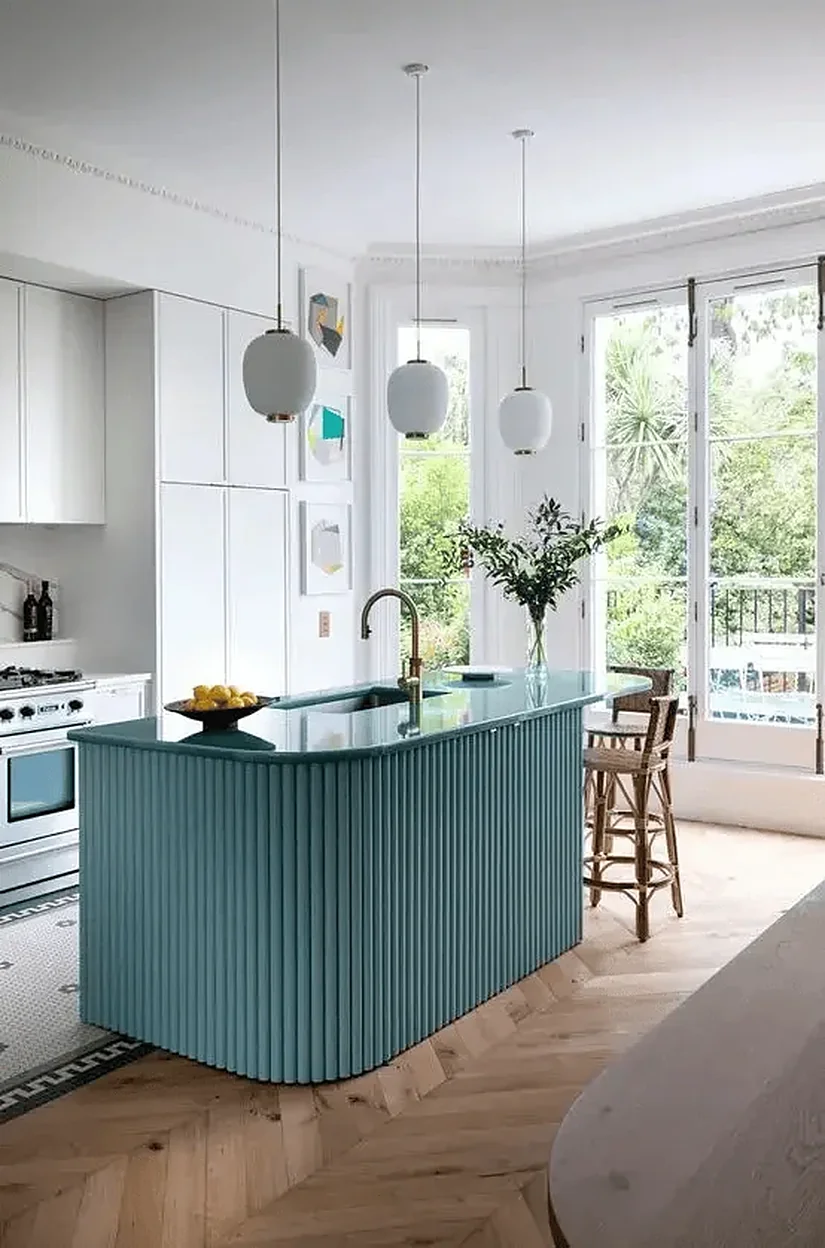
Flat green cabinetry can feel plain once the first colour impact settles. Try texture before adding another shade. Keep the perimeter cabinets simple and give the island a fluted dark green front.
The ribs change with the light, so the island keeps some movement without needing patterned tile. Keep the stone plain too. Once the island has colour and texture, it has enough going on. I would let that one surface do the extra work.
These floating kitchen island ideas are worth a look if the island is the piece you are still deciding on.
18. Put Warm Grey Microcement Beside Matte Dark Green Cabinets
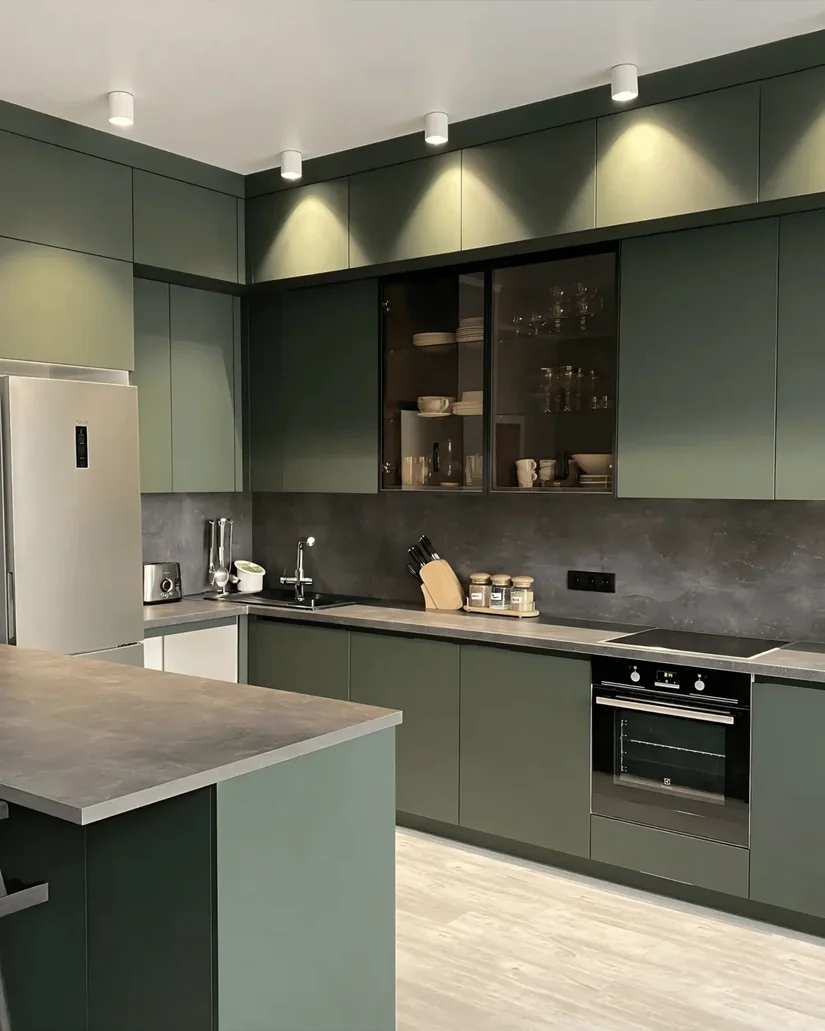
A modern dark green kitchen does not need bright white stone to feel clean. Warm grey microcement on the wall or backsplash can sit beside matte green cabinetry without creating a sharp colour break.
Add decorative doors and bright hardware, and you change the whole direction. I would keep the cabinet fronts simple and the metal quiet here. You will see the same material-led thinking across our modern kitchen design ideas, where cleaner forms leave more room for colour.
19. Pair Deep Green Shaker Cabinets With Antiqued Pewter
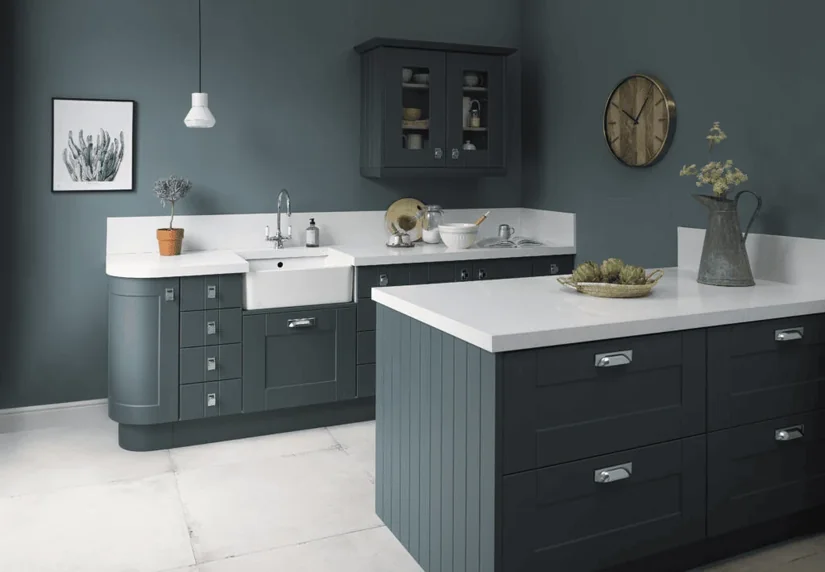
Almost every deep green Shaker kitchen seems to reach for brass. I kept liking the ones that did not.
Antiqued pewter gives the framed green doors a softer grey metal instead. It does not flash against the cabinetry in the same way bright brass can. One mistake I have learned to avoid when comparing material palettes is judging metal on its own. A finish that seems quiet can become much stronger once it sits against saturated green.
20. Build A Dark Green Banquette Beside A Neutral Kitchen
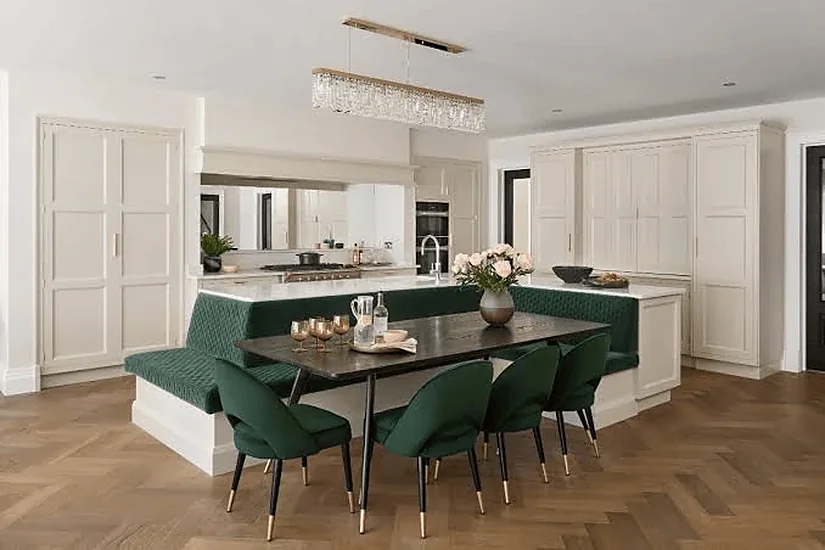
This one kept catching my eye because the green had left the cabinetry completely. A dark green banquette beside a cream or pale timber kitchen still carries the colour into the room, but you do not end up with another green cabinet wall.
Repeat the kitchen timber in the table or banquette base, and the two areas start to look like they belong in the same room. It is a useful dark green kitchen decor idea for an eat-in layout.
21. Break A Dark Green Cabinet Run With One Pale-Backed Glass Cabinet
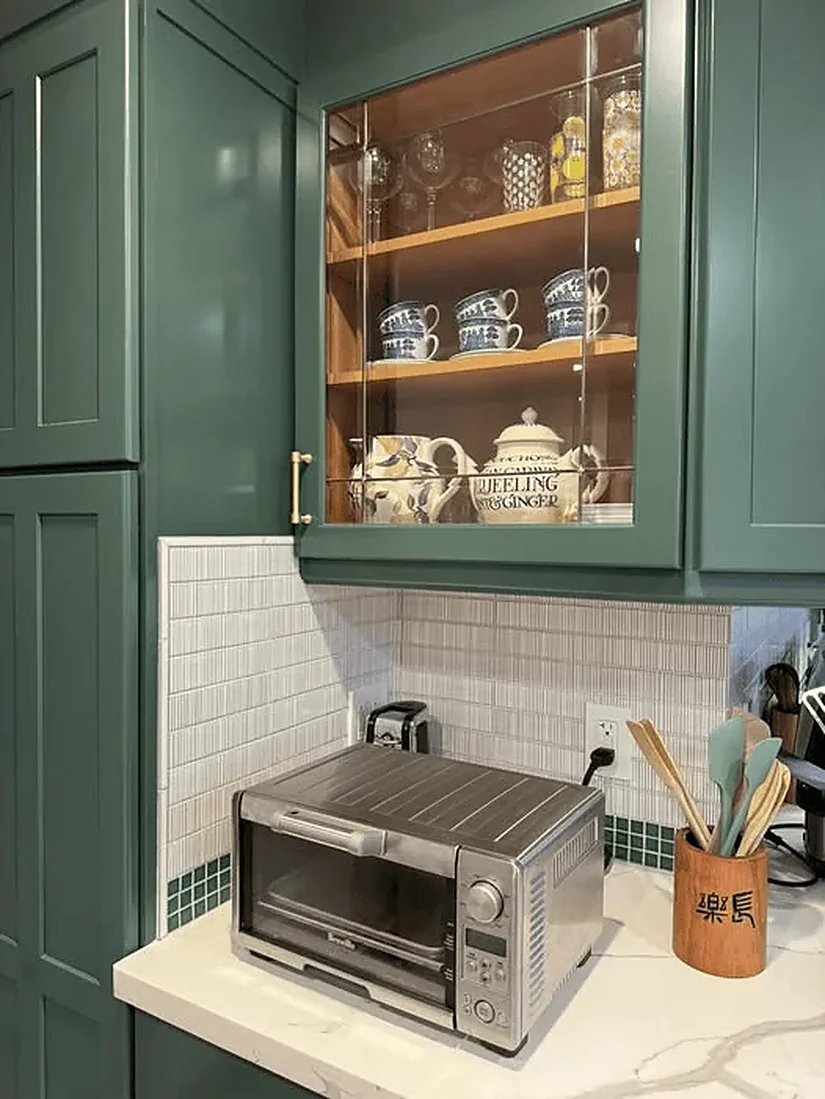
A long row of solid dark green upper cabinets can feel dense even when you need the storage. Swap one pair of doors for glazed fronts and give the cabinet a pale painted or light timber interior.
One glass cabinet is enough to interrupt the run. Keep the crockery restrained and leave the rest closed. Our kitchen cabinet designs show several glass-front directions, but here I would watch the pale backing. That is the detail breaking the green.
22. Panel The Fridge And Dishwasher, but Leave The Range Visible
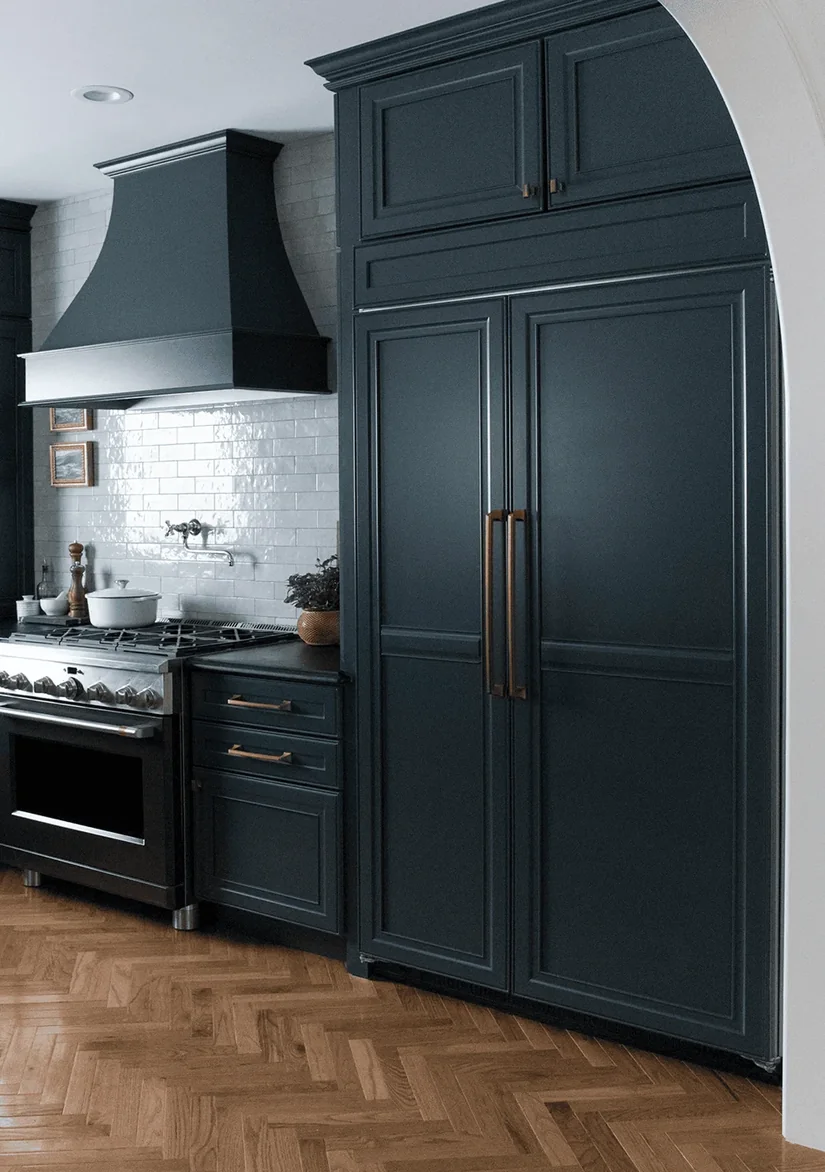
Dark green cabinetry, a second cabinet finish, and several appliance colours can start competing quickly. Hide the two biggest appliance blocks by panelling the fridge and dishwasher, then let one stainless steel range stay visible.
Suddenly, the metal looks chosen instead of accidental. The point is not to hide every appliance. I would decide which one deserves to stay part of the dark green kitchen design, then let the larger appliance faces disappear into the cabinetry.
Our modular kitchen design ideas show how panelled runs are planned from the start.
23. Make The Range Hood A Dark Green Feature
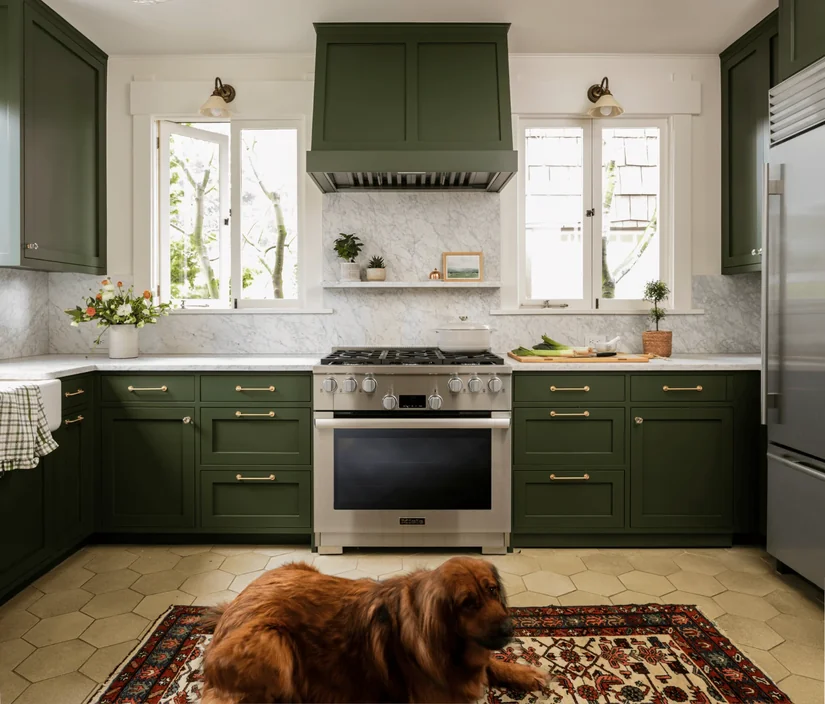
A dark green kitchen feature can still feel architectural when you have no island and do not want painted cabinetry. Keep the cabinets warm white or pale timber, then paint a boxed or sculptural range hood deep green.
Give the hood enough scale to carry the colour and repeat the shade once in a small nearby detail. Stop there. Matching green appliances or several extra accents will only weaken the feature that was meant to lead.
24. Choose Green-Stained Timber When Flat Paint Feels Too Final
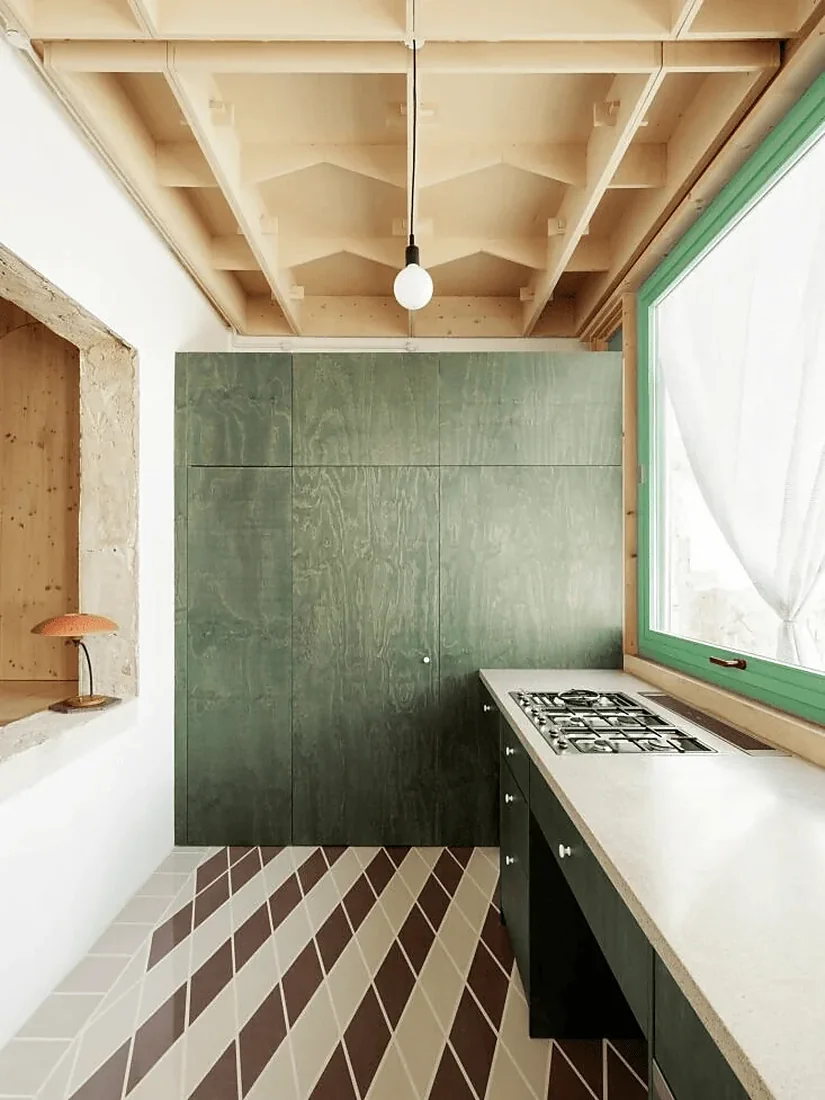
This is for the person who loves dark green but hesitates every time paint is about to cover the wood grain. A deep green stain gives you both.
The cabinets still read green, but the timber has not disappeared under flat paint. Pair it with quiet stone and restrained metal because the grain is now part of the design too. Ask to see a full door sample. Grain variation becomes much more obvious at cabinet scale.
25. Use Smoked Mirror Behind Dark Green Cabinets Instead Of A Pale Backsplash
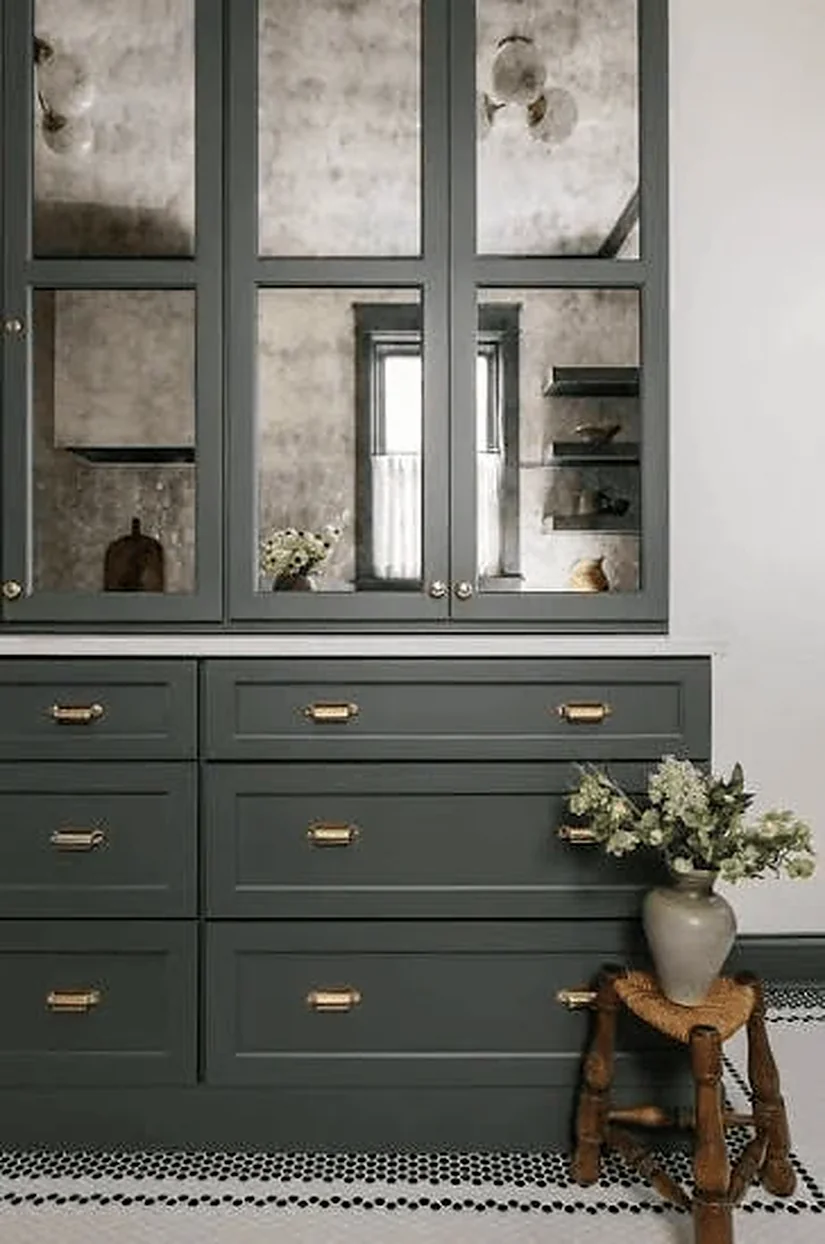
A dark green kitchen can need depth without needing another pale surface. In a bar niche or smaller backsplash zone, smoked mirror can reflect light and movement while keeping the palette dark.
I would use it selectively. A full mirrored kitchen wall can become busy once appliances and people appear in every reflection. Behind one contained green cabinet run, the reflection keeps the small area from feeling flat, but you still get the darker mood you wanted.
26. Style Dark Green With Rust, Cream, and Aged Copper Instead Of More Green
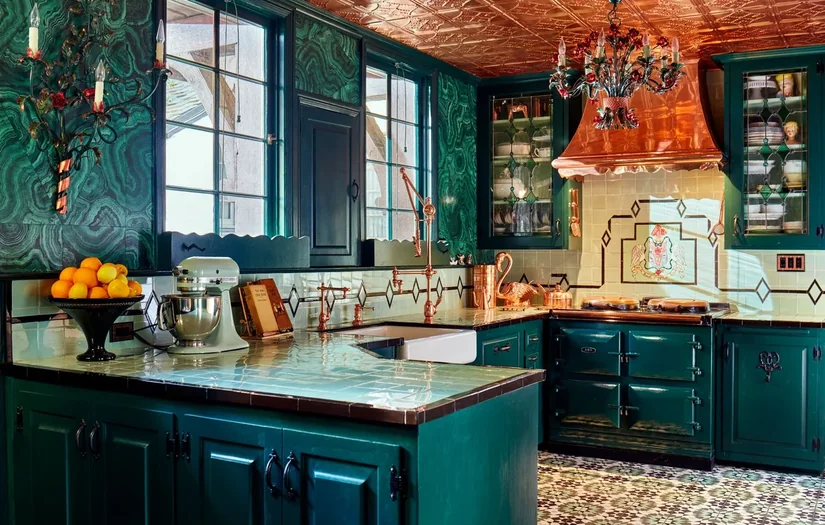
I stopped liking the dark green kitchens that tried to match every accessory to the cabinets. A green kettle, toaster, jars, and towels can turn the room into a set very quickly.
Let the cabinetry remain the main green, then bring in rust or ochre through a runner, cream ceramics, and aged copper. Those colours give your eye somewhere else to go without fighting the cabinets. Remove anything that is green only because the cabinets are green.
Still Torn Between Two Dark Green Kitchen Designs? Start With What You Cannot Change
After looking through so many dark green kitchens, I would stop asking which green is the prettiest. One thing I have noticed from being around design conversations is how early the fixed materials and layout come up. The worktop, timber floor, appliance finish, or separate scullery often narrows the direction before anyone needs to argue over two almost-identical green samples.
Start with what you are definitely keeping.
| If You Are Keeping… | Consider This Composition |
|---|---|
| White appliances | Deep green cabinetry with white repeated through the worktop or backsplash |
| A separate scullery | A pale main kitchen with dark green moved into the back kitchen |
| An open-plan peninsula | Dark green on the living-facing side only |
| A narrow galley layout | Forest green concentrated at the short end |
| A black countertop | Dark green cabinets with a pale plaster backsplash |
| Pale oak | Forest green with creamy quartzite |
| Walnut | Low-sheen dark olive with honed limestone |
| Terracotta flooring | Compare muted forest green with emerald before choosing |
| A tall cabinet wall | Almost-black green with a bright stone niche |
| A neutral eat-in kitchen | A dark green banquette instead of another green cabinet run |
Return to the composition built around the condition you cannot easily change. That is a much smaller decision than comparing another ten almost-identical dark green kitchen colours, and it gives the exact shade a clearer job once you choose it.
Maybe This Is Why I Could Not Stop Looking At Dark Green Kitchens
Maybe the green was never the whole reason these kitchens kept pulling me back. One hid the deepest colour in a scullery. Another cut pale stone into an almost-black cabinet wall. Emerald looked completely different once gold disappeared, and forest green changed again beside terracotta.
The strongest dark green kitchen ideas did not repeat one formula but gave the colour a different job each time. Look at the biggest layout or material issue in your own kitchen first. The shade becomes a much easier decision once you know what you actually need the green to do.
When cabinet colour also affects the worktop, storage and wider layout, our kitchen interior design services bring those decisions into the same design conversation. The aim is not to fit a favourite dark green into the room. It is to understand where the colour belongs and build the materials around it with the same clarity.
Narrow layouts have their own rules, which our L shaped kitchen design guide covers.
Our kitchen design guide walks through the fixed decisions first, and simple kitchen design covers the pared back version.