

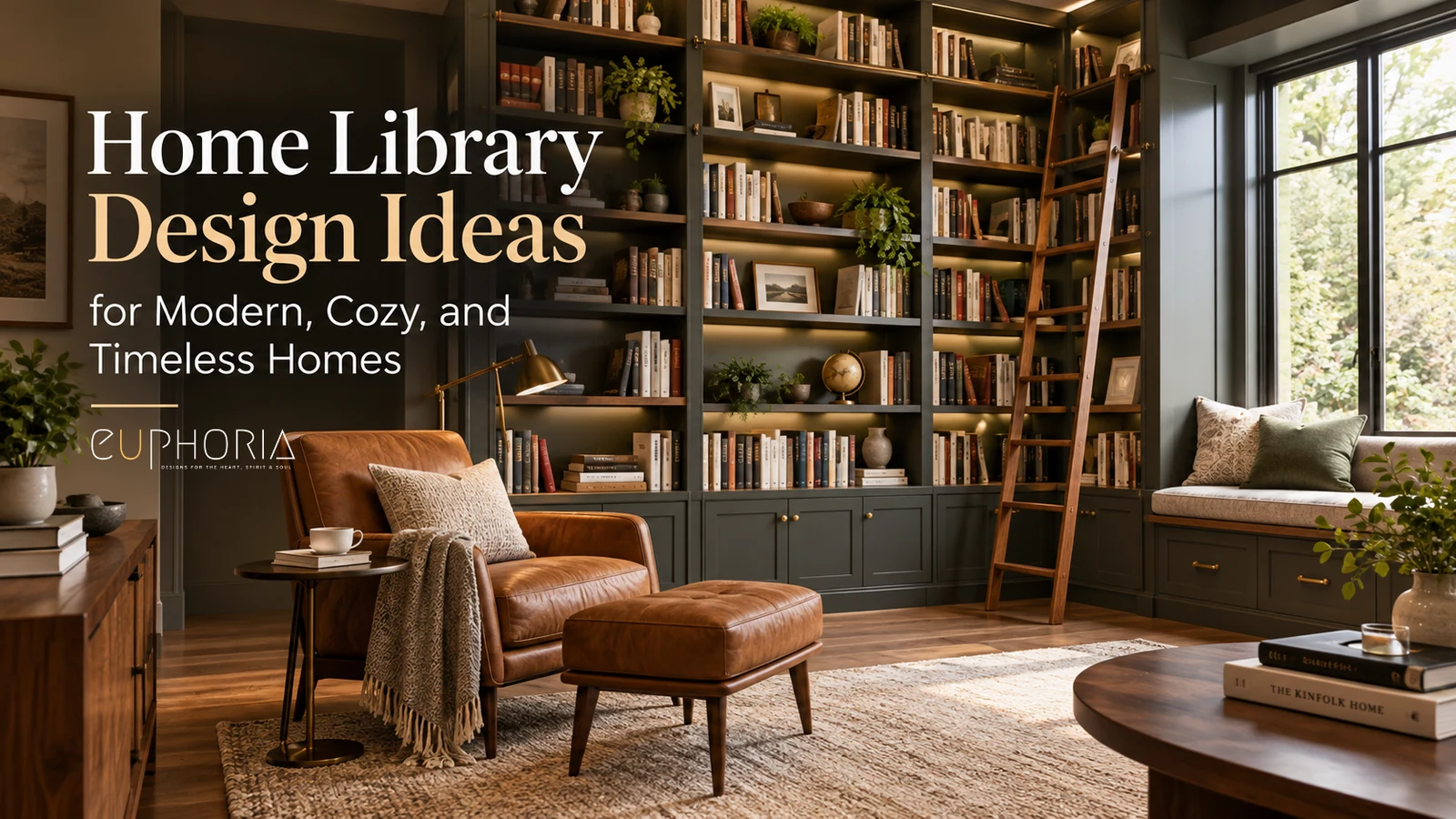
Screen fatigue is real, open-plan living gets loud, and at some point, most people start craving a room that actually has some quiet to it. That is a big part of why the home library has become one of the most requested features in UAE residential design. “If you have a garden and a library, you have everything you need,” Cicero reportedly said, and two thousand years later, interior designers are proving him right.
Reading rooms are no longer reserved for country estates or academic buildings. Designers are weaving home library ideas into living rooms, unused corridors, and home offices across Dubai and beyond. The bibliophile who once had to squeeze a shelf into a bedroom corner now has an entire design movement behind them. Books have become decor. Shelving has become architecture. The act of reading has become a lifestyle choice worth designing around.
Got a spare room, a generous corner, or just a stubborn wall that needs purpose? These home library ideas for home setups of every size are broken down into 26 ideas by style and space, from sprawling floor-to-ceiling statements to small, carved-out reading corners. Keep reading.
1. Minimal White Shelving Libraries
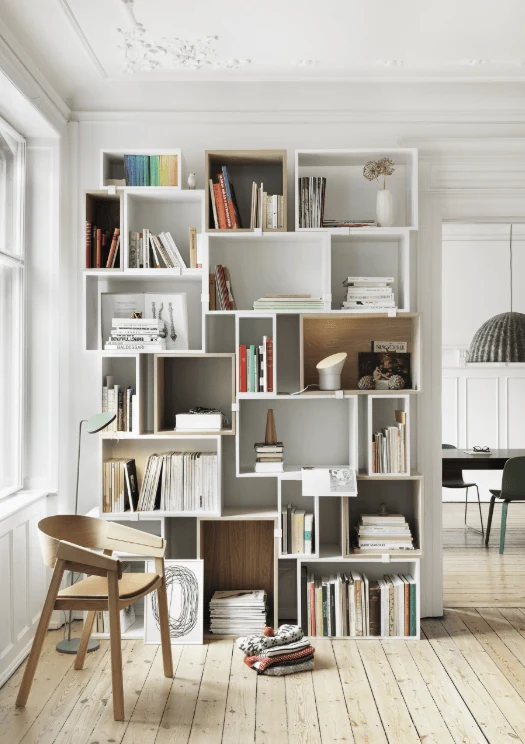
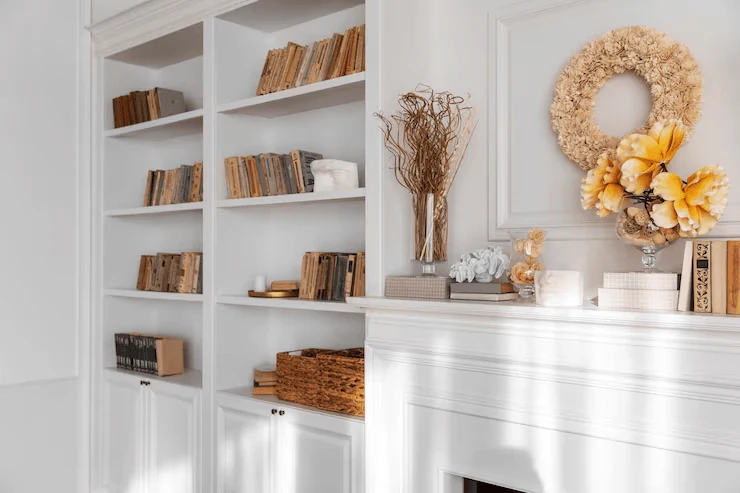
White shelving done right has a particular kind of confidence to it. Minimalist in spirit, this approach lets your books and objects carry the room without competing with a loud backdrop. It is also one of the most searched styles for home library design photos, and that tracks: the combination of pale shelving, oak floors, and daylight photographs exceptionally well. Most designers recommend shelves no deeper than 25 to 30 cm for a wall-mounted setup: deep enough for a standard hardback, shallow enough to keep the room feeling open. Leave deliberate gaps between books and objects rather than filling every inch.
The essential detail: Shelf depth of 25 to 30 cm keeps white shelving from feeling bulky and still fits the full range of book formats.
2. Floor-to-Ceiling Modern Libraries
Going vertical is one of those decisions that sounds obvious once you have done it. In urban homes where floor space is genuinely precious, a wall of floor-to-ceiling shelving does more per square metre than almost any other move. A standard 2.4 m ceiling gives you roughly six to seven shelf runs, which can hold upwards of 400 books on a single wall unit. Add a rolling ladder in brass or matte black, and you have something that stops people mid-conversation when they walk in.
The spatial payoff: A single floor-to-ceiling wall unit on a 3 m wide wall stores 400 to 500 books without occupying a single square metre of floor space.
3. Modern Home Office Libraries
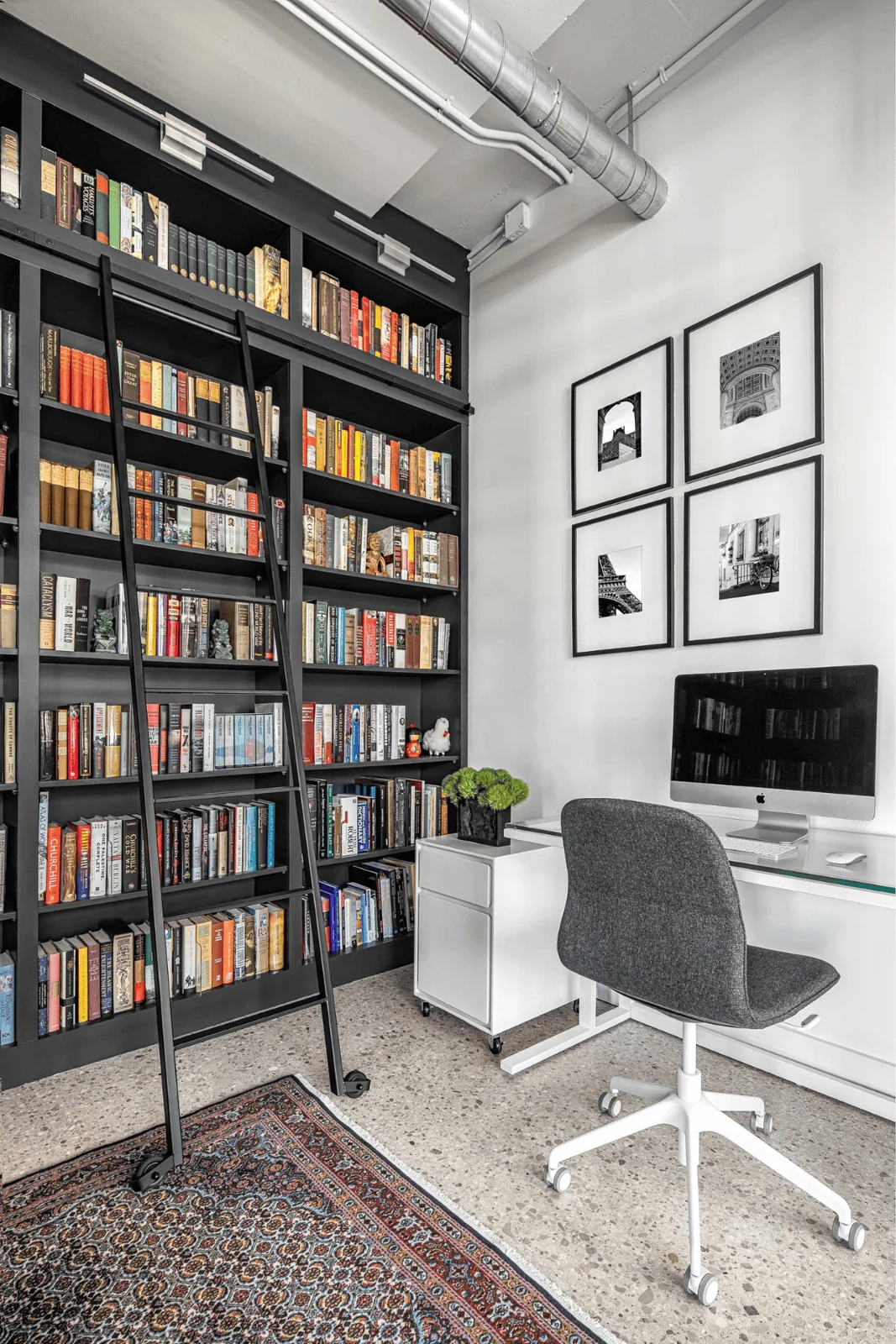
Books lining the walls behind your desk absorb sound, reduce echo, and create a working environment that is quieter than a bare room. They look good on a video call, too, though that is not the main argument for them. For a dedicated home office library, a desk surface of at least 120 cm wide gives you enough room to work comfortably alongside an open reference book. Mix open shelving for books with closed cabinets for the less photogenic work realities, and the room functions at both ends of the day.
A practical minimum: A desk width of at least 120 cm makes the office-library hybrid genuinely functional, not just visually convincing.
If the room doubles as a workspace, our guide to creating a luxury home office covers the layout side.
4. Floating Shelf Home Libraries
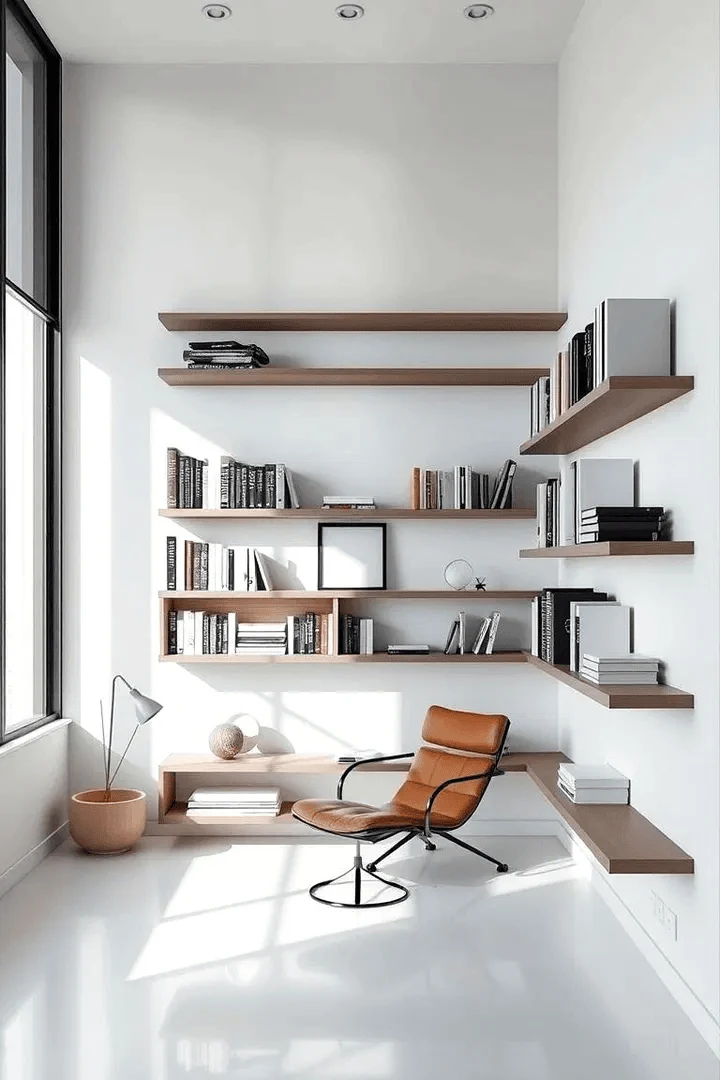
For renters or anyone who wants a lighter commitment, floating shelves are the smartest route in. Installed at varying heights across a bare wall, they build a curated, gallery-like effect that reads as considered rather than improvised. Standard floating shelf spacing sits at around 30 cm between runs, which comfortably clears most paperbacks and standard hardbacks. For oversized art books, bump that gap to 35 cm. Leave negative space between books and objects. The gaps do as much design work as the books.
The spacing rule: 30 cm between shelves clears most books; go to 35 cm if art books or coffee table editions are part of your collection.
5. Glass and Metal Contemporary Libraries
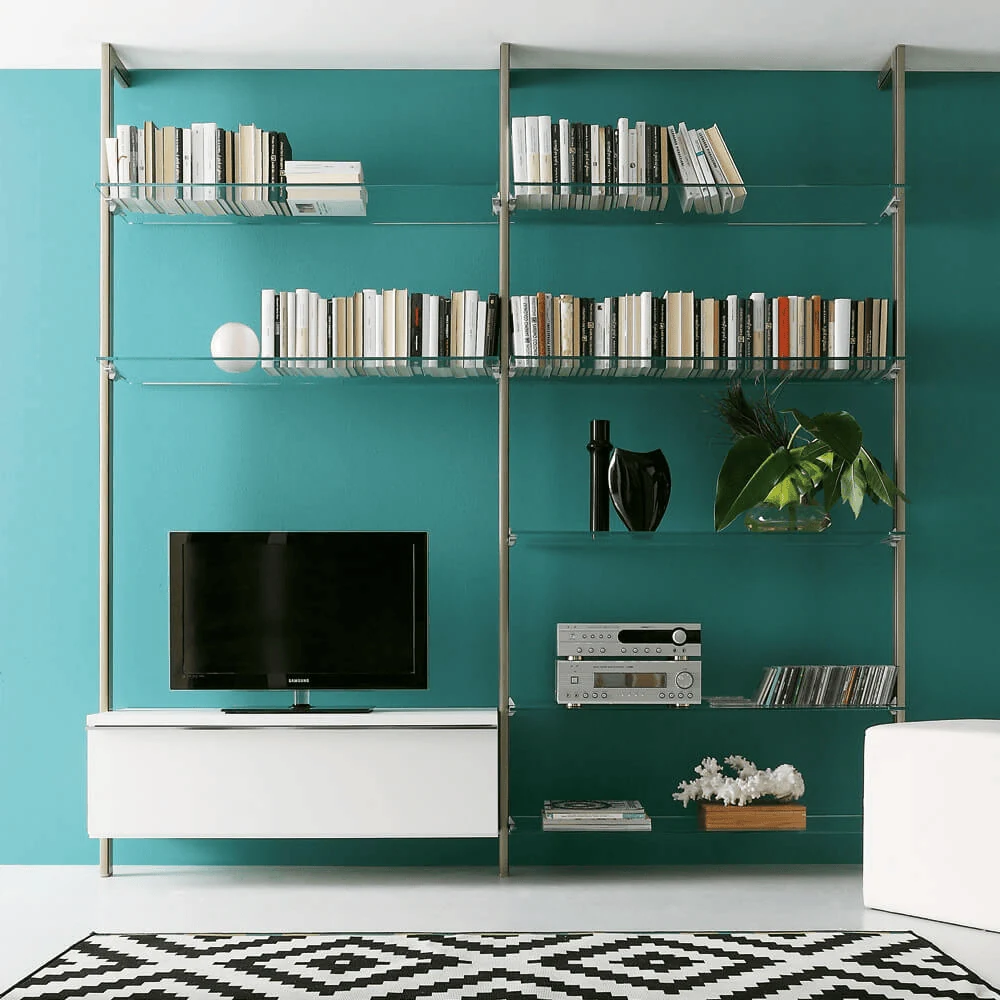
Black steel frames with smoked or clear glass panels create shelving that reads as architecture first, storage second. This works well in loft conversions, open-plan spaces, or any room that already has concrete, brick, or industrial texture in it. Frame widths of 60 to 80 cm per bay tend to hit the structural sweet spot: wide enough to display books generously, narrow enough that the glass does not bow under the weight of a full run of hardbacks.
The structural limit: Keep individual glass shelf bays between 60 and 80 cm wide to prevent flexing under a full load of books.
6. Home Library With a Fireplace
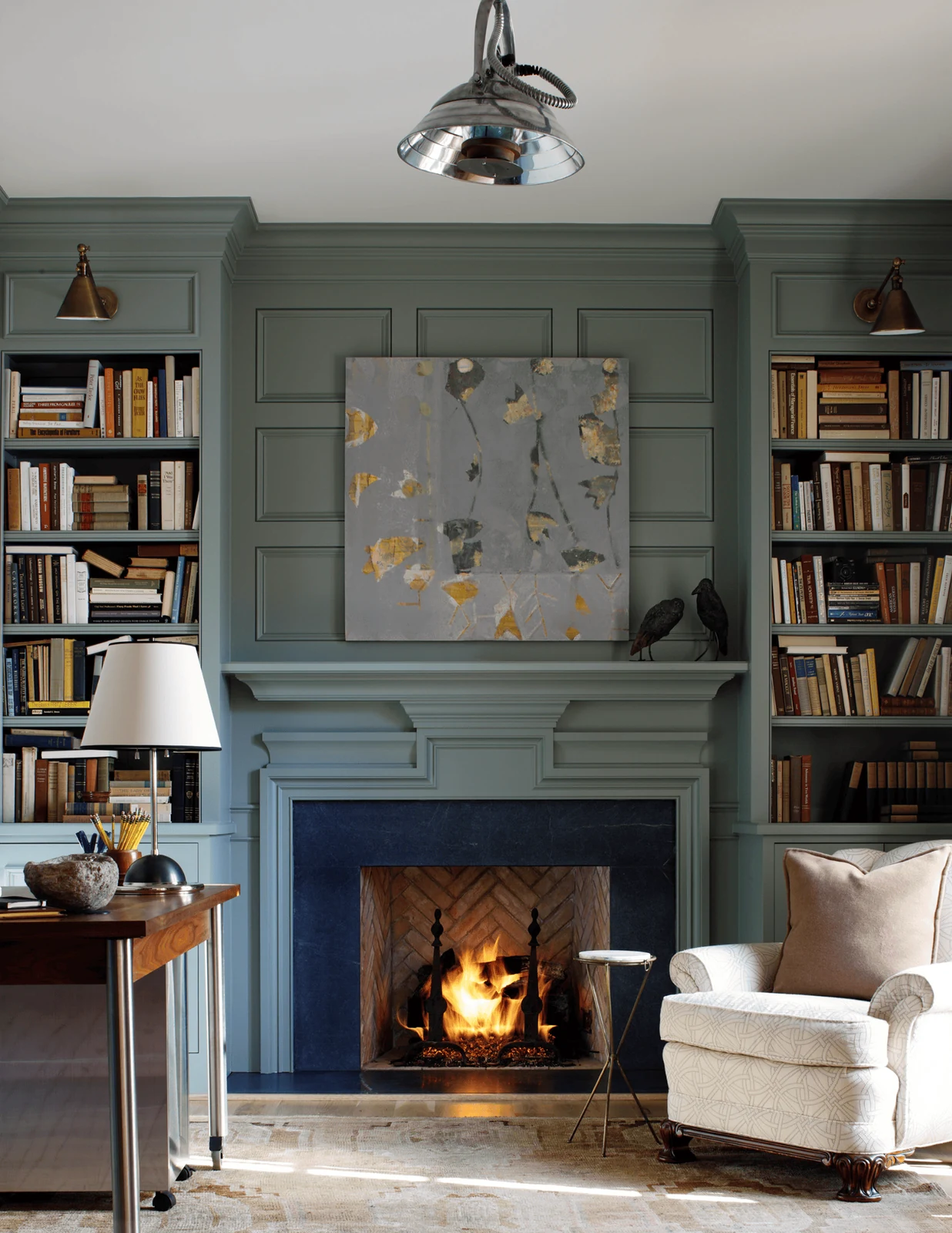
A home library with a fireplace is one of those combinations that simply cannot be improved on. Architectural Digest has long positioned fireplaces as emotional anchors in reading rooms, and if you have spent a winter evening in a room where both exist, you already understand the argument. Keep books at least 50 cm away from an open fireplace on either side: closer than that and you risk heat damage to spines over time. A worn kilim rug, a decent armchair, and a throw that gets used rather than arranged completes the picture.
The safety margin: Keep shelving and books a minimum of 50 cm from an open fireplace on either side, both for fire safety and to avoid long-term heat damage to your collection.
7. Bay Window Reading Libraries
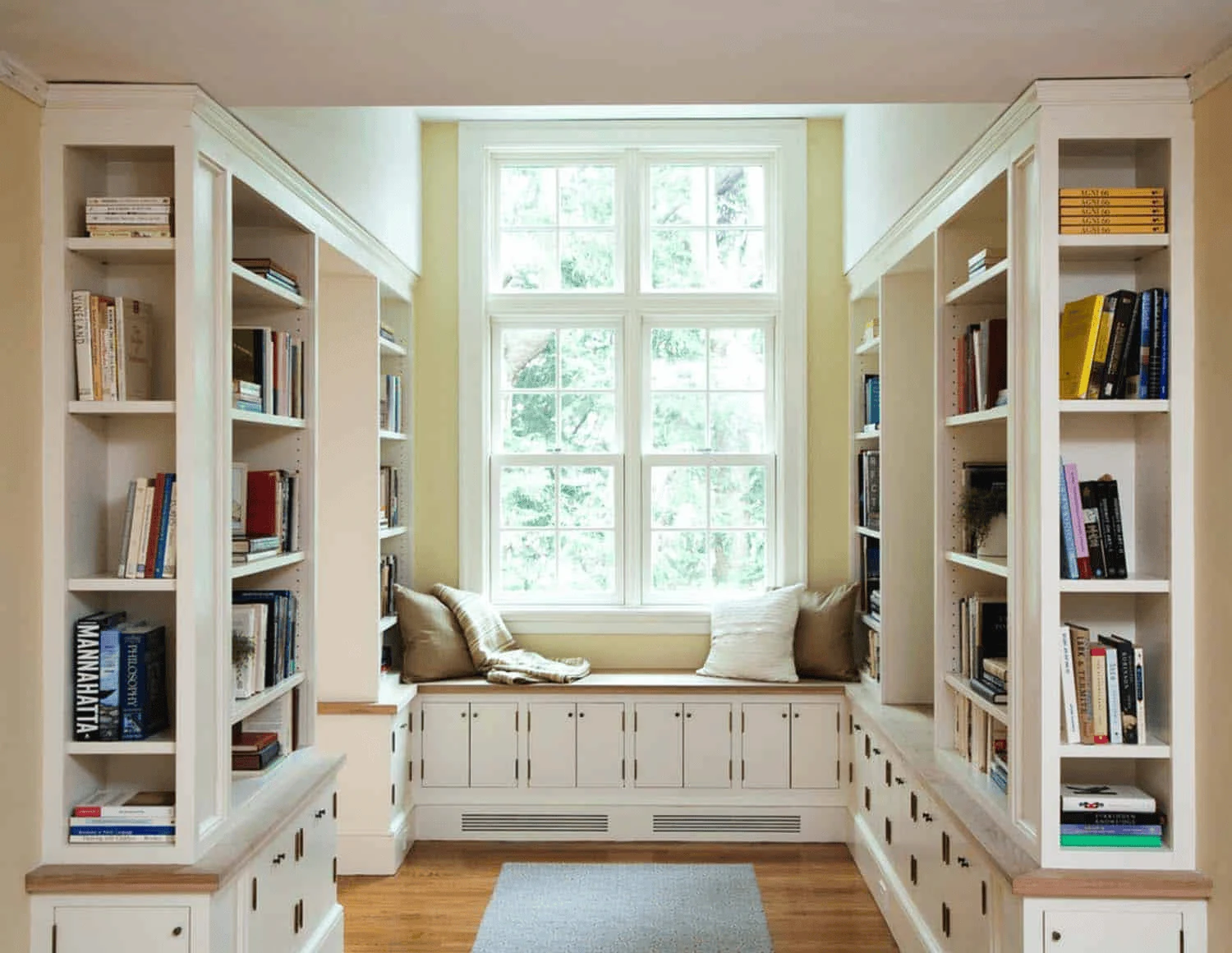
Bay windows are chronically underused in older homes. Build a cushioned window seat into the recess, and you immediately gain between 1 and 1.5 square metres of usable surface that previously did nothing. Run shelves up the surrounding walls, and you have a reading nook that natural light and a view make almost impossibly good. Roman blinds or linen curtains handle those moments when the afternoon sun becomes too much.
The hidden gain: Converting a standard bay window recess into a reading nook recovers 1 to 1.5 sq m of usable space with no structural work required.
8. Soft Neutral Reading Rooms
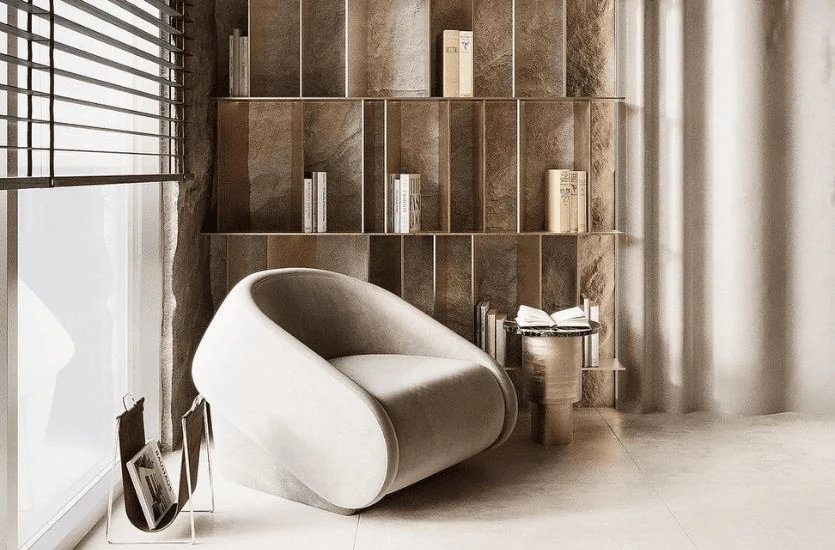
Creams and warm taupes create a soothing room for the end of a long day. The specific paint shade matters less than its light reflectance value. Paint manufacturers like Jotun UAE recommend an LRV between 55 and 70 for reading spaces. This specific range bounces warm light around the room without creating a clinical glare on the pages. Pale plaster walls and linen seating make the space feel expensive and calm.
Colour precision: This precise light reflectance rule ensures the room stays bright enough to read in while remaining relaxing.
Picking the shade is half the work, and choosing the best colour for office walls applies here too.
9. Candlelit Moody Libraries
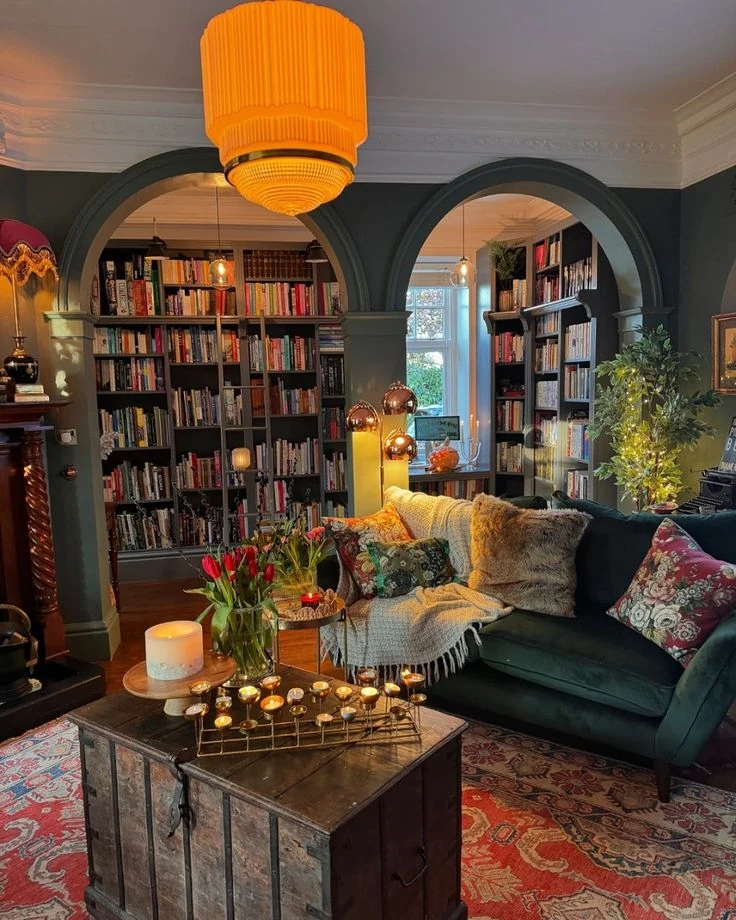
Dark academia leaped from mood board to mainstream interior trend with remarkable speed, mostly because the aesthetic is genuinely persuasive when you are standing inside it. Forest green walls, walnut shelving, warm lamplight, leather-bound spines in various states of age: this is the kind of room that makes a Sunday feel like an event. Dark paints in this palette typically have an light reflectance value below 20. This means the walls absorb light aggressively. You need to plan for at least one dedicated reading lamp per seating position. Adding picture lights over the shelving prevents the room from feeling like a cave.
Lighting necessity: This lighting strategy is mandatory because dark paints will otherwise make the room too dim to read comfortably.
10. Cozy Apartment Home Libraries
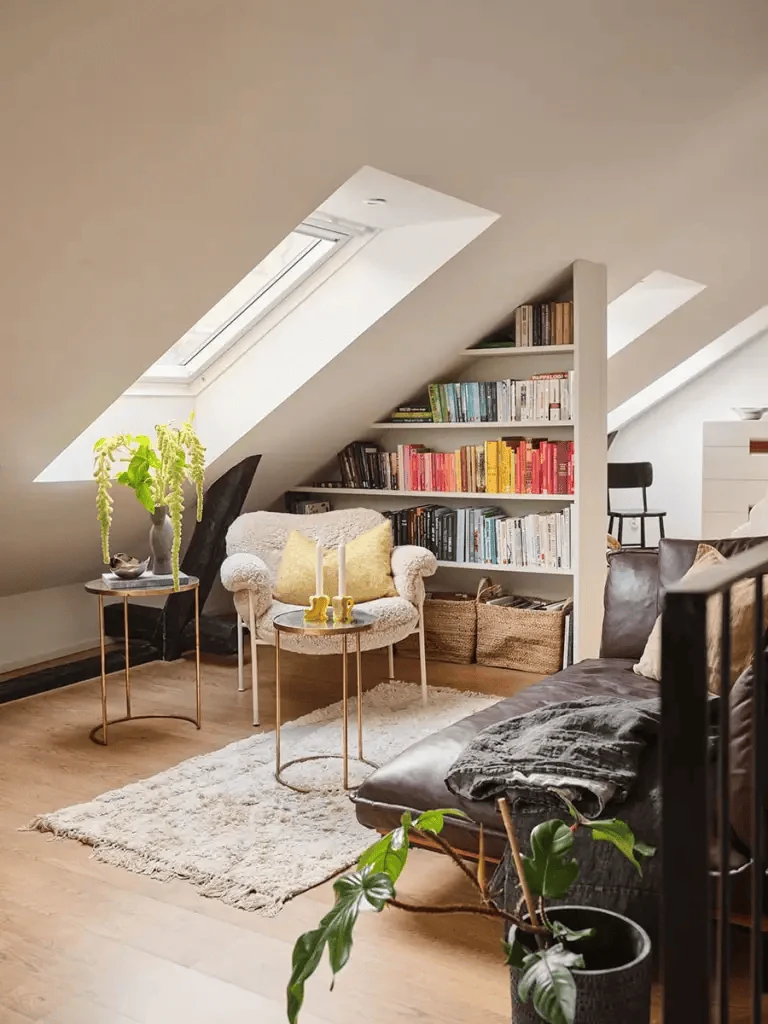
In a studio or one-bedroom flat, a corner footprint of around 2 square metres is enough to build something that genuinely reads as a library: one tall bookcase, a compact armchair with a 65 to 70 cm seat width, and a floor lamp angled at reading height. A modest collection displayed with care communicates that this is a reading space. That distinction comes from how the corner is arranged, not from how many books are in it.
The minimum footprint: A 2 sq m corner is genuinely enough to build a home library setup that looks and functions like one.
11. Corner Library Ideas
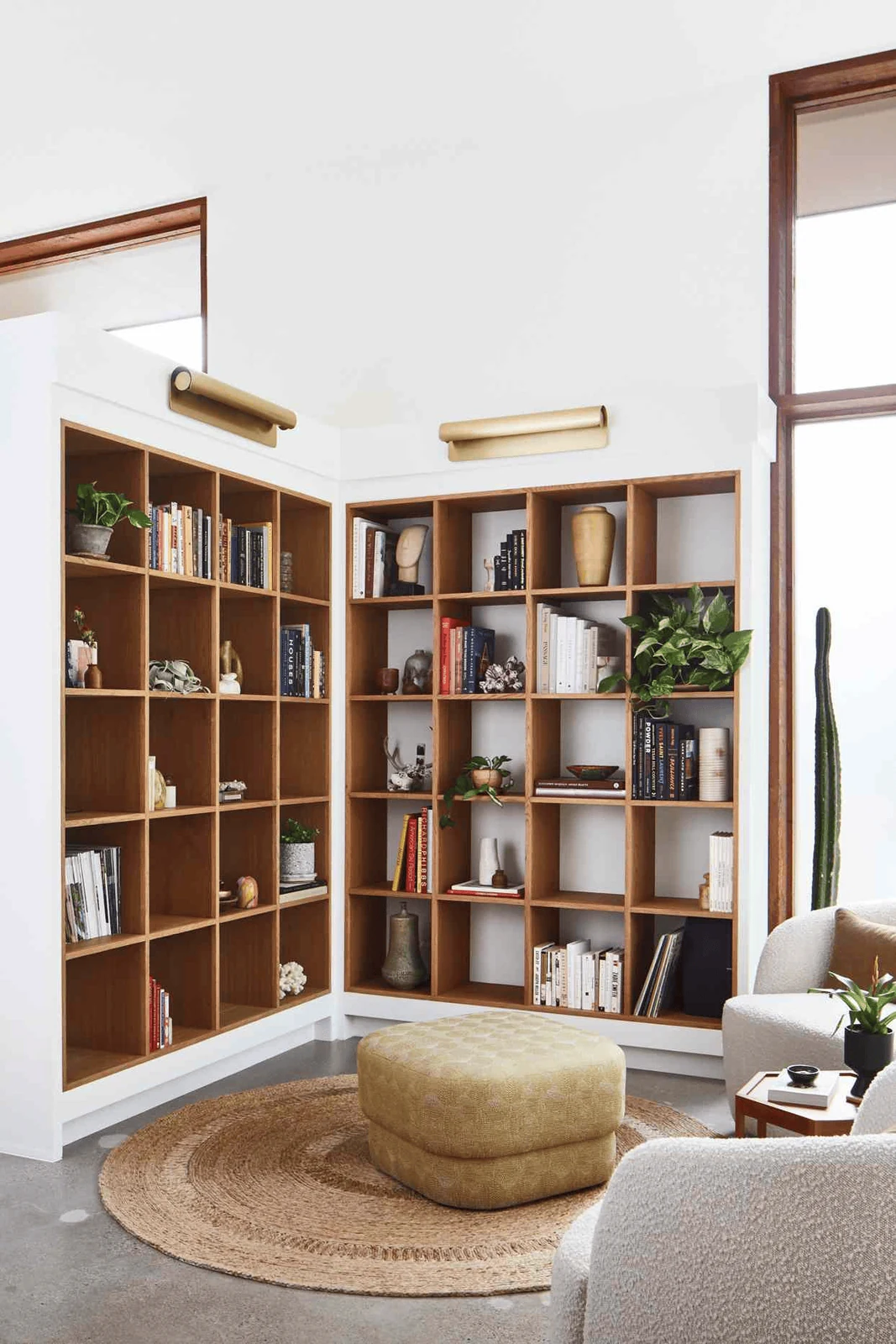
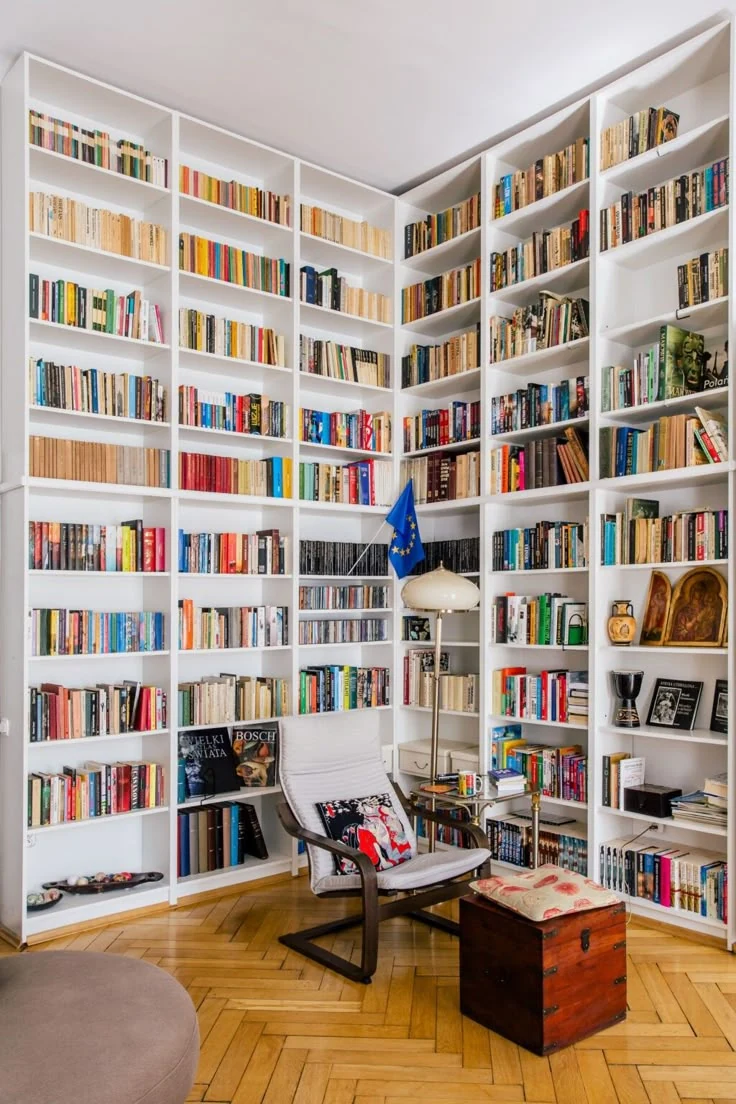
Corners are among the most neglected areas of real estate in any home. A corner library, done properly with two intersecting shelving units installed floor-to-ceiling and meeting at a right angle, takes a dead zone and makes it the most interesting part of the room. A standard corner unit covers roughly 60 x 60 cm of floor space, yet the combined shelving surface on both walls can hold 200 to 300 books. Add an armchair angled into the shelving and a floor lamp at reading height, and the corner becomes the destination.
The corner yield: Two intersecting floor-to-ceiling units in a 60 x 60 cm corner can hold 200 to 300 books and occupy less than half a square metre of floor.
12. Under-Stair Libraries
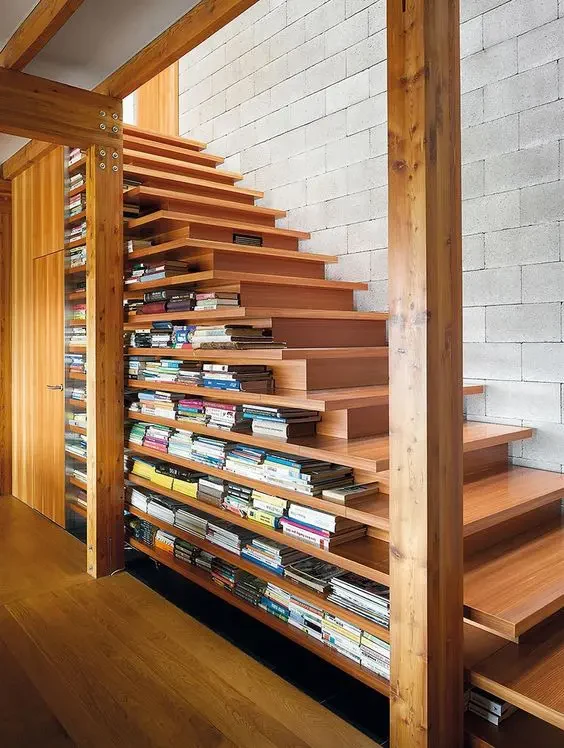
Most people waste the void beneath their staircase by turning it into a messy coat closet. Real estate reports from Bayut indicate that maximizing under stair storage is a highly requested renovation in Dubai townhouses. A typical straight flight staircase requires a footprint of roughly 3.5 square metres. Fitting custom shelves under this exact footprint creates massive storage potential for hundreds of books. Books stored under stairs are naturally protected from direct sunlight, preventing the covers from fading.
Hidden potential: This unused void offers incredible storage capacity once properly fitted by a skilled carpenter.
13. Hallway Library Walls
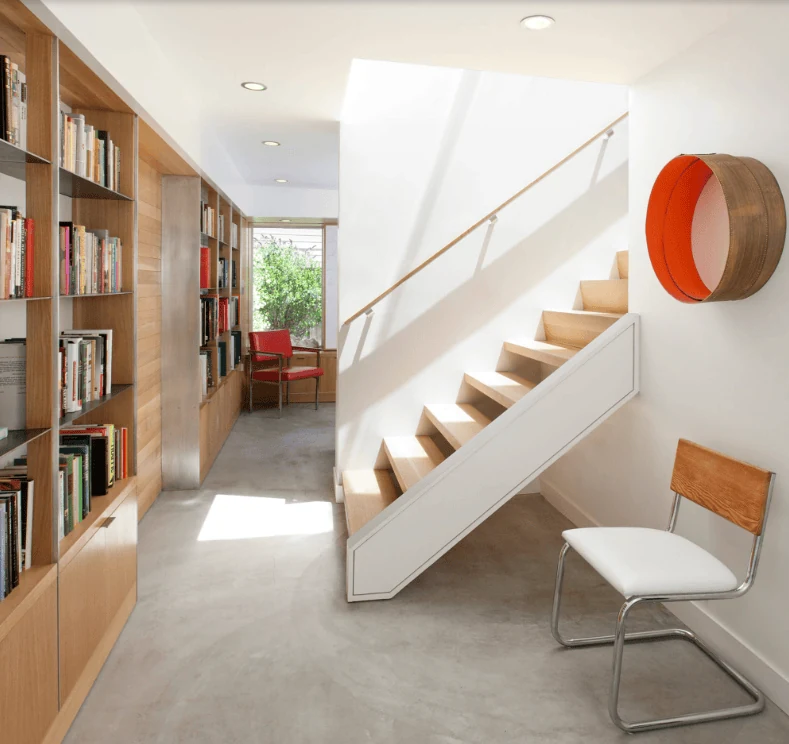
A hallway lined with bookshelves becomes something you walk through slowly rather than past. It sets the tone for the rest of the house in a way that most hallway design decisions simply cannot compete with. Keep shelf depth to 20 to 22 cm maximum in a corridor: any deeper and you start narrowing the walkable width to an uncomfortable degree. Warm lighting overhead turns the passage from transitional to genuinely deliberate.
The depth limit: In a hallway, keep shelves to a maximum of 20 to 22 cm deep. Any deeper and the corridor starts to feel like a squeeze rather than a feature.
14. Alcove Reading Nooks
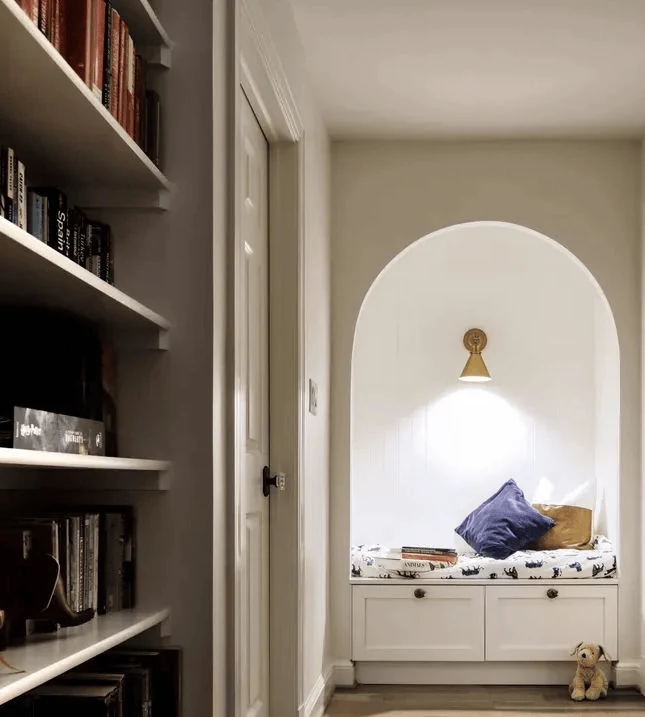
Alcoves flanking chimney breasts or structural pillars are practically meant for built in shelves. Home improvement data from Gulf News property sections highlight that bespoke bookcases turn awkward architectural recesses into highly effective storage in UAE villas. Standard architectural alcoves are often 60 to 90 cm wide, perfectly matching standard bookshelf widths. Filling these natural recesses creates a custom look that makes the room feel much larger.
Perfect match: Because natural recesses match standard furniture depths, a fitted solution maximizes space beautifully without needing expensive structural changes.
These calming design ideas help the corner feel restful rather than closed in.
15. Compact Ladder Shelving
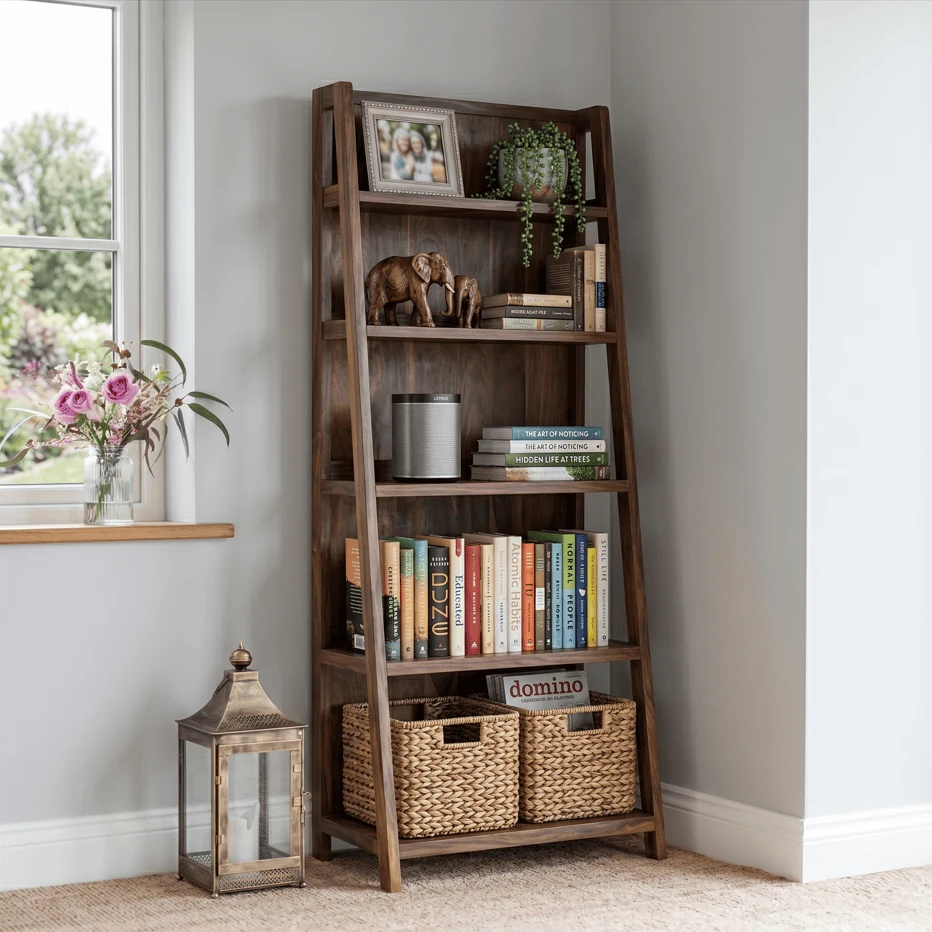
A-frame or leaning ladder shelves are the most accessible starting point for anyone building their first home library setup, and the default choice when the available space is genuinely small. A typical five-tier ladder unit stands around 170 to 180 cm tall and covers a wall footprint of just 60 to 80 cm wide, making it workable in almost any room that has a spare wall. No drilling, no professional installation. Styled with a combination of books and objects rather than books alone, they read as considered and personal rather than provisional.
The commitment-free option: A standard five-tier ladder unit at 170 cm tall fits into a 60 to 80 cm wall space, enough for a meaningful display without a single drill hole.
16. Classic Walnut Wood Libraries
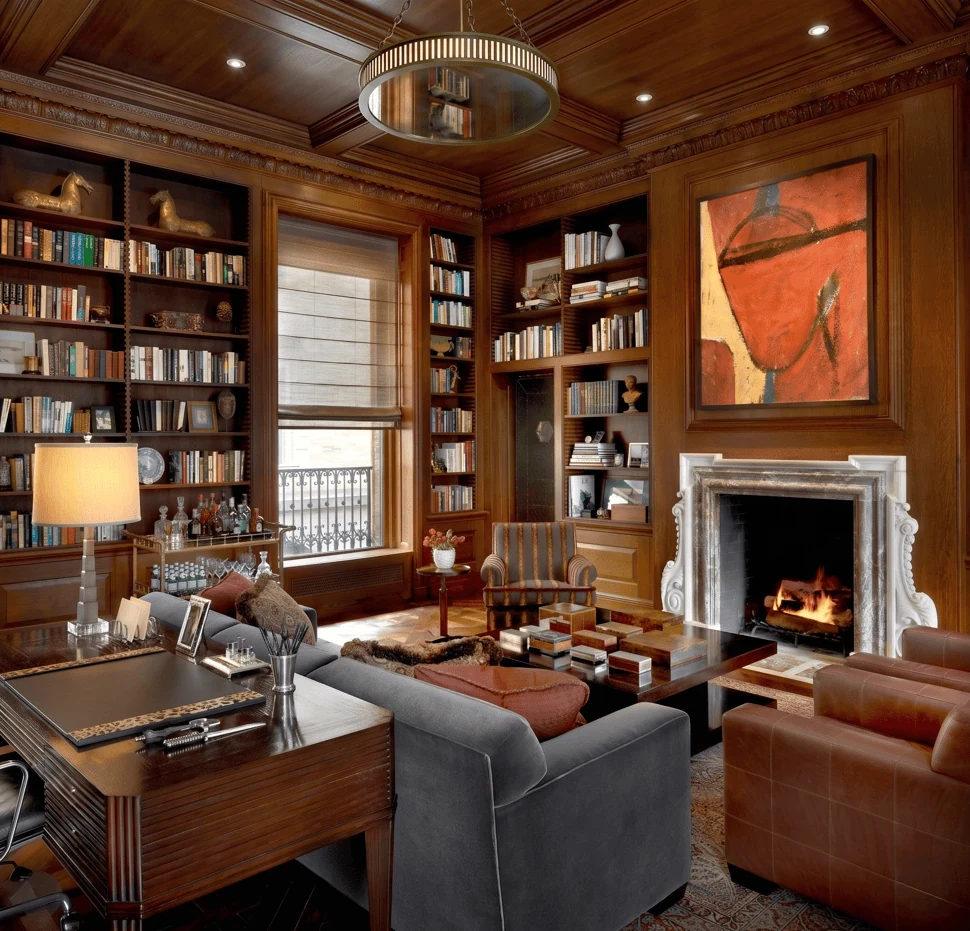
A wooden library built in dark walnut is what traditional library design keeps returning to, and walnut being expensive has never really slowed the demand. Rich, warm, and looking better with every passing year, it creates a sense of permanence that lighter timbers genuinely cannot replicate. Solid walnut shelves should be at least 25 mm thick to avoid sagging under a full run of hardbacks: thinner than that and the shelf will develop a visible bow within a few years. Pair with brass picture lights, a green-shaded reading lamp, and a worn leather chair, and you have an interior that feels assembled over decades rather than ordered on a Saturday afternoon.
The structural rule: Solid walnut shelves need to be at least 25 mm thick to carry a full run of hardbacks without bowing. Anything thinner is a false economy on a material this expensive.
17. Double-Height Library Rooms
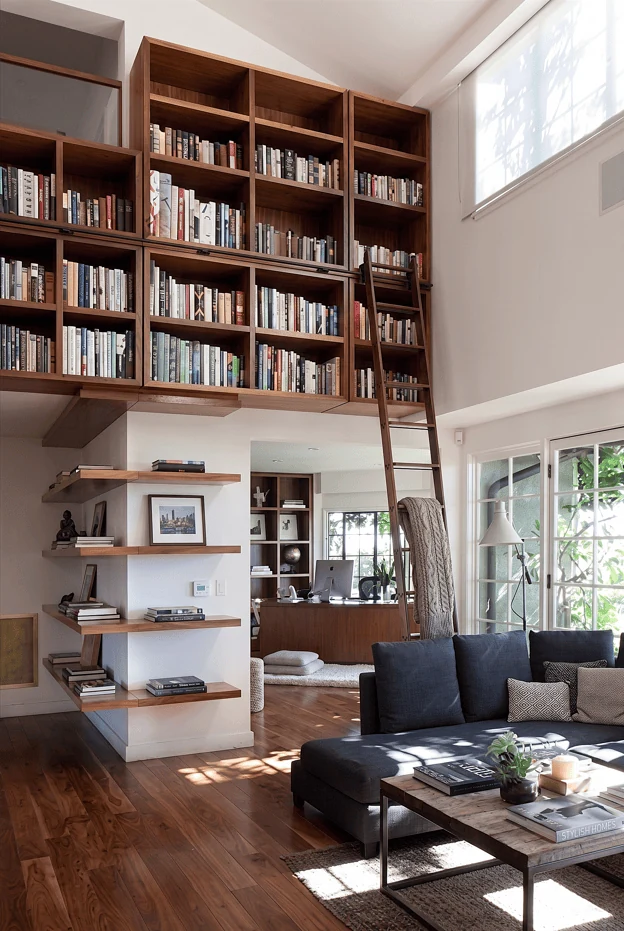
A double-height library is one of the few residential design moves that is simply hard to argue with. You typically need a clear ceiling height of at least 4.5 to 5 metres to make mezzanine access worthwhile rather than theatrical. Shelving from floor to upper gallery, a rail, and a rolling ladder: the sense of scale this creates is something you feel before you consciously register it.
The height threshold: A double-height library needs at least 4.5 to 5 metres of clear ceiling height to feel genuinely architectural rather than merely tall.
18. Library Rooms With Rolling Ladders
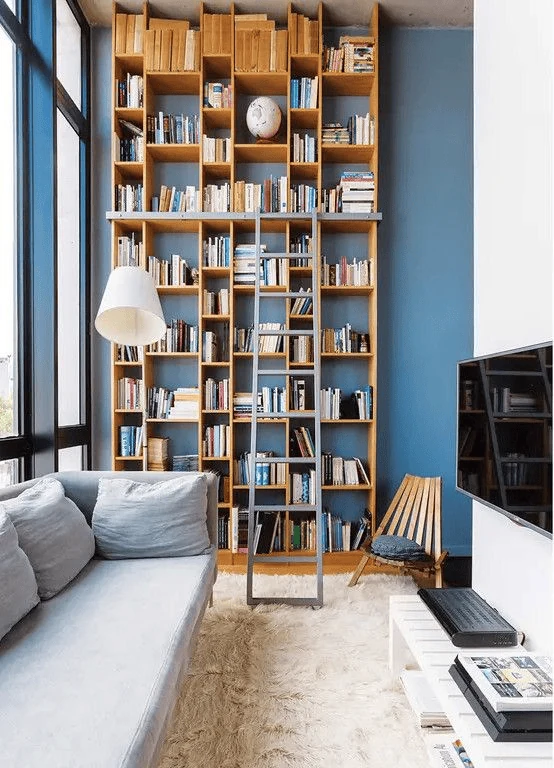
A rolling library ladder does something to the atmosphere of a room that is difficult to fully explain and easy to experience. Tall shelves, a brass rail, the particular pleasure of searching: the image is culturally loaded in the best way. The rail system needs a minimum of 2.2 to 2.4 metres of wall run to function properly and feel proportionate. As House Beautiful notes, the rolling ladder is one of those features that makes a home library feel like an actual library rather than a room that happens to have books in it.
The rail requirement: A rolling ladder rail needs at least 2.2 to 2.4 m of continuous wall run to work properly. Less than that and it becomes more of a decorative feature than a functional one.
19. Vintage English Study Libraries
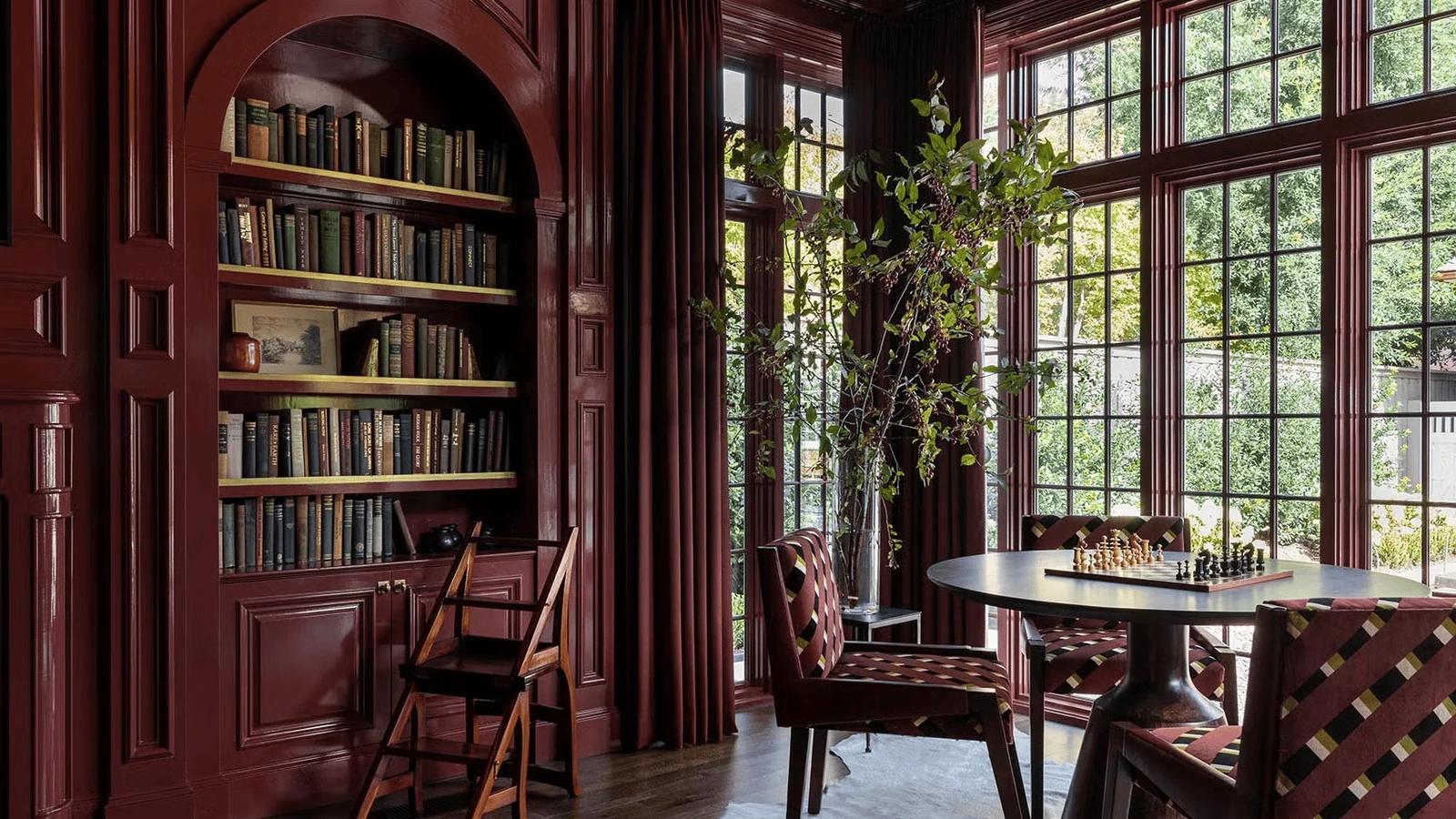
Panelled walls, a leather Chesterfield, hunting prints, shelves carrying more hardbacks than any one person could read in a lifetime: the traditional home library has remained one of the most enduringly attractive formats in residential design. A traditional Chesterfield sofa runs around 180 to 200 cm long, and worth planning the shelving layout around rather than fitting in afterwards. The rule for this aesthetic is that nothing should look too new. Warmth, texture, and patina carry it.
The furniture anchor: A classic Chesterfield sofa at 180 to 200 cm long defines the footprint of the entire room. Plan the shelving layout around it, not the other way around.
20. Library Dining Rooms
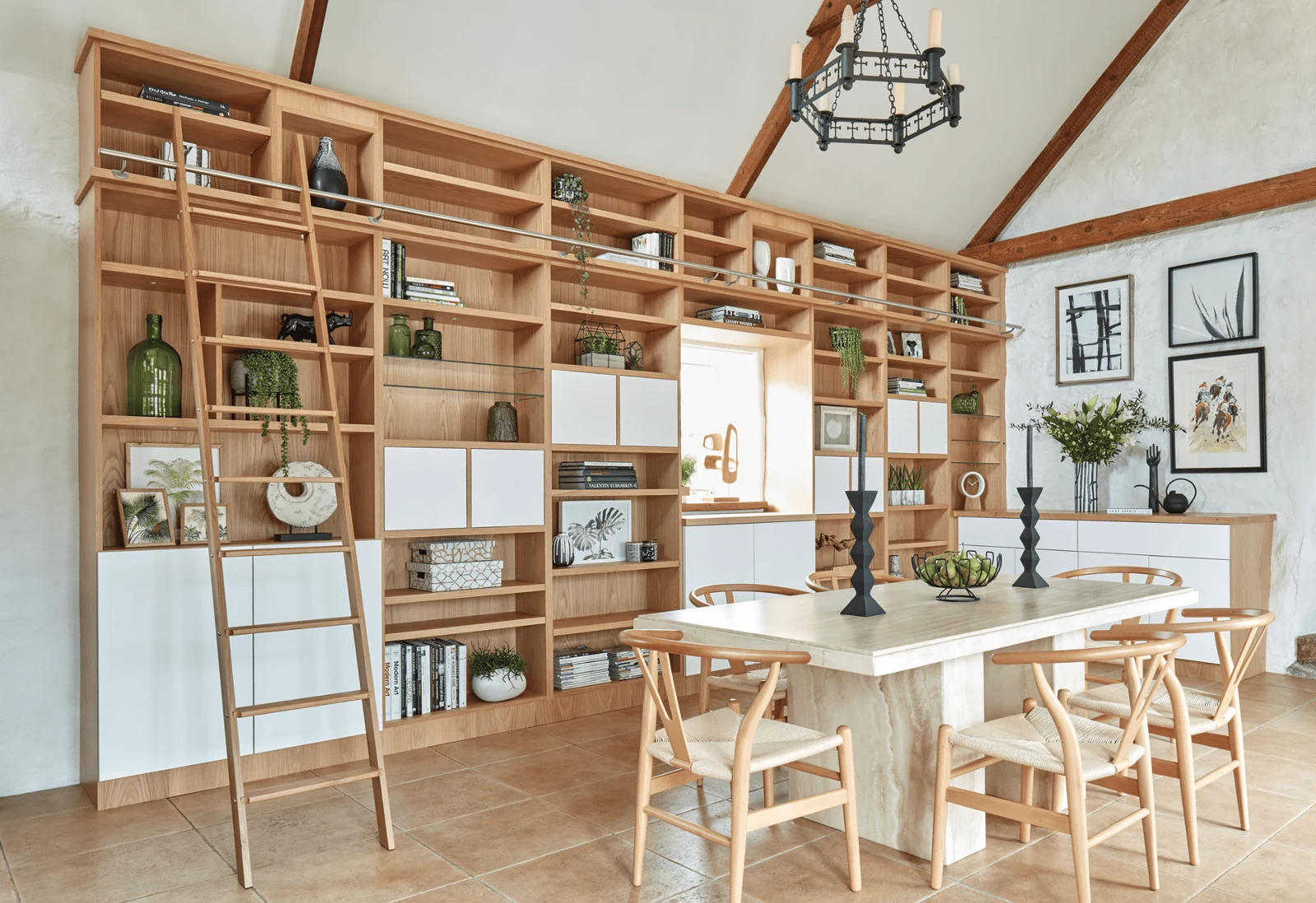
Dining room library design is having a moment, and it is easy to see why. Walls of books create atmosphere, improve acoustics for conversation, and communicate something about the household that a bare wall simply cannot. For this hybrid to work comfortably, allow at least 90 cm of clearance between the dining table edge and the nearest shelving run: enough to pull out a chair fully and move around without catching the collection. A long refectory table, simple pendant lighting, and shelving on two or three surrounding walls photograph beautifully and work even better in person.
The clearance rule: Leave at least 90 cm between the dining table edge and shelving walls so chairs can pull out fully and the room does not start to feel like a corridor.
21. TV Wall Libraries
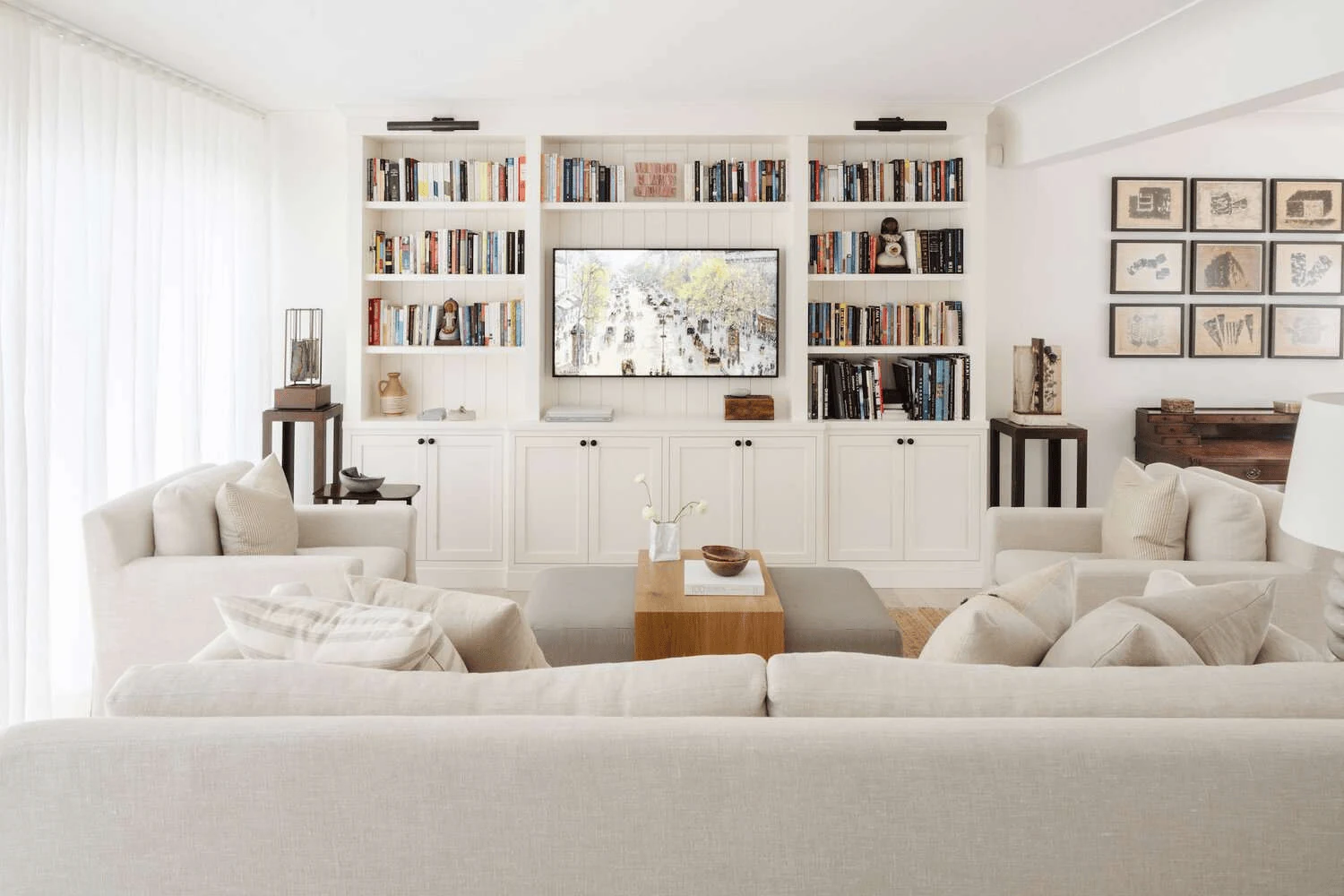
Shelving units flanking a central television soften one of the more visually awkward elements in any living room. For the proportions to feel right, the shelving on each side should extend at least 40 to 50 cm beyond the TV unit horizontally, and ideally run to the ceiling to avoid a floating, disconnected look. Books and objects break up the hard rectangle of a screen, and the combination works both for active viewing evenings and quiet reading ones. Choose shelving with a matte finish to handle screen reflections.
The proportion rule: Flanking shelves that extend at least 40 to 50 cm beyond each side of the TV unit and run to the ceiling stop the whole composition from looking like an afterthought.
Keeping the cables and screens discreet is a craft of its own, covered in our guide to designing a smart space with discreet technology.
22. Hidden Door Bookshelves
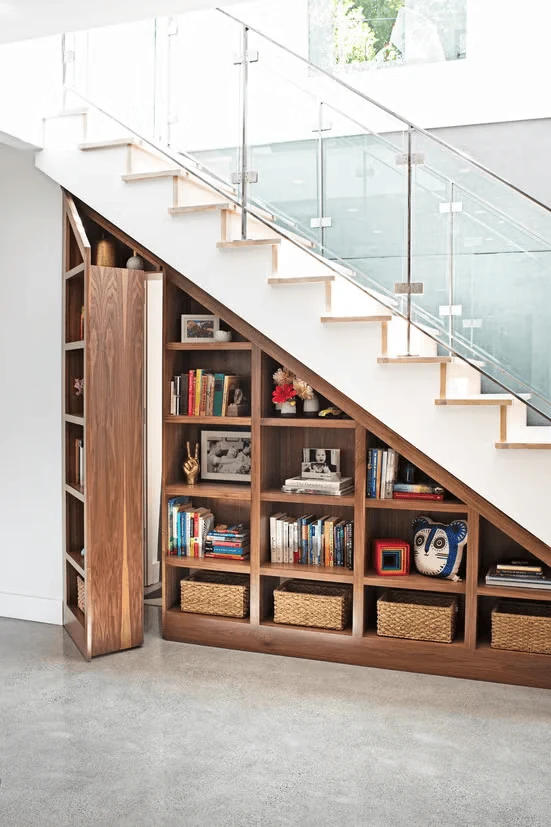
Few residential features generate social media engagement or genuine real-world excitement the way a bookshelf concealing a door does. The door mechanism requires the bookcase to be at least 30 to 35 cm deep to accommodate both the pivot hardware and a functional shelf; shallower than that, and the engineering becomes awkward. Installation requires planning and usually professional fitting, but the payoff in terms of how the space feels is real and lasting.
The hidden engineering: A functional hidden bookshelf door needs a unit depth of at least 30 to 35 cm to accommodate the pivot mechanism without compromising shelf usability.
23. Library Backgrounds for Zoom Rooms
Books are among the most legible visual signals of depth and intelligence, and a home library background for video calls delivers all of that before anyone has said a word. For a background that reads as deliberate on camera, plan for at least 1.5 to 2 metres of shelving behind your seated position, lit separately from your key light so the books do not disappear into shadow. A dedicated corner with organised shelving and warm lighting has become a genuinely practical home feature for anyone working remotely.
The camera-ready minimum: At least 1.5 to 2 m of shelving behind your seated position, separately lit from your face, is what separates a convincing library background from an accidental one.
For more on this setup, see our home office design solutions for Dubai remote workers.
24. Reading Libraries With Plants
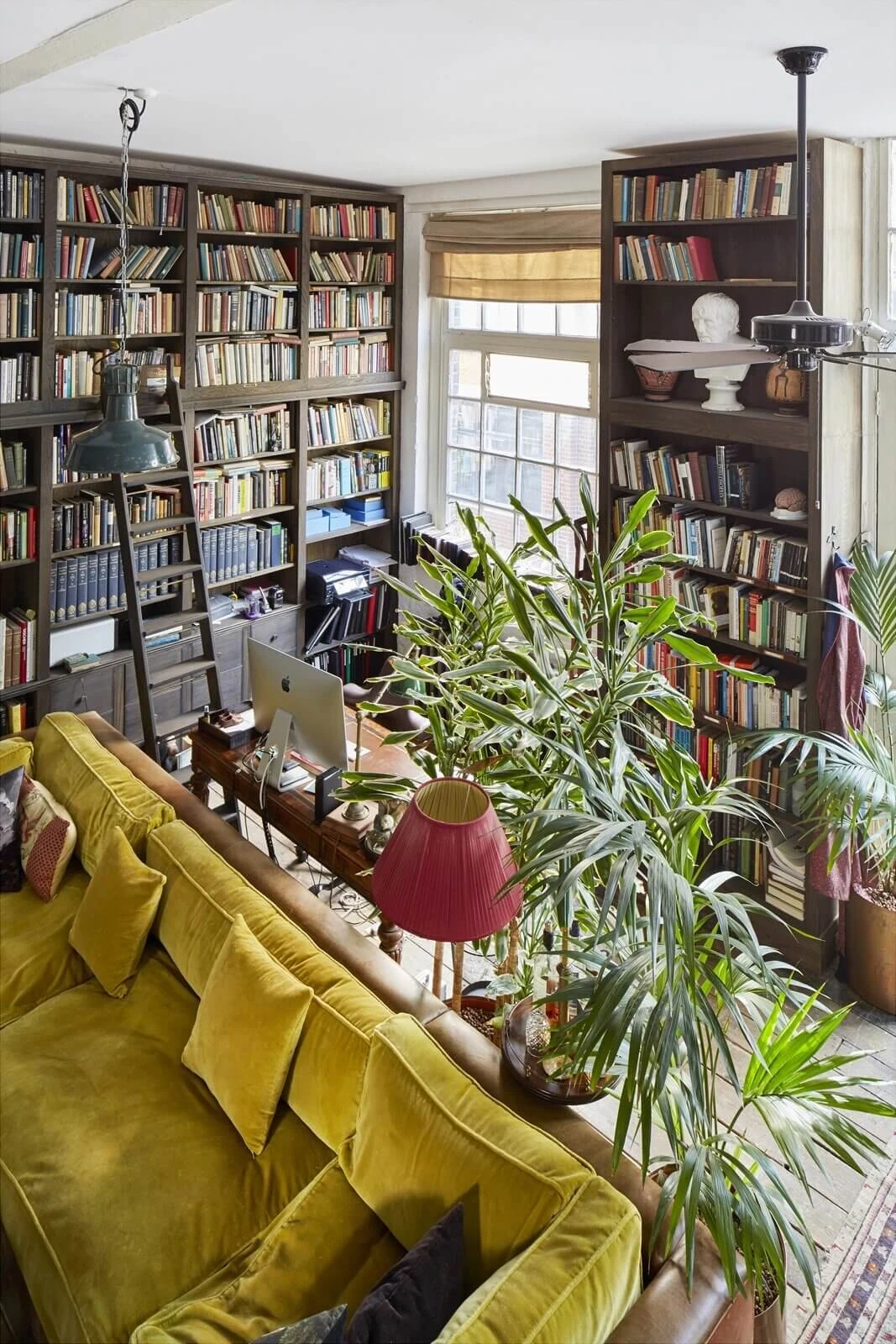
Indoor greenery softens shelving-heavy rooms in a way that furniture alone cannot: it adds oxygen and creates a reading atmosphere that feels calming rather than visually busy. As a rough guide, one medium plant per 10 square metres of room space keeps the balance right without tipping into greenhouse territory. A trailing pothos, a fiddle-leaf fig, or smaller plants placed between book stacks work well without requiring much maintenance.
The green balance: One medium plant per 10 sq m of room space integrates greenery without the shelving starting to look like a garden centre.
25. Scandinavian Reading Corners
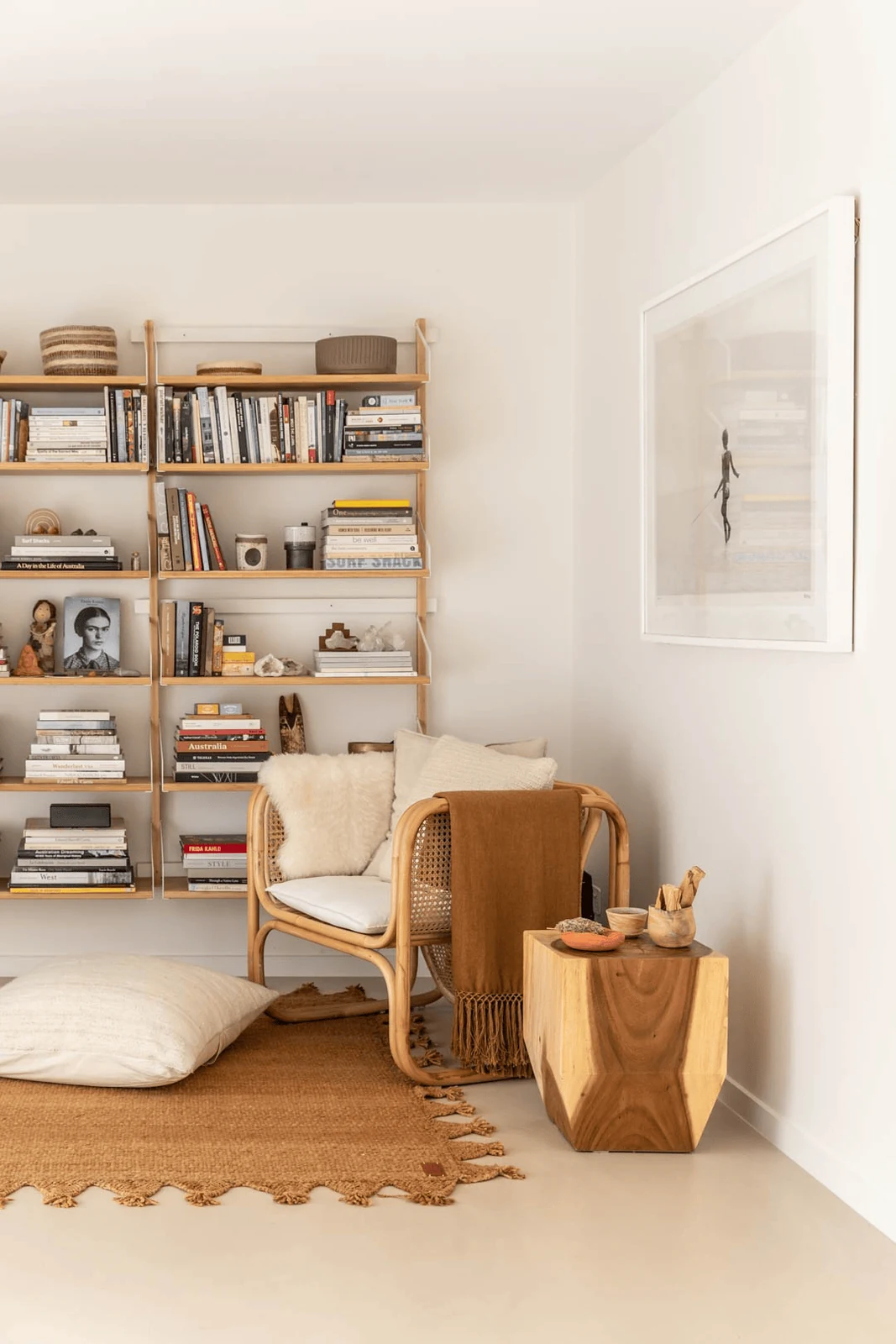
Hygge, loosely translated as cosiness with intention, finds a natural home in the reading corner. A well-executed Scandinavian reading corner typically works within a 3 to 4 square metre footprint: a compact armchair, a low side table at around 50 to 55 cm height, a floor lamp, and a shelf running 80 to 100 cm wide. Soft natural woods, a sheepskin throw, a low pendant light: the combination creates a space that feels restorative rather than decorative, and it scales down to a compact flat as readily as it works in a larger sitting room.
The compact footprint: A fully functional Scandinavian reading corner fits within 3 to 4 sq m, an armchair, lamp, side table, and a shelf running 80 to 100 cm wide.
26. Student-Friendly Home Libraries
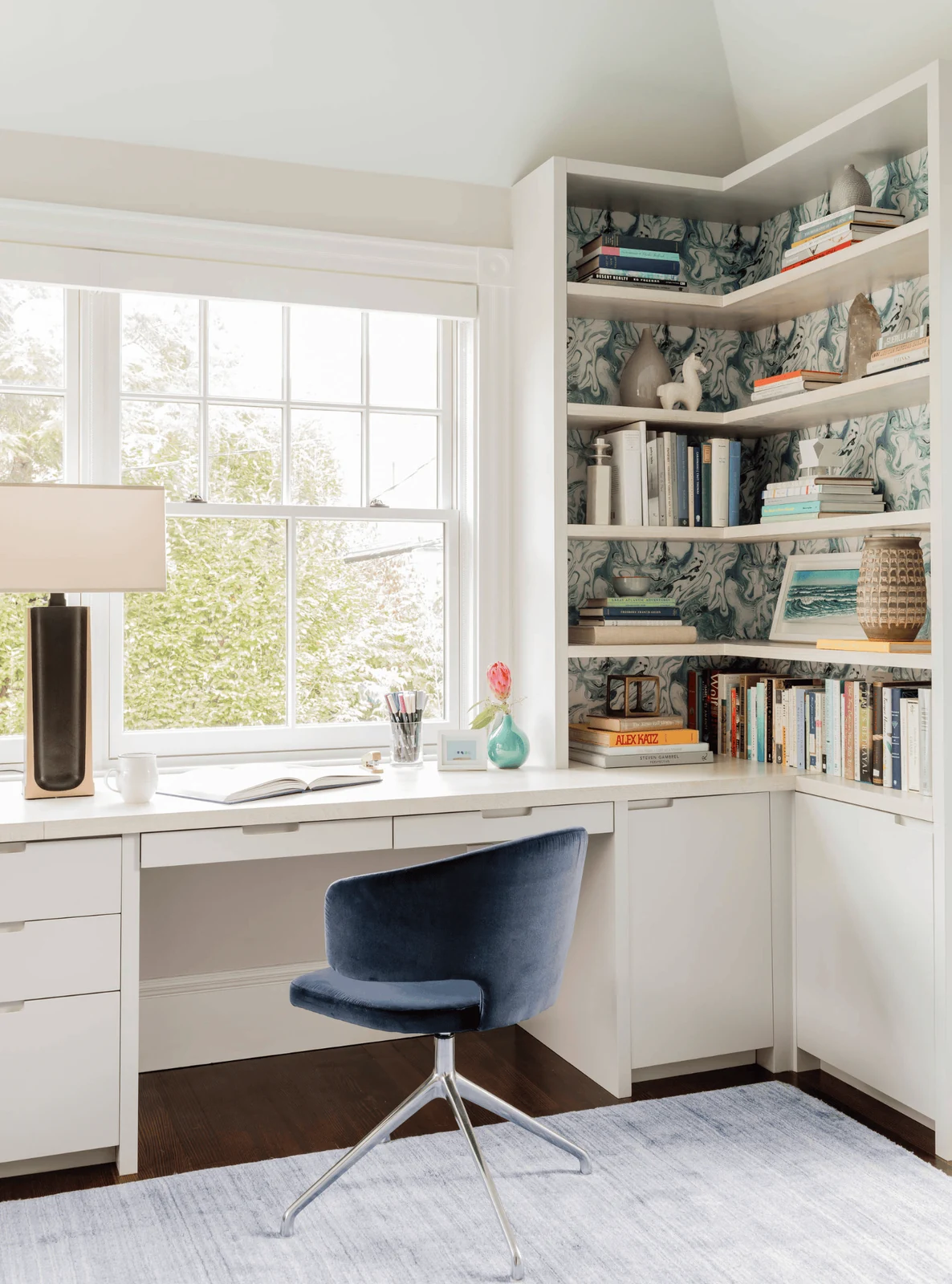
A student library must prioritize function over pure aesthetics. Ergonomic guidelines recommend a desk surface of at least 120 cm wide and 60 cm deep. This provides enough room for a laptop and notebooks without constant shuffling. The Illuminating Engineering Society states that study areas require task lighting of at least 500 lux to prevent eye strain. You should organize shelves by subject rather than colour for practical access.
The study desk spec: Aim for these two numbers alone separate a study library that works from one that merely looks like it should.
What Interior Designers Actually Prioritise in a Home Library
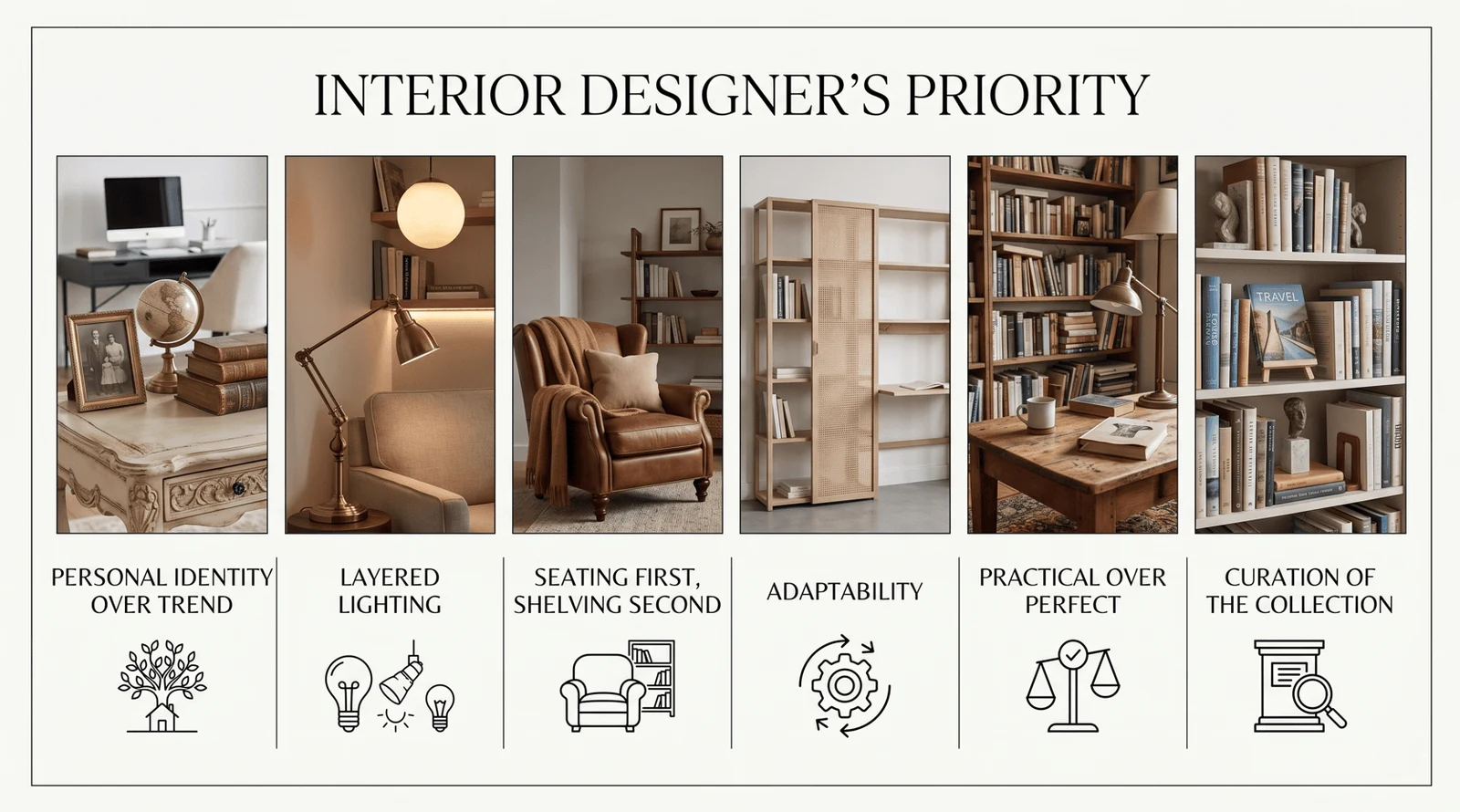
For anyone planning a library from scratch, here is what professionals look for beyond the visual:
- Personal identity over trend. Nate Berkus has long argued that meaningful interiors reflect who the owner actually is, not who they aspire to appear to be. A home library filled with books you have genuinely read will always feel more authentic than one dressed for a photoshoot.
- Layered lighting. Overhead lighting alone creates visual fatigue during extended reading. The consistent recommendation across designers is ambient ceiling light combined with a directional reading lamp and, where possible, candles or warm accent lighting for atmosphere.
- Seating first, shelving second. Designers regularly make the point that a library with uncomfortable seating is a library that does not get used. The chair matters as much as the shelving.
- Adaptability. The best libraries are designed to flex: as home offices when needed, as guest rooms on occasion, as entertainment spaces without the room losing its identity.
- Practical over perfect. Real homeowners consistently value comfort and usability over purely aesthetic arrangements. A library you actually read in will always serve you better than one you are nervous to disturb. On that note, cataloguing tools like LibraryThing have made it easier than ever to track what you own, which is more useful than it sounds once a collection grows past a few hundred books.
Build Your Home Library With the Right Designer
A well-designed home library becomes the quietest, most personal room in the house. The right combination of shelving, light, and seating creates something you will use every single day, and that is rare in interior design.
If you are planning a reading space in your UAE home and want it done with precision and real aesthetic intelligence, Euphoria Interiors brings exactly that to residential projects across the region. From a single alcove nook to a full double-height library room, their team works with your space, your collection, and your lifestyle to create something genuinely yours. Reach out to Euphoria Interiors to start the conversation.